Link to Chronology
The Battle off Samar
Prelude
When you’ve been a student of a topic for fifty years, the problem in talking about it is editing your thoughts down to the minimum necessary to do justice to that topic. This is not an easy thing to do. To understand the events of late 1944 you need to know a bit of what came before. And to fully appreciate the dramatic turn of events, you need even more information, especially about the naval officers involved. With this in mind, I’m going to start by talking -- briefly -- about the Japanese invasion of the Dutch East Indies and their conquest of the Java Sea in the spring of 1942. (The text in blue is not about the Battle off Samar, so you can skip it if you are in a hurry, or just not that interested.)In the late winter of 1942 the Imperial Japanese Navy (IJN) ruled the waves in the Pacific. The battle forces of both the Royal Navy and the US Navy (USN) in the Pacific had been sunk or scattered. The IJN Mobile Force of fleet carriers (CVs), fast battleships (BBs), heavy cruisers (CAs), and destroyers (DDs) (which had attacked Pearl Harbor) roamed at will as (arguably) the most powerful naval force the world had ever seen. In the Java Sea this force was not even needed as the IJN employed smaller, but overwhelmingly capable, forces composed of pairs of powerful heavy cruisers or else destroyer squadrons supported by a light cruiser. Both of these forces had as their main weapon the “Long Lance” torpedo. It would take the Allies about a year to understand the capabilities of that weapon, and until that time their ships would blow up and sink in battles with the Japanese and they didn’t know why (not only were they more explosively powerful than other torpedoes, but their speed and range was so great that they sank ships that believed themselves to be outside the danger area.)
The IJN went from victory to victory, and at almost no cost to themselves as they were at so clear an advantage. We will see the reverse of this at Leyte. Whether it came down to destroyers, heavy cruisers, or carrier air groups, the IJN was the best in the world, and the Allies struggled to even compete. At this time, the drive into the Dutch East Indies was conducted at sea by the the 2nd Fleet under Admiral Kondo with the Carrier Group commanded by Vice Admiral (VA) Nagumo; and 3rd Fleet under VA Takahashi with the Eastern Attack Group (one of the destroyer squadrons) commanded by Rear Admiral RA Nishimura, the Eastern Covering Group commanded by RA Takagi (CAs Nachi x, Haguro) with RA Tanaka commanding another destroyer squadron, Western Attack Group commanded by VA Ozawa in CA Chokai x, Western Covering Group commanded by RA Kurita with CAs Mogami x, Mikuma, Kumano, Suzuya x. We will see many of these officers at Leyte as well.
x = ships sunk as a result of the Leyte Battles.
But things change quickly in modern war and only two and a half years later everything had changed. Nagumo and Takagi had both died when the US invaded and captured the Mariana Islands. Nishimura, now a VA, died the night before the action we are focusing on when his Southern Force was annihilated by the US 7th Fleet at the Battle of Surigao Strait. The IJN lost BBs Yamashiro and Fuso plus CA Mogami in this battle. Elements of 7th Fleet were still pursuing some surviving destroyers and the ships of IJN Force C, commanded by VA Shima, with CAs Nachi and Ashigara. (Nachi was damaged the previous night in a collision with Mogami and would be sunk by air attack about ten days later in Manila Bay.)
In October 1944 the IJN 5th Fleet under VA Kurita was dispatched to defend the Philippines. Kurita had a powerful force of BBs -- Yamato, Musashi (sunk the day before), Nagato, Kongo (sunk returning to Japan after the battle) & Haruna -- and CAs -- Atago & Maya & Takao (all torpedoed on the way to the battle. The first two sank and Takao withdrew to Singapore where she was judged unrepairable), Chokai , Myoko (torpedoed the day before and also ended up unrepairable at Singapore), Haguro, Kumanno, Suzuya, Chikuma & Tone. In addition, there was the Mobile Force now under the command of VA Ozawa. This was a decoy force of aircraft carriers, old battleships that had been partly converted to carriers, with an assortment of lighter escorts. The plan was to show Admiral Halsey, the commander of US 3rd Fleet, some flight decks and have him chase after them -- and away from Kurita’s main body. The air groups that should have made these Japanese ships a powerful fighting force had been destroyed four months before by US 5th Fleet under Admiral Spruance. Now the IJN carriers were empty floating hangers of no particular military value. This plan would work to perfection.
Now it was the Allies moving from victory to victory and penetrating closer and closer to Japan. Both sides had (for decades) prepared for an anticipated “Decisive Battle” in the Caroline/Mariana Islands area of the central/western Pacific. There had indeed been a battle in the area anticipated, the Battle of the Philippine Sea, but this had been a battle of aircraft and submarines only. The naval air power of the IJN had been destroyed -- and in this war that was indeed decisive -- but the battle fleets had never even seen each other. Now the Allies were invading the Philippines with a major landing on Leyte Island, and the IJN decided to make one last total effort to stop the Allied advance across the Pacific. There would be diversionary fleets to the north (Ozawa with the surviving aircraft carriers but with no aircraft to speak of) and to the south (Nishimura with some old battleships and cruisers, enough to pull strong forces away from Leyte Gulf). The main force would be in the Center under the command of Kurita. With luck, Kurita would be able to sail through San Bernardino Strait and then into Leyte Gulf where his powerful force of battleships and heavy cruisers could destroy the shipping supporting the Allied amphibious invasion and possibly even take a toll on 7th Fleet.
This sounds like a reasonable plan. (Though the invasion had come sooner than expected and it took time to get all the pieces in motion, so the Japanese could not know how much shipping would still be in Leyte Gulf when they could finally arrive. Perhaps a lot. Perhaps most of the ships would have unloaded and departed.) And the fact that it almost did work shouldn’t hide the fact that the USN had more than enough resources to cover all these threats. USN 7th Fleet was in and around Leyte Gulf with a battle force of older ships, many of which had been sunk or damaged at Pearl Harbor. Nonetheless, these were still powerful ships and the ships sunk and then raised at Pearl Harbor had been modernized and were much better than they had been in 1941. And these six battleships were supported by a powerful force of cruisers, destroyers, and even PT boats. But this was only the USN’s second team. The USN’s main strength was 3rd Fleet.
3rd Fleet was also known as The Big Blue Fleet. For the most part, these were ships that had been built during the war -- with a handful of speedy survivors from the pre-war Navy. When commanded by Admiral Spruance it was known as 5th Fleet, as at the Battle of the Philippine Sea. When commanded by Admiral Halsey it was known as 3rd Fleet. Halsey and his staff had been preparing for the invasion of the Philippines while Spruance managed the invasion of the Marianas. Now Halsey would get his first chance to command during a major battle. Unfortunately, this was what the Japanese were counting on, and they weren’t wrong.
I will talk about 3rd Fleets air strength and disposition later, but 3rd Fleet also contained a potential battle fleet. The six new, fast battleships in 3rd fleet were distributed among the Task Groups to provide anti-aircraft protection. But there was a plan to form them into a battle Group (Task Force 34) if needed, under the command of Admiral Willis Augustus Lee (the victor of the 2nd Naval Battle of Guadalcanal). (There were some problems with this plan. Two of the BBs were faster -- and more powerful -- than the other ships. These were the ships that should have been rushed off to deal with the Central Force, but while Halsey flew his flag on one of these ships, Lee, the sub-force commander was on one of the other ships. Task Force 34 -- which never quite existed -- became one of the greatest controversies of the Pacific War, derailing friendships and resulting in a lack of honest information about the situation. It’s impossible to know how large a role this seemingly minor issue of which commanding officers were on which ships had on all this blowing up in Halsey’s face. “The World Wonders.”)
So that’s the basics of the forces and some of the officers involved in what was about to be the largest naval battle of the war. But that’s the Battle of Leyte Gulf. I’m going to jump directly to one of the four sub-battles of this colossal engagement of rival navies. Here is the Battle off Samar. Quite possibly the USN’s finest hour.
The Battle off Samar
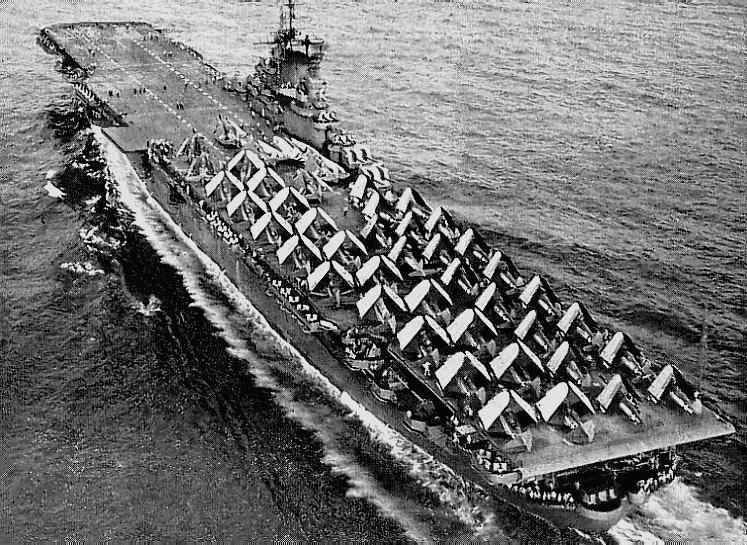
The challenge here is to not write too much. Let’s see if I can manage that.On the morning of October 25th, 1944, RA Clifton "Ziggy" Sprague was overseeing the dawn launch of his anti-submarine patrol -- his task group of five tiny escort carriers (CVEs) had two responsibilities, anti-submarine patrolling and fire support for the troops recently landed on Leyte island prior to the establishment of airfields on Leyte itself. (I love that the US Navy commander for this improbably battle had the nickname, "Ziggy.") Taffy 3 was one of three similar task groups comprising Task Force 77.4. They were all equipped with war-build merchant ships converted to tiny aircraft carriers with the addition of a flight deck and small hanger.

Unfortunately, they were a third the size of a fleet carrier with only about half the speed and they also lacked the defensive armament. Each CVE featured a single 5” gun in an open mount at its stern. Beside that, they had a few light anti-aircraft guns. And instead of being escorted by fast battleships, cruisers, and destroyers, Taffy 3 was supported by 3 Destroyers (DDs) and 4 Destroyer escort (DEs) (a mini-destroyer developed for the anti-submarine role.)

So that’s what C. Sprague was up to that morning when reports started coming in of ships on the horizon. Large warships moving fast and in their direction. These ships were Admiral Kurita’s Central Force, the main battle fleet of the Imperial Japanese Navy. Central Force had been weakened by air and submarine attack the previous days, but it still boasted the super battleship Yamato, the BBs Nagato, Kongō, and Haruna; and an especially impressive force of heavy cruisers (Chōkai, Haguro, Kumano, Suzuya, Chikuma, Tone) escorted by two light cruisers and eleven destroyers. This was the most powerful surface fleet the US Navy would fight in WW2.
Kurita had come through San Bernardino strait that morning expecting to run into the full might of Halsey’s 3rd Fleet at any moment. Instead he found an empty sea before him, until he ran into Taffy 3. The IJN had not known about the Taffy’s, so he assumed he was seeing a task group of 3rd Fleet, not 7th Fleet. To him, the CVEs looked like CVs and the DDs and DEs looked like cruisers and destroyers. To him, this looked like the opportunity of a lifetime and he turned his ships loose to chase down and destroy the enemy. This was meant to be the Decisive Battle that both navies had dreamed of for decades. If Kurita could destroy 3rd Fleet, the U.S. advance across the Pacific would be stopped and the invasion of Leyte would be thwarted.
C. Sprague responded quickly to events. He ordered all his aircraft be launched and then had his little carriers head into some nearby storms where the Japanese wouldn’t be able to see them. He ordered his support ships to try to delay the Japanese and he got on the radio and sought help from everyone he could think of. He would spend the remainder of the day, trying to keep his ships as far from the Japanese guns as possible. This was not really a battle he could “fight” with the insignificant forces under his command. The amazing outcome was that he only lost one CVE, the Gambier Bay, to enemy guns.
The Little Boys
At least one of the destroyer captains didn’t even wait for orders before attacking the oncoming enemy force. The USS Johnston, the closest ship to the enemy, lay down a smoke screen and then headed for Kurita at top speed with guns blazing. Their 5" guns started fires on the CA Kumano.
C. Sprague now ordered two more DDs (Hoel and Heerman) to form up and launch a torpedo attack. These fleet destroyers were joined, in at least one case against orders, by the DEs (Samuel B. Roberts, Raymond, Dennis, and John C. Butler). Roberts played a crucial role in driving two of the IJN CAs out of the battle and all the DEs fired their torpedoes causing the Japanese ships to scatter as they evaded.
Given the overwhelming advantages of the Japanese fleet in number and size and preparedness for the attack. This knee jerk response by seven of the smallest fighting ships in the US Navy should have been a joke. It should have been brushed off without even slowing down the approaching Japanese, but that’s not what happened. I will not go into the details of this improbable battle but you can find them HERE.
Besides the actual damage from gun fire and torpedoes to IJN ships, the Yamato, the most powerful battleship in the world, was driven out of the battle, running away from torpedoes from the USS Hoel. And this was Kurita’s flagship (since his original flagship had been sunk by a submarine two nights before). He was now heading in the opposite direction of his fleet and lost track of the battle. To paraphrase Winston Churchill, never was so much achieved by so few.
But the cost of this attack was high. Hoel, Johnson and Samuel B. Roberts were all sunk. It is an odd sort of tribute that in the IJN ship's logs these tiny ships are described as cruisers.
The air attack
I keep specifying "C. Sprague" because there happened to be another Admiral Sprague on the scene. Taffy 2 was commanded by RA Felix Stump while Taffy 1, and Task Force 77.4 as a whole, was commanded by Thomas L. Sprague (no relation). Together, all the little carriers of TF 77.4 carried around 450 aircraft -- what four fleet carriers might have carried.
Even as the attack of the "small boys" was in progress, and continuing long after most of those ships had lost their battles to stay afloat, the aircraft from all three Taffys were attacking the Japanese as best they could. Aside from the Avenger torpedo bombers which you would also find on the bigger fleet carriers, these were mostly Wildcat fighters that had been replaced by Hellcats on the bigger carriers. And even the Avengers were armed with depth charges (for use against submarines) and high explosive bombs (to attack shore targets in support of the infantry on Leyte). And these aircrews had never trained to attack enemy fleets, as that was the job of the fleet carriers. But attack they did.
The Wildcats were, for the most part, only armed with their .50 cal machine guns -- no sane person would advocate attacking heavily armed and armored warships with only machine guns, but that’s what they had and, in fact, six .50 cal machine guns strafing the bridge and decks is not nothing. If nothing else it distracted the officers and crew from the attacks of the destroyers and Avengers carrying more potent munitions. Some Wildcats, even after they had used up their ammunition, continued to buzz the enemy decks making everyone dive for cover.
The results of this prolonged air attack, no matter how impromptu, were considerable. I haven't been able to find a statistic for the number of aircraft lost by Task Force 77.4 during the battle itself. It seems that Taffy 3 lost 128 but that must include planes lost in the Kamikaze sinking of the St Lo and similar attacks on other Taffy 3 carriers after the battle proper. In all of the Battle of Leyte Gulf the US Navy lost around 200 aircraft.
3rd Fleet finally makes an appearance
The reason the Taffys were so unprepared for this action was that they were a very small cog in a huge machine. Together, the Taffys formed Task Group 77.4, a small portion of 7th Fleet. The bulk of 7th Fleet on that morning was inside Leyte Gulf or still chasing the remnants of two other Japanese fleets down Surigau Strait. The Battle of Surigau Strait the previous night (just as interesting in its own way) had distracted 7th Fleet’s battle force and expended a lot of ammunition, but there were still powerful forces (including the USS Pennsylvania, which hadn’t managed to find a target during the battle) waiting inside Leyte Gulf should the Japanese make it that far. But they were in no position to come out and assist the Taffys.
3rd Fleet was the main strength of the US Navy -- what was called the Big Blue Fleet. It was divided into four Task Groups each of which was a powerful force by itself. Three of these Task Groups were off to the north chasing Ozawa -- a diversionary force. The fourth, commanded by John S. “Slew” McCain (Senator McCain's grandfather) had been sent toward Ulithi to resupply. When C. Sprague’s calls for help came in, McCain changed course and raced back toward Leyte. Late in the battle, an attack from McCain’s fleet carriers finally hit the Japanese. This was a rushed attack at maximum range, and the results were not impressive. Still, it was an indication to anyone paying attention that things were likely to soon get even worse for the Japanese. The day had not gone well for the Japanese and USN forces (stronger than what they were already facing) were now on every side.
Kurita departs
This is the most controversial phase of the battle. The whole idea of this multi-pronged Japanese attack had been to get Kurita’s Central Force into Leyte Gulf where it could destroy the ships supporting the amphibious landing on Leyte, so that the Japanese Army could then drive the Americans into the sea. The Central Force was now just outside Leyte Gulf and 7th Fleet would have been hard pressed to counter a determined attack. Perhaps Central Force would have been destroyed in the attempt, but they had the opportunity to do some damage and die gloriously, usually an attractive option for the Japanese. Instead, Kurita decided to go home.
I sympathize with Kurita here. The man had had one flagship sunk under him and had lost one of Japan’s two super battleships. He had seen his fleet savaged by a mystery fleet that should have been inconsequential. He knew stronger air attacks were likely. He suspected 3rd Fleet’s battle force was also on the way. He had no idea what awaited him in Leyte Gulf. There might be no good targets. There might be a wall of up to six older battleships. He had already lost many of the IJN’s best ships: (BB Musashi, CAs Atago, Maya, Suzuya, Chokai, Chikuma were all sunk, three of the CAs in this action, and other ships had been damaged and would be chased down and sunk in the near future) and if he continued, his losses would only grow. Nothing he could have foreseen at this point looked anything like a true victory. And if the full strength of 3rd Fleet -- which he falsely believed himself to be engaging with -- caught up with him before he cleared San Bernardino Strait, he would probably be annihilated. I’m not going to judge a commander in this situation.
Epilogue
There’s a sad epilogue to the story of this battle. I mean from the American perspective, it’s all sad from the Japanese side. Cleanup operations were continuing to the north and the south and the first Kamikaze attacks were also distracting 7th Fleet. After losing the CVE Gambier Bay to battleship shells Taffy would also lose CVE St. Lo to a Kamikaze attack. The effort to recover survivors from the sinking of the Gambier Bay, Johnson, Hoel, and Samuel B. Roberts was delayed and the currents were strong, so that it took the navy a long time to find where the survivors had drifted. Many of the men who had survived the sinkings, died before they could be recovered.
Still, the Battle off Samar turned out to be as close to the anticipated “Decisive Battle” as the Pacific War would see. The US Navy’s equivalent of junior varsity took on the best the IJN had and fought them to a standstill. Ships never intended to see a fleet action faced a powerful battle fleet and gave as well as they received. The USN lost a militarized merchant ship and three escort ships while the IJN lost three of their powerful heavy cruisers sunk. The Japanese fleet would never again sortie in an attempt to engage in battle (Ten Go, the sortie of the Yamato with a few escort ships in 1945, was a Kamikaze operation.)