Showing posts with label Chester Nimitz. Show all posts

Wednesday, July 24, 2019

337. Nimitz


Link to Table of Contents


Random

It is probably a good indication of how bored I am that I was kind of excited when our street sign started to fall off and I needed to repair it. It is, of course, an awkward job. The screw that has failed is at the full extension point of our extension ladder. So working on this means balancing a little higher than I’m entirely comfortable with. Thus, I am not repairing the stripped out screw hole the way I would if it were more accessible. I just bought a replacement screw -- the old one was so rusty it is obvious it hasn’t been in contact with the wood for decades. And I bought some plastic screw inserts that you screw in to fill the hole before screwing the new screw into the plastic. This should be reasonably easy to do at the top of our ladder. I even have my drill/driver charging at home to make this even easier. I'm hoping this paragraph will also serve as a “not-suicide” note in the event things go south.

We are now in the June lull of event greening season (I'm still way behind with my publishing) so I had breakfast at the Pork Store and learned that one of my favorite waitresses is moving to Dallas in July. At this point I can’t blame anyone for leaving SF, but it is unfortunate.


Someone on the Chronicle wrote something this week pointing out that the city -- and this means both the politicians and the people -- are willing to do anything to address the housing shortage so long as it doesn’t mean building new housing. That just about sums it up. And this goes nicely with our eagerness to solve the global warming problem so long as it doesn’t mean any change in lifestyle. The obesity situation also suggests itself here.


There’s also a political/sociological aspect to this. To change the world you have to have an unreasonable expectation that change is possible. I don’t believe people are currently willing to make things better. Perhaps it is better to be young and naive (or ignorant) than to see how bad the situation really is. 


If I knew more about Berthier, I would not be surprised to learn that at the beginning, before Napoleon first crossed the Alps into Italy, Berthier was pessimistic based on the very real difficulties of conducting a war on the far side of the Alps while the Royal Navy controlled the Med. I suspect Berthier both understood the difficulties and had reasonable ideas for how to overcome them. But you need a Napoleon who thinks unreasonable things are possible before anyone will attempt the thing. And yes, I’ve been thinking about the Waterloo campaign again and I’m even more convinced that Napoleon could have pulled it off if his army had moved the way it always had when Berthier was his Chief of Staff. Hypotheticals in history are never a sure thing, but this one is relatively easy when you consider how close run the real history was. 


Biography of Nimitz

This is a book I read a long time ago and own a copy of. I’ve been thinking that it was a great introduction to the USN both leading up to and during the Pacific War. Like a one book guide to the USN in the Pacific War. But, as I said, it had been a long time since I’d read it, so I thought I should give it another read to confirm this. There’s a lot I had remembered but some details I had forgotten. I just ran into one which inspired me to write this.

P164 “In June 1936 Chet [Chester Nimitz’s only son] was graduated from the Naval Academy and, after a period of leave, went to sea in the cruiser Indianapolis...” There’s nothing unusual about this except that the Indianapolis was Spruance’s flagship for much of the time he commanded 5th Fleet and the ship was sunk in particularly unfortunate circumstances at the very end of the war.

I had remembered that it was Nimitz who built the submarine base at Pearl Harbor, and that he had been an advocate of the circular sailing formation that became standard during the war. I had forgotten that he had the idea for underway oil replenishment and was serving as an officer on the first oiler to make it work while sending USN destroyers to Britain after the USA entered the Great War. It would be hard to exaggerate the importance of both the circular formation and underway replenishment in the conduct of the Pacific War.

P167 And here’s my favorite Nimitz story -- and this one I have remembered, though I thought it was in San Diego, not Long Beach. Doesn’t matter.

I mis-remembered the story about who transported Roosevelt on a destroyer back in the 20s? It was Halsey, not Nimitz. And it was apparently someone other than Spruance who came up with the “platoon” system for the Big Blue Fleet. And speaking of both of these matters, it occurs to me that Halsey is a perfect example of the Peter Principle. Right up until he took command of 3rd Fleet, everything went perfectly for him and the USN. He just was not up to that last step. If they had only given him 7th Fleet instead, and Kinkaid 3rd Fleet. Only he would not have been happy, though maybe MacArthur could have made him see reason. That’s an odd thing to say.


Sunday, July 2, 2017

171. George Marshall


Previous - 170. Dorothy Day


Link to Table of Contents


George Marshall

I hadn't realized Marshall had been a staff officer his entire career. Of course I see in his story support for my belief that by "Napoleon" we really mean Napoleon and Berthier. Even the modestly sized "modern" armies of that time required some kind of a staff genius, along with a field command genius, to excel. By WW2 the ability to manage logistics and personnel was all important and so we celebrate Marshall, Eisenhower, and Nimitz. 

A good field army general -- like Patton -- had basically the same skill set as a corps commander during the American Civil War. Like Hooker, who was excellent at the head of a corps but a disaster at the head of an army. Within the context of an army group, Patton's 3rd Army was at the same level of the hierarchy as Hooker's corps in the Army of the Potomac.

And, again this suggests what was so remarkable about Admiral Spruance, perhaps the most successful fleet commander of WW2, and who, when not in command of 5th Fleet, served as Nimitz's Chief of Staff. He excelled in both roles. 

p121 As chief of staff to the US Army in 1939, Marshall was in charge of culling the officer corps. It looks like he had basically the same role as Nimitz, who was Chief of the Navy Bureau of Navigation (actually the Bureau of Naval Personnel, but that name change wasn't official until 1942). This meant that Marshall and Nimitz were personally familiar with the records of all the regular officers in the Army and Navy respectively at the start of the war. Thus they were uniquely qualified to know who to put into what position.


This chapter has talked about how people like Marshall were trained to model themselves on famous figures from the past. Either from history or from the Bible. There's nothing novel about this, a very common variation on this is the near worship of sports figures and the tendency to use them as role models. But a couple hours later, while on my way to the market, I got excited about a tweak I realized I could make to one of my main, personal spreadsheets, and I actually heard the voice of an old girl friend calling out, "Dweeb!" So it isn't just Great Figures and Celebrities that become a part of our character over time. We pick up all sorts of voices to add to our internal chorus of advice.


Puritanism revisited
Not sure why, but an old professor of mine just sent me a link to an interesting piece of writing about Puritanism and the George W Bush administration. HERE

Ayn Rand isn't mentioned -- because the author is going for a religious connection -- but it isn't hard to see Rand and the Puritans as the world's strangest bedfellows. 

Brooks has gone to some trouble to avoid stepping into Puritanism or Jansenism, but one does wonder what he would make of this take on "Modern" economic history. I don't think Dostoevsky would have a problem with it. 


Next - 172. George, the 3rd time

Saturday, December 17, 2016

95. War stories


Previous - 94. Absolute pitch


Absalom

Well... I can't say I'm surprised. I wondered about this when it was first revealed that Sutpen put his first wife aside. It also plays into the whole question of Race that we are discussing without it being much mentioned.

I'm sitting at the window of Another Cafe. Haven't been here for a long time, but because this is a rainy day, I decided to stay close to home. Until now, the incoming storm was parting with the colorful bits (on the Doppler radar map) drenching counties to the north and south but missing us almost entirely. But now we are getting more of it. I don't mind. 


Pacific War

A YouTube content provider (Military History Visualized) who covers warfare in general has started doing more episodes about the Pacific War. Recently he did some odd episodes where he merely talked to an expert in the field and created a lengthy bibliography of the war. 

I was impressed with the suggestions made by the expert and added my own suggestions. The expert and I got into a rather long (geeky) chain of messages. Since the point of all this is to give MHV suggestions for future topics, my mind started working overtime. 

Once again I am amazed by just how many wonderful topics and stories there are for this war. So much so that it is hard to know where to start. And most of these stories are not just "military history" but also have compelling personal aspects -- it isn't just ships and battles but the stories of the men involved. The story of Shōji Nishimura is one of my favorites.

Nishimura started the war as a Rear Admiral in command of one of the IJN's (Imperial Japanese Navy) wonderful destroyer squadrons. He participated in, but didn't really achieve much at, the Battle of the Java Sea in 1942. By late 1944 he had risen to Vice Admiral, though still without achieving anything of note, and was placed in command of the Southern Force in the IJN's complicated (as was their wont) plan for the Battle of Leyte Gulf. His son had recently been killed in the fighting around the Philippines and he seems to have become despondent. He refused to meet with the captains under his command and his conduct of this vital phase of the overall battle plan appears to have been a massive suicide attempt. So much so that the advance of the Southern Force in the Surigao Strait is often compared to the Charge of the Light Brigade during the Crimean War. If death was in fact his goal, then the operation was a success. Though if, from the perspective of Combined Fleet, the goal was a distracting demonstration on the enemy flank, the annihilation of Southern Force was also a success, as it left U.S. 7th Fleet out of position, and a bit low on munitions, for the main Japanese attack that followed within hours.

Which brings us to Takeo Kurita. Kurita had been a very competent Rear Admiral in command of a force of cruisers at the Battle of the Java Sea, and had also risen to Vice Admiral by late 1944. He was in command of the IJN main, or, Central Force at Leyte Gulf. His flagship cruiser was sunk under him as he steamed toward battle. He shifted his flag to Yamato and ended up racing away in the wrong direction, chased by a brace of torpedoes, at a crucial moment and never really managed to get back in control of the battle. (The fatigue that was such a huge factor around Guadalcanal also played a role here.) 

The key part of this story is that Kurita, and the IJN in general, didn't know the 7th Fleet had a force of Escort Carriers to provide air support to the Leyte landing. This force, divided into three task groups known as "Taffy" 1, 2, and 3, was composed of sixteen CVEs -- essentially Liberty Ships with flight decks. 


An escort carrier.


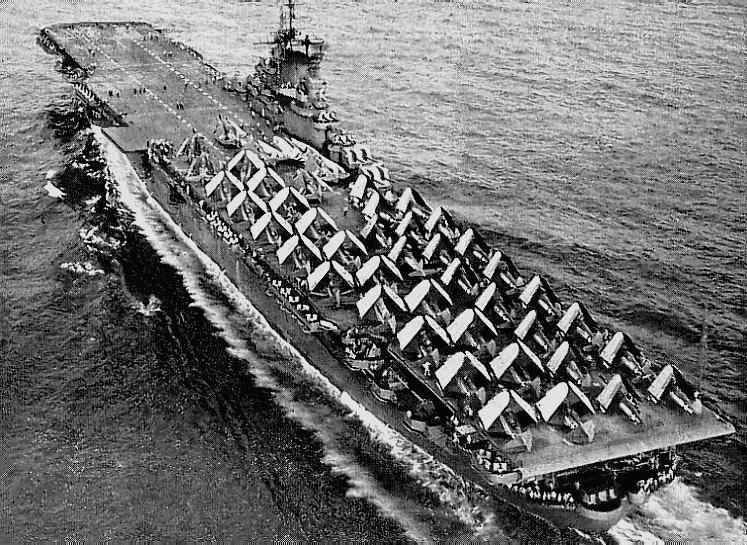
A full size Fleet carrier.


Compared to the Fleet Carriers of 3rd Fleet, these CVEs were a joke. When, to everyone's surprise, Kurita's ships stumbled upon Taffy 3 the morning of the Battle off Samar (the third of the four sub-battles that comprise the Battle of Leyte Gulf. In order: Battle of the Sibuyan Sea, Battle of Surigao Strait, Battle off Samar, and Battle of Cape Engaño), he assumed they were a task group of 3rd Fleet escorted by the usual array of battleships, cruisers, and destroyers. 

Over the course of the battle (hours), Taffy 3's escort, of destroyers and a destroyer escort, counter attacked Kurita (hence the torpedoes that chased him away from the battle) while the aircraft of all three Taffies attacked the Japanese while the little CVEs tried to evade destruction by a larger and faster enemy force. In the end, Taffy 3's losses were less than you would expect, while Kurita's Central Force was mauled by the tiny ships and second string air groups. What isn't clear to me is when, if ever, Kurita realized that he wasn't fighting 3rd Fleet. 

Because, at this time the IJN could not provide trained air groups for the carriers it still had. That the Americans, in addition to fielding the most powerful fleet the world had ever seen (the carrier divisions of 3rd Fleet designated Task Force 38), could also build and provide air groups for a deceptively powerful auxiliary fleet, would have been as disheartening for Kurita as the loss of four more of his powerful heavy cruisers. Kurita is often second guessed for not pursuing his attack that day, but if he did indeed realize the significance of the Taffies, you can easily imagine him thinking, "What are we even doing out here?" And heading home.

I should stop there but I have a favorite detail of this battle regarding the "pea shooters." The U.S. fleet possessed a wide array of naval artillery ranging from the 16" guns on the Iowa class battleships, to the 8" and 6" guns on cruisers, to the 5" guns in single and dual turrets on destroyers, cruisers, battleships and even Essex class carriers. (By the way because of the difference in the weight of the projectile, a 6" gun is about twice as potent as a 5" gun.) Because the escort carriers had originally been developed for anti-submarine warfare, they mounted a single 5" gun that wasn't even placed in a turret. It was for engaging submarines that had been forced to the surface. 

At the crisis of the Battle off Samar, when Taffy 3 was caught between rain squalls and was being fired at by most of the huge ships of Central Force, the following order was given to the U.S. escort carriers,  "open with pea shooters." They even claimed quite a number of hits with those little 5" guns conveniently mounted on the aft of the fleeing little ships.


And then there's my favorite angle on the war: Nimitz, Spruance, and Halsey. Really that should be Roosevelt, Nimitz, Spruance, and Halsey. When you read about the almost unimaginable dysfunction at the command level on the Japanese side -- especially when it comes to Army-Navy cooperation -- and look for why the same thing didn't happen on the U.S. side, you almost always come back to Nimitz. He placed Halsey as Commander in the Southwest Pacific where he could act as liaison with General MacArthur. Nimitz also chose Spruance, who like the Japanese officers I mentioned above, started the war as a Rear Admiral commanding a force of Cruisers, as his Chief of Staff. And how did the comparatively junior Nimitz end up in command in the Pacific, because of Roosevelt.

I don't know if it was Nimitz or Spruance who thought up the "platoon" command system for the Big Blue Fleet, but it was probably one of them. This system, one of the great innovations in military history, was crucial to maintaining the pace of the offensive against Japan starting in 1943. The U.S. main "Fleet" was designated either 3rd Fleet, and commanded by Halsey and his staff, or 5th Fleet, and commanded by Spruance and his staff. This meant that while one staff was fighting the war, the other was resting and preparing for the next operations. There was no pause in operations (as was a problem with the Allied armies in Italy, for example) while the staff decided what to do next and then prepared to execute the new plan. This tag-team approach continued all the way to Tokyo Bay where Halsey stood on the deck of the USS Missouri during the surrender ceremony while Spruance commanded from the USS New Jersey -- just in case the Japanese pulled a fast one.

The Halsey/Spruance back story, their friendship extending back to their earliest commands, makes this story all the better and the fallout from Halsey's "swallowing the bait" at Leyte Gulf and sailing into two typhoons even gives it a tragic coda. What more can anyone ask for?


Next - 96. Synesthesia & Tourette's