Showing posts with label Raymond Spruance. Show all posts

Tuesday, December 25, 2018

307. The Battle off Samar


Link to Chronology


The Battle off Samar


Prelude

When you’ve been a student of a topic for fifty years, the problem in talking about it is editing your thoughts down to the minimum necessary to do justice to that topic. This is not an easy thing to do. To understand the events of late 1944 you need to know a bit of what came before. And to fully appreciate the dramatic turn of events, you need even more information, especially about the naval officers involved. With this in mind, I’m going to start by talking -- briefly -- about the Japanese invasion of the Dutch East Indies and their conquest of the Java Sea in the spring of 1942. (The text in blue is not about the Battle off Samar, so you can skip it if you are in a hurry, or just not that interested.)

In the late winter of 1942 the Imperial Japanese Navy (IJN) ruled the waves in the Pacific. The battle forces of both the Royal Navy and the US Navy (USN) in the Pacific had been sunk or scattered. The IJN Mobile Force of fleet carriers (CVs), fast battleships (BBs), heavy cruisers (CAs), and destroyers (DDs) (which had attacked Pearl Harbor) roamed at will as (arguably) the most powerful naval force the world had ever seen. In the Java Sea this force was not even needed as the IJN employed smaller, but overwhelmingly capable, forces composed of pairs of powerful heavy cruisers or else destroyer squadrons supported by a light cruiser. Both of these forces had as their main weapon the “Long Lance” torpedo. It would take the Allies about a year to understand the capabilities of that weapon, and until that time their ships would blow up and sink in battles with the Japanese and they didn’t know why (not only were they more explosively powerful than other torpedoes, but their speed and range was so great that they sank ships that believed themselves to be outside the danger area.)

The IJN went from victory to victory, and at almost no cost to themselves as they were at so clear an advantage. We will see the reverse of this at Leyte. Whether it came down to destroyers, heavy cruisers, or carrier air groups, the IJN was the best in the world, and the Allies struggled to even compete. At this time, the drive into the Dutch East Indies was conducted at sea by the the 2nd Fleet under Admiral Kondo with the Carrier Group commanded by Vice Admiral (VA) Nagumo; and 3rd Fleet under VA Takahashi with the Eastern Attack Group (one of the destroyer squadrons) commanded by Rear Admiral RA Nishimura, the Eastern Covering Group commanded by RA Takagi (CAs Nachi x, Haguro) with RA Tanaka commanding another destroyer squadron, Western Attack Group commanded by VA Ozawa in CA Chokai x, Western Covering Group commanded by RA Kurita with CAs Mogami x, Mikuma, Kumano, Suzuya x. We will see many of these officers at Leyte as well.

x = ships sunk as a result of the Leyte Battles.

But things change quickly in modern war and only two and a half years later everything had changed. Nagumo and Takagi had both died when the US invaded and captured the Mariana Islands. Nishimura, now a VA, died the night before the action we are focusing on when his Southern Force was annihilated by the US 7th Fleet at the Battle of Surigao Strait. The IJN lost BBs Yamashiro and Fuso plus CA Mogami in this battle. Elements of 7th Fleet were still pursuing some surviving destroyers and the ships of IJN Force C, commanded by VA Shima, with CAs Nachi and Ashigara. (Nachi was damaged the previous night in a collision with Mogami and would be sunk by air attack about ten days later in Manila Bay.)

In October 1944 the IJN 5th Fleet under VA Kurita was dispatched to defend the Philippines. Kurita had a powerful force of BBs -- Yamato, Musashi (sunk the day before), Nagato, Kongo (sunk returning to Japan after the battle) & Haruna -- and CAs -- Atago & Maya & Takao (all torpedoed on the way to the battle. The first two sank and Takao withdrew to Singapore where she was judged unrepairable), Chokai , Myoko (torpedoed the day before and also ended up unrepairable at Singapore), Haguro, Kumanno, Suzuya, Chikuma & Tone. In addition, there was the Mobile Force now under the command of VA Ozawa. This was a decoy force of aircraft carriers, old battleships that had been partly converted to carriers, with an assortment of lighter escorts. The plan was to show Admiral Halsey, the commander of US 3rd Fleet, some flight decks and have him chase after them -- and away from Kurita’s main body. The air groups that should have made these Japanese ships a powerful fighting force had been destroyed four months before by US 5th Fleet under Admiral Spruance. Now the IJN carriers were empty floating hangers of no particular military value. This plan would work to perfection. 

Now it was the Allies moving from victory to victory and penetrating closer and closer to Japan. Both sides had (for decades) prepared for an anticipated “Decisive Battle” in the Caroline/Mariana Islands area of the central/western Pacific. There had indeed been a battle in the area anticipated, the Battle of the Philippine Sea, but this had been a battle of aircraft and submarines only. The naval air power of the IJN had been destroyed -- and in this war that was indeed decisive -- but the battle fleets had never even seen each other. Now the Allies were invading the Philippines with a major landing on Leyte Island, and the IJN decided to make one last total effort to stop the Allied advance across the Pacific. There would be diversionary fleets to the north (Ozawa with the surviving aircraft carriers but with no aircraft to speak of) and to the south (Nishimura with some old battleships and cruisers, enough to pull strong forces away from Leyte Gulf). The main force would be in the Center under the command of Kurita. With luck, Kurita would be able to sail through San Bernardino Strait and then into Leyte Gulf where his powerful force of battleships and heavy cruisers could destroy the shipping supporting the Allied amphibious invasion and possibly even take a toll on 7th Fleet.

This sounds like a reasonable plan. (Though the invasion had come sooner than expected and it took time to get all the pieces in motion, so the Japanese could not know how much shipping would still be in Leyte Gulf when they could finally arrive. Perhaps a lot. Perhaps most of the ships would have unloaded and departed.) And the fact that it almost did work shouldn’t hide the fact that the USN had more than enough resources to cover all these threats. USN 7th Fleet was in and around Leyte Gulf with a battle force of older ships, many of which had been sunk or damaged at Pearl Harbor. Nonetheless, these were still powerful ships and the ships sunk and then raised at Pearl Harbor had been modernized and were much better than they had been in 1941. And these six battleships were supported by a powerful force of cruisers, destroyers, and even PT boats. But this was only the USN’s second team. The USN’s main strength was 3rd Fleet.

3rd Fleet was also known as The Big Blue Fleet. For the most part, these were ships that had been built during the war -- with a handful of speedy survivors from the pre-war Navy. When commanded by Admiral Spruance it was known as 5th Fleet, as at the Battle of the Philippine Sea. When commanded by Admiral Halsey it was known as 3rd Fleet. Halsey and his staff had been preparing for the invasion of the Philippines while Spruance managed the invasion of the Marianas. Now Halsey would get his first chance to command during a major battle. Unfortunately, this was what the Japanese were counting on, and they weren’t wrong.

I will talk about 3rd Fleets air strength and disposition later, but 3rd Fleet also contained a potential battle fleet. The six new, fast battleships in 3rd fleet were distributed among the Task Groups to provide anti-aircraft protection. But there was a plan to form them into a battle Group (Task Force 34) if needed, under the command of Admiral Willis Augustus Lee (the victor of the 2nd Naval Battle of Guadalcanal). (There were some problems with this plan. Two of the BBs were faster -- and more powerful -- than the other ships. These were the ships that should have been rushed off to deal with the Central Force, but while Halsey flew his flag on one of these ships, Lee, the sub-force commander was on one of the other ships. Task Force 34 -- which never quite existed -- became one of the greatest controversies of the Pacific War, derailing friendships and resulting in a lack of honest information about the situation. It’s impossible to know how large a role this seemingly minor issue of which commanding officers were on which ships had on all this blowing up in Halsey’s face. “The World Wonders.”)

So that’s the basics of the forces and some of the officers involved in what was about to be the largest naval battle of the war. But that’s the Battle of Leyte Gulf. I’m going to jump directly to one of the four sub-battles of this colossal engagement of rival navies. Here is the Battle off Samar. Quite possibly the USN’s finest hour.


The Battle off Samar

The challenge here is to not write too much. Let’s see if I can manage that.

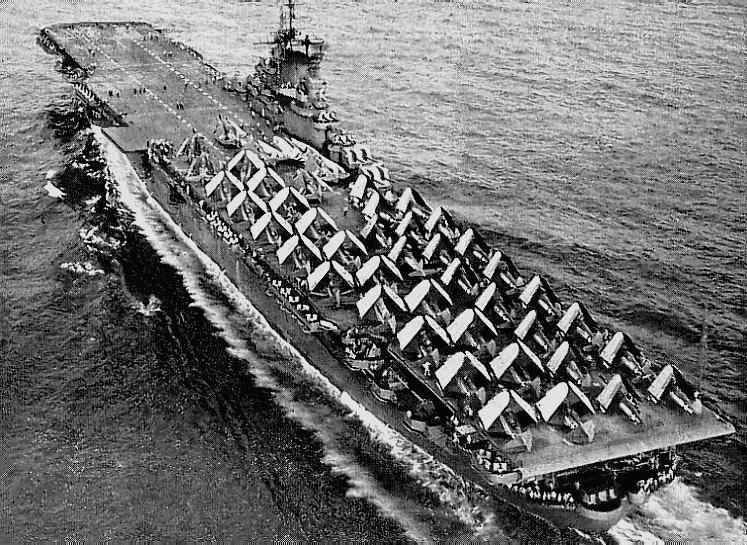
On the morning of October 25th, 1944, RA Clifton "Ziggy" Sprague was overseeing the dawn launch of his anti-submarine patrol -- his task group of five tiny escort carriers (CVEs) had two responsibilities, anti-submarine patrolling and fire support for the troops recently landed on Leyte island prior to the establishment of airfields on Leyte itself. (I love that the US Navy commander for this improbably battle had the nickname, "Ziggy.") Taffy 3 was one of three similar task groups comprising Task Force 77.4. They were all equipped with war-build merchant ships converted to tiny aircraft carriers with the addition of a flight deck and small hanger. 


Unfortunately, they were a third the size of a fleet carrier with only about half the speed and they also lacked the defensive armament. Each CVE featured a single 5” gun in an open mount at its stern. Beside that, they had a few light anti-aircraft guns. And instead of being escorted by fast battleships, cruisers, and destroyers, Taffy 3 was supported by 3 Destroyers (DDs) and 4 Destroyer escort (DEs) (a mini-destroyer developed for the anti-submarine role.)


So that’s what C. Sprague was up to that morning when reports started coming in of ships on the horizon. Large warships moving fast and in their direction. These ships were Admiral Kurita’s Central Force, the main battle fleet of the Imperial Japanese Navy. Central Force had been weakened by air and submarine attack the previous days, but it still boasted the super battleship Yamato, the BBs Nagato, Kongō, and Haruna and an especially impressive force of heavy cruisers (Chōkai, Haguro, Kumano, Suzuya, Chikuma, Tone) escorted by two light cruisers and eleven destroyers. This was the most powerful surface fleet the US Navy would fight in WW2.

Kurita had come through San Bernardino strait that morning expecting to run into the full might of Halsey’s 3rd Fleet at any moment. Instead he found an empty sea before him, until he ran into Taffy 3. The IJN had not known about the Taffy’s, so he assumed he was seeing a task group of 3rd Fleet, not 7th Fleet. To him, the CVEs looked like CVs and the DDs and DEs looked like cruisers and destroyers. To him, this looked like the opportunity of a lifetime and he turned his ships loose to chase down and destroy the enemy. This was meant to be the Decisive Battle that both navies had dreamed of for decades. If Kurita could destroy 3rd Fleet, the U.S. advance across the Pacific would be stopped and the invasion of Leyte would be thwarted. 


C. Sprague responded quickly to events. He ordered all his aircraft be launched and then had his little carriers head into some nearby storms where the Japanese wouldn’t be able to see them. He ordered his support ships to try to delay the Japanese and he got on the radio and sought help from everyone he could think of. He would spend the remainder of the day, trying to keep his ships as far from the Japanese guns as possible. This was not really a battle he could “fight” with the insignificant forces under his command. The amazing outcome was that he only lost one CVE, the Gambier Bay, to enemy guns.


The Little Boys
At least one of the destroyer captains didn’t even wait for orders before attacking the oncoming enemy force. The USS Johnston, the closest ship to the enemy, lay down a smoke screen and then headed for Kurita at top speed with guns blazing. Their 5" guns started fires on the CA Kumano

C. Sprague now ordered two more DDs (Hoel and Heerman) to form up and launch a torpedo attack. These fleet destroyers were joined, in at least one case against orders, by the DEs (Samuel B. Roberts, Raymond, Dennis, and John C. Butler). Roberts played a crucial role in driving two of the IJN CAs out of the battle and all the DEs fired their torpedoes causing the Japanese ships to scatter as they evaded. 

Given the overwhelming advantages of the Japanese fleet in number and size and preparedness for the attack. This knee jerk response by seven of the smallest fighting ships in the US Navy should have been a joke. It should have been brushed off without even slowing down the approaching Japanese, but that’s not what happened. I will not go into the details of this improbable battle but you can find them HERE.

Besides the actual damage from gun fire and torpedoes to IJN ships, the Yamato, the most powerful battleship in the world, was driven out of the battle, running away from torpedoes from the USS Hoel. And this was Kurita’s flagship (since his original flagship had been sunk by a submarine two nights before). He was now heading in the opposite direction of his fleet and lost track of the battle. To paraphrase Winston Churchill, never was so much achieved by so few.

But the cost of this attack was high. Hoel, Johnson and Samuel B. Roberts were all sunk. It is an odd sort of tribute that in the IJN ship's logs these tiny ships are described as cruisers.


The air attack
I keep specifying "C. Sprague" because there happened to be another Admiral Sprague on the scene. Taffy 2 was commanded by RA Felix Stump while Taffy 1, and Task Force 77.4 as a whole, was commanded by Thomas L. Sprague (no relation). Together, all the little carriers of TF 77.4 carried around 450 aircraft -- what four fleet carriers might have carried.

Even as the attack of the "small boys" was in progress, and continuing long after most of those ships had lost their battles to stay afloat, the aircraft from all three Taffys were attacking the Japanese as best they could. Aside from the Avenger torpedo bombers which you would also find on the bigger fleet carriers, these were mostly Wildcat fighters that had been replaced by Hellcats on the bigger carriers. And even the Avengers were armed with depth charges (for use against submarines) and high explosive bombs (to attack shore targets in support of the infantry on Leyte). And these aircrews had never trained to attack enemy fleets, as that was the job of the fleet carriers. But attack they did.

The Wildcats were, for the most part, only armed with their .50 cal machine guns -- no sane person would advocate attacking heavily armed and armored warships with only machine guns, but that’s what they had and, in fact, six .50 cal machine guns strafing the bridge and decks is not nothing. If nothing else it distracted the officers and crew from the attacks of the destroyers and Avengers carrying more potent munitions. Some Wildcats, even after they had used up their ammunition, continued to buzz the enemy decks making everyone dive for cover.

The results of this prolonged air attack, no matter how impromptu, were considerable. I haven't been able to find a statistic for the number of aircraft lost by Task Force 77.4 during the battle itself. It seems that Taffy 3 lost 128 but that must include planes lost in the Kamikaze sinking of the St Lo and similar attacks on other Taffy 3 carriers after the battle proper. In all of the Battle of Leyte Gulf the US Navy lost around 200 aircraft.


3rd Fleet finally makes an appearance 
The reason the Taffys were so unprepared for this action was that they were a very small cog in a huge machine. Together, the Taffys formed Task Group 77.4, a small portion of 7th Fleet. The bulk of 7th Fleet on that morning was inside Leyte Gulf or still chasing the remnants of two other Japanese fleets down Surigau Strait. The Battle of Surigau Strait  the previous night (just as interesting in its own way) had distracted 7th Fleet’s battle force and expended a lot of ammunition, but there were still powerful forces (including the USS Pennsylvania, which hadn’t managed to find a target during the battle) waiting inside Leyte Gulf should the Japanese make it that far. But they were in no position to come out and assist the Taffys.


3rd Fleet was the main strength of the US Navy -- what was called the Big Blue Fleet. It was divided into four Task Groups each of which was a powerful force by itself. Three of these Task Groups were off to the north chasing Ozawa -- a diversionary force. The fourth, commanded by John S. “Slew” McCain (Senator McCain's grandfather) had been sent toward Ulithi to resupply. When C. Sprague’s calls for help came in, McCain changed course and raced back toward Leyte. Late in the battle, an attack from McCain’s fleet carriers finally hit the Japanese. This was a rushed attack at maximum range, and the results were not impressive. Still, it was an indication to anyone paying attention that things were likely to soon get even worse for the Japanese. The day had not gone well for the Japanese and USN forces (stronger than what they were already facing) were now on every side.


Kurita departs
This is the most controversial phase of the battle. The whole idea of this multi-pronged Japanese attack had been to get Kurita’s Central Force into Leyte Gulf where it could destroy the ships supporting the amphibious landing on Leyte, so that the Japanese Army could then drive the Americans into the sea. The Central Force was now just outside Leyte Gulf and 7th Fleet would have been hard pressed to counter a determined attack. Perhaps Central Force would have been destroyed in the attempt, but they had the opportunity to do some damage and die gloriously, usually an attractive option for the Japanese. Instead, Kurita decided to go home.


I sympathize with Kurita here. The man had had one flagship sunk under him and had lost one of Japan’s two super battleships. He had seen his fleet savaged by a mystery fleet that should have been inconsequential. He knew stronger air attacks were likely. He suspected 3rd Fleet’s battle force was also on the way. He had no idea what awaited him in Leyte Gulf. There might be no good targets. There might be a wall of up to six older battleships. He had already lost many of the IJN’s best ships: (BB Musashi, CAs  Atago, Maya, Suzuya, Chokai, Chikuma were all sunk, three of the CAs in this action, and other ships had been damaged and would be chased down and sunk in the near future) and if he continued, his losses would only grow. Nothing he could have foreseen at this point looked anything like a true victory. And if the full strength of 3rd Fleet -- which he falsely believed himself to be engaging with -- caught up with him before he cleared San Bernardino Strait, he would probably be annihilated. I’m not going to judge a commander in this situation.


Epilogue
There’s a sad epilogue to the story of this battle. I mean from the American perspective, it’s all sad from the Japanese side. Cleanup operations were continuing to the north and the south and the first Kamikaze attacks were also distracting 7th Fleet. After losing the CVE Gambier Bay to battleship shells Taffy would also lose CVE St. Lo to a Kamikaze attack. The effort to recover survivors from the sinking of the Gambier Bay, Johnson, Hoel, and Samuel B. Roberts was delayed and the currents were strong, so that it took the navy a long time to find where the survivors had drifted. Many of the men who had survived the sinkings, died before they could be recovered.

Still, the Battle off Samar turned out to be as close to the anticipated “Decisive Battle” as the Pacific War would see. The US Navy’s equivalent of junior varsity took on the best the IJN had and fought them to a standstill. Ships never intended to see a fleet action faced a powerful battle fleet and gave as well as they received. The USN lost a militarized merchant ship and three escort ships while the IJN lost three of their powerful heavy cruisers sunk. The Japanese fleet would never again sortie in an attempt to engage in battle (Ten Go, the sortie of the Yamato with a few escort ships in 1945, was a Kamikaze operation.)


Saturday, September 30, 2017

209. Don't Know Mind


Hef

Hugh Hefner died the other day. When I first saw the notice online I didn't think much of it, but then I kept seeing more. Finally, I read the AP obit by Andrew Dalton (here). I don't think I had known he came from a strict Methodist family (northern persuasion). I didn't know he had been married three times -- and that doesn't even include his years with Barbi Benton, the ultimate Playmate. He claims to have bedded over a thousand women. But the line I found most interesting was, “He acknowledged, at age 85, that 'I never really found my soulmate.' ”

It occurs to me that tossing out a claim to have slept with over a thousand women would be a clever way to force everyone to rethink everything they thought they knew about me when I die.

I was a regular Playboy reader (yes, I read all the articles and fiction) in my teens. By the time I was in college I had too much else on my plate, and the Playboy sense of style was diverging too much from my reality. Also, at some point during my college years the women in the pictorials went from enticing to odd looking. After that I didn't pay much attention to Playboy or Hefner. He represented yet another of those culture shifts in the 1960s that were not all that interesting after the fact.

Whenever some event (or crime) at the Playboy Mansion would be in the news, it was almost like when they trot out the last survivors of the Army of the Potomac, or the last Great War survivors, or here in SF, the last people who remembered the 1906 earthquake and fire.


Cultivate Don't Know Mind

From The Five Invitations
This is the fifth invitation. This is also something I think I'm pretty good at. Reading the passage I'm about to quote got me thinking of something inappropriate for this book, but not so inappropriate when you consider the history of Japanese warrior monks,

p253 We've all had moments when we discovered solutions to our problems without needing to "figure them out." We've said things like, "All of a sudden, it became clear," or "The answer just came to me," or "There was no question in my mind what I had to do." When we slow down enough to listen carefully, we can hear what the Quakers call "the still, small voice within." What we often refer to as our intuition. It is a quality of mind that senses what is needed without relying solely on rational processes.

When we don't know where we are going, we have to remain fully present, carefully feeling our way inch by inch, moment by moment. We have to stay close to our actual experiences. When we don't know, anything is possible because we are not limited by old habits of thinking or others' points of view. We see the bigger picture. Not knowing leaves room for wisdom to arise, for the situation itself to inform us.

I still hope to run into a Zen, Japanese assessment of Admiral Spruance in the Pacific War, but failing that, this will just about do. Don't know mind is central to Clausewitz's notion of battlefield intuition. Hooker's conduct of his Chancellorsville battle was a disaster because he was so sure he knew one thing, that he couldn't recognize the signs that contradicted that belief. And this happens over and over in military history. 

At Midway, Spruance was blessed with Don't know mind when it came to the conduct of carrier operations because he had just assumed command (Halsey was ill) and was never intended to be the force commander (Fletcher had his flagship knocked out of the battle and turned command over to Spruance). And, really, since this was only the second carrier vs carrier battle, no one really knew what they were doing. Yet he was able, with his staff, to come up with an inspired plan and then to stick with it when someone else would have been tempted to respond in the way the Japanese hoped. On the night following the first day of battle, he completely thwarted the Japanese hopes and sent a frustrated Yamamoto steaming back to Japan by simply sailing away from the battle. For the Japanese, there was no possible response to his refusing battle until the following day. Had he known more, or thought he had known more, it could easily have ended very differently.

I'm reminded now of a line I quoted before from My Name is Lucy Barton,

"You will have only one story," she had said. "You'll write your one story many ways. Don't ever worry about story. You have only one."


The way I keep returning to Spruance, or at least to the Pacific War, makes me think that may be my story.

Saturday, September 16, 2017

203. Welcome everything


A good day

For me it doesn't get any better than having a tricky problem to solve, and then quickly solving it. The other evening I received the HOA's utility bill and the electricity was 230% of what it normally is. We don't use electricity for that much, so there was no way this made sense. Because we have "Smart" meters, I knew the usage per day, so I could see that the increase started suddenly one day and remained constant after that. My first thought was the work we had done on our sump pumps, but that finished five days before the increase. 

I went down into the laundry room and became familiar with the meter. It turns out it gives the current usage in watts. By playing around with our lights and circuit breakers, I discovered the building is always using about 22 watts, for things like emergency lights and smoke detectors and timers and the washer and dryer while they aren't turned on. But, at that point, there was an additional 777 watts of constant draw that I couldn't explain -- until I tracked it down to the sump pump circuit.

I then got the other set of keys, and a ladder, and went down to the basement and discovered the pump was running. Continuously apparently. I shut off the #1 pump (the one we just replaced) and the #2 pump switched on. I turned that one off too and called the boss at our pump repair contractor. Together (he on the phone), we tested everything we could on the control board and he came to the conclusion that the board itself must have failed. (I suggested the alternate conclusion that the floats were in some impossible-to-imagine tangle, but he pointed out that that would have triggered the alarm that goes off when both pumps are turned on at the same time.)

They are coming on Monday to replace the board. I will have questions about warranties and the condition of that pump that was stuck on for about a month, but at least we should have a functional system again. By luck, the only residents with plumbing that drains to that septic system are out of town this weekend, so the only people inconvenienced are anyone who was planning to use the washer, which is officially out-of-order for the weekend.

I so rock. And while being so modest!


Stanley Saitowitz

I think I've written about Saitowitz before, but I need to write in more depth now. Most of his residential projects are in SOMA -- he can thus be seen as a tool of gentrification for South of the Slot -- but there are exceptions. His earlier work dates from a period when architects had more creative freedom working in SOMA than in other neighborhoods, it was the only place here you could get away with building the kind of projects you might see in Japan, for example. And as both developer and architect he had even more freedom. 

I was originally familiar with him because I happened to work on the little street where he built his home/office and developed two small residential buildings. 


His residence and office on right. Later project on left.


Another project on next street over.

As is so often the case when architects are driving, the buildings were visually interesting but, at least for me, un-livable (very little wall space for books or art). As his reputation grew, so did the size of his projects. The Folsom Lofts, also in SOMA,   


Folsom Lofts.

...and 8 Octavia, just north of Market Street on the corner of Octavia, are both obviously his work.


Corner of Market (on right) and Octavia (curving left.)

But 1080 Sutter is not at all similar to the others. And yet that's the project I want to talk about.


1080 Sutter meets the sidewalk.


1080 Sutter in context.


Even wider context.

I watched that building as it rose from a hole in the ground until it was completed, and never knew quite what to make of it. But today, as I was walking on Sutter on my way to pizza, I was finally struck by how well it fits on that street. On Natoma, in SOMA, he was creating an almost Japanese, anything goes, aesthetic. On Folsom and Octavia that modern look was made more sophisticated. But on Sutter he is, for once, creating a new look that blends with the existing, urban, look of the street.

And the building itself looks like something that could have started out École des Beaux-Arts and then Adolf Loos took a pass at striping it down to the basics. Not only does the fenestration match the granularity of the neighboring buildings, even the use of brick on the facade is consistent with building practices of the Tenderloin's Golden Age. (The brick is non-structural, of course, and I assume they took measures to insure it wont fall into the street during the next earthquake. The structure itself is steel reinforced concrete with the main structure several feet behind this facade.)


Welcome everything, push away nothing


From The Five Invitations
This is a concept I'm completely on board with. Did I learn it while my parents were dying, or did I just fall back on something I already knew? I think of hospitals as a special zone where you have no control over what's happening so you can only say "Yes" and deal with whatever comes your way.

But reading some of this reminds me of something else,

p82 Welcoming what is, as it is, we move toward reality. We may not like or agree with all that we encounter. However, when we argue with reality, we lose every time. We waste our energy and exhaust ourselves with the insistence that life be otherwise. 

p83 In spite of what we have been led to believe, which is that destiny rests firmly in our own hands, we often have little control over the external circumstances of our lives. However, we have a great deal of choice about how we relate to and learn from the cards life deals us. We build resilience by allowing ourselves to experience what we are feeling in any given situation, whether it's good or bad. Until we come to accept life with all its madness and inspiration, we will feel cut off, separate, isolated. We will view the world around us as a dangerous and frightening place.

Clips from the old TV show "Kung Fu" have appeared in my YouTube feed recently, and I've rewatched several of them. The fighting style Caine exemplified was based on this same theory. Caine would often receive or deflect the blows of his foes without counter attacking. He would accept the negative energy and sometimes turn it against the other person.

This was also the secret behind Admiral Spruance's uncanny success in the Pacific War. Especially at Midway, the Japanese counted on him to respond to their night attack, but he just went back to bed. He did respond, unnecessarily, at the very end of the Battle of the Philippine Sea, but by that time his enemy's strength was totally spent and there was no risk -- except of his planes running out of fuel, which did happen.

Even Patton's "Rock Soup" is a variation on this passive approach to warfare, probe until you discover where the enemy is weak and attack his weakness rather than his strength.

Sunday, July 2, 2017

171. George Marshall


Previous - 170. Dorothy Day


Link to Table of Contents


George Marshall

I hadn't realized Marshall had been a staff officer his entire career. Of course I see in his story support for my belief that by "Napoleon" we really mean Napoleon and Berthier. Even the modestly sized "modern" armies of that time required some kind of a staff genius, along with a field command genius, to excel. By WW2 the ability to manage logistics and personnel was all important and so we celebrate Marshall, Eisenhower, and Nimitz. 

A good field army general -- like Patton -- had basically the same skill set as a corps commander during the American Civil War. Like Hooker, who was excellent at the head of a corps but a disaster at the head of an army. Within the context of an army group, Patton's 3rd Army was at the same level of the hierarchy as Hooker's corps in the Army of the Potomac.

And, again this suggests what was so remarkable about Admiral Spruance, perhaps the most successful fleet commander of WW2, and who, when not in command of 5th Fleet, served as Nimitz's Chief of Staff. He excelled in both roles. 

p121 As chief of staff to the US Army in 1939, Marshall was in charge of culling the officer corps. It looks like he had basically the same role as Nimitz, who was Chief of the Navy Bureau of Navigation (actually the Bureau of Naval Personnel, but that name change wasn't official until 1942). This meant that Marshall and Nimitz were personally familiar with the records of all the regular officers in the Army and Navy respectively at the start of the war. Thus they were uniquely qualified to know who to put into what position.


This chapter has talked about how people like Marshall were trained to model themselves on famous figures from the past. Either from history or from the Bible. There's nothing novel about this, a very common variation on this is the near worship of sports figures and the tendency to use them as role models. But a couple hours later, while on my way to the market, I got excited about a tweak I realized I could make to one of my main, personal spreadsheets, and I actually heard the voice of an old girl friend calling out, "Dweeb!" So it isn't just Great Figures and Celebrities that become a part of our character over time. We pick up all sorts of voices to add to our internal chorus of advice.


Puritanism revisited
Not sure why, but an old professor of mine just sent me a link to an interesting piece of writing about Puritanism and the George W Bush administration. HERE

Ayn Rand isn't mentioned -- because the author is going for a religious connection -- but it isn't hard to see Rand and the Puritans as the world's strangest bedfellows. 

Brooks has gone to some trouble to avoid stepping into Puritanism or Jansenism, but one does wonder what he would make of this take on "Modern" economic history. I don't think Dostoevsky would have a problem with it. 


Next - 172. George, the 3rd time

Saturday, December 17, 2016

95. War stories


Previous - 94. Absolute pitch


Absalom

Well... I can't say I'm surprised. I wondered about this when it was first revealed that Sutpen put his first wife aside. It also plays into the whole question of Race that we are discussing without it being much mentioned.

I'm sitting at the window of Another Cafe. Haven't been here for a long time, but because this is a rainy day, I decided to stay close to home. Until now, the incoming storm was parting with the colorful bits (on the Doppler radar map) drenching counties to the north and south but missing us almost entirely. But now we are getting more of it. I don't mind. 


Pacific War

A YouTube content provider (Military History Visualized) who covers warfare in general has started doing more episodes about the Pacific War. Recently he did some odd episodes where he merely talked to an expert in the field and created a lengthy bibliography of the war. 

I was impressed with the suggestions made by the expert and added my own suggestions. The expert and I got into a rather long (geeky) chain of messages. Since the point of all this is to give MHV suggestions for future topics, my mind started working overtime. 

Once again I am amazed by just how many wonderful topics and stories there are for this war. So much so that it is hard to know where to start. And most of these stories are not just "military history" but also have compelling personal aspects -- it isn't just ships and battles but the stories of the men involved. The story of Shōji Nishimura is one of my favorites.

Nishimura started the war as a Rear Admiral in command of one of the IJN's (Imperial Japanese Navy) wonderful destroyer squadrons. He participated in, but didn't really achieve much at, the Battle of the Java Sea in 1942. By late 1944 he had risen to Vice Admiral, though still without achieving anything of note, and was placed in command of the Southern Force in the IJN's complicated (as was their wont) plan for the Battle of Leyte Gulf. His son had recently been killed in the fighting around the Philippines and he seems to have become despondent. He refused to meet with the captains under his command and his conduct of this vital phase of the overall battle plan appears to have been a massive suicide attempt. So much so that the advance of the Southern Force in the Surigao Strait is often compared to the Charge of the Light Brigade during the Crimean War. If death was in fact his goal, then the operation was a success. Though if, from the perspective of Combined Fleet, the goal was a distracting demonstration on the enemy flank, the annihilation of Southern Force was also a success, as it left U.S. 7th Fleet out of position, and a bit low on munitions, for the main Japanese attack that followed within hours.

Which brings us to Takeo Kurita. Kurita had been a very competent Rear Admiral in command of a force of cruisers at the Battle of the Java Sea, and had also risen to Vice Admiral by late 1944. He was in command of the IJN main, or, Central Force at Leyte Gulf. His flagship cruiser was sunk under him as he steamed toward battle. He shifted his flag to Yamato and ended up racing away in the wrong direction, chased by a brace of torpedoes, at a crucial moment and never really managed to get back in control of the battle. (The fatigue that was such a huge factor around Guadalcanal also played a role here.) 

The key part of this story is that Kurita, and the IJN in general, didn't know the 7th Fleet had a force of Escort Carriers to provide air support to the Leyte landing. This force, divided into three task groups known as "Taffy" 1, 2, and 3, was composed of sixteen CVEs -- essentially Liberty Ships with flight decks. 


An escort carrier.


A full size Fleet carrier.


Compared to the Fleet Carriers of 3rd Fleet, these CVEs were a joke. When, to everyone's surprise, Kurita's ships stumbled upon Taffy 3 the morning of the Battle off Samar (the third of the four sub-battles that comprise the Battle of Leyte Gulf. In order: Battle of the Sibuyan Sea, Battle of Surigao Strait, Battle off Samar, and Battle of Cape Engaño), he assumed they were a task group of 3rd Fleet escorted by the usual array of battleships, cruisers, and destroyers. 

Over the course of the battle (hours), Taffy 3's escort, of destroyers and a destroyer escort, counter attacked Kurita (hence the torpedoes that chased him away from the battle) while the aircraft of all three Taffies attacked the Japanese while the little CVEs tried to evade destruction by a larger and faster enemy force. In the end, Taffy 3's losses were less than you would expect, while Kurita's Central Force was mauled by the tiny ships and second string air groups. What isn't clear to me is when, if ever, Kurita realized that he wasn't fighting 3rd Fleet. 

Because, at this time the IJN could not provide trained air groups for the carriers it still had. That the Americans, in addition to fielding the most powerful fleet the world had ever seen (the carrier divisions of 3rd Fleet designated Task Force 38), could also build and provide air groups for a deceptively powerful auxiliary fleet, would have been as disheartening for Kurita as the loss of four more of his powerful heavy cruisers. Kurita is often second guessed for not pursuing his attack that day, but if he did indeed realize the significance of the Taffies, you can easily imagine him thinking, "What are we even doing out here?" And heading home.

I should stop there but I have a favorite detail of this battle regarding the "pea shooters." The U.S. fleet possessed a wide array of naval artillery ranging from the 16" guns on the Iowa class battleships, to the 8" and 6" guns on cruisers, to the 5" guns in single and dual turrets on destroyers, cruisers, battleships and even Essex class carriers. (By the way because of the difference in the weight of the projectile, a 6" gun is about twice as potent as a 5" gun.) Because the escort carriers had originally been developed for anti-submarine warfare, they mounted a single 5" gun that wasn't even placed in a turret. It was for engaging submarines that had been forced to the surface. 

At the crisis of the Battle off Samar, when Taffy 3 was caught between rain squalls and was being fired at by most of the huge ships of Central Force, the following order was given to the U.S. escort carriers,  "open with pea shooters." They even claimed quite a number of hits with those little 5" guns conveniently mounted on the aft of the fleeing little ships.


And then there's my favorite angle on the war: Nimitz, Spruance, and Halsey. Really that should be Roosevelt, Nimitz, Spruance, and Halsey. When you read about the almost unimaginable dysfunction at the command level on the Japanese side -- especially when it comes to Army-Navy cooperation -- and look for why the same thing didn't happen on the U.S. side, you almost always come back to Nimitz. He placed Halsey as Commander in the Southwest Pacific where he could act as liaison with General MacArthur. Nimitz also chose Spruance, who like the Japanese officers I mentioned above, started the war as a Rear Admiral commanding a force of Cruisers, as his Chief of Staff. And how did the comparatively junior Nimitz end up in command in the Pacific, because of Roosevelt.

I don't know if it was Nimitz or Spruance who thought up the "platoon" command system for the Big Blue Fleet, but it was probably one of them. This system, one of the great innovations in military history, was crucial to maintaining the pace of the offensive against Japan starting in 1943. The U.S. main "Fleet" was designated either 3rd Fleet, and commanded by Halsey and his staff, or 5th Fleet, and commanded by Spruance and his staff. This meant that while one staff was fighting the war, the other was resting and preparing for the next operations. There was no pause in operations (as was a problem with the Allied armies in Italy, for example) while the staff decided what to do next and then prepared to execute the new plan. This tag-team approach continued all the way to Tokyo Bay where Halsey stood on the deck of the USS Missouri during the surrender ceremony while Spruance commanded from the USS New Jersey -- just in case the Japanese pulled a fast one.

The Halsey/Spruance back story, their friendship extending back to their earliest commands, makes this story all the better and the fallout from Halsey's "swallowing the bait" at Leyte Gulf and sailing into two typhoons even gives it a tragic coda. What more can anyone ask for?


Next - 96. Synesthesia & Tourette's