Showing posts with label William Faulkner. Show all posts

Thursday, January 26, 2017

112. I immediately regret this...


Previous - 111. Miscegenation


Trump

I have a confession to make. Since G.W. Bush, I've tried to avoid hearing Presidents speak and, to the extent possible, avoid reading about their antics. From everything I've run into about Obama, he was exemplary (though still just more of the same when it comes to trade and all that trade implies -- this relates to my hatred of David Ricardo) and yet I still mostly avoided listening to his speeches. I've really done an excellent job of avoiding listening to Trump. 

I mention this because it seems that I may have over estimated his usefulness in my anti-Ricardo scheme. This morning I woke-up to a conversation on the local CBS radio news station about how reporters were learning to be very careful about calling Trump a liar as the growing consensus -- in just his first week in office -- is that he is actually delusional. Just as Bill Clinton taught us all how to parse statements about sexual relationships, Trump is helping us to understand that it isn't "lying" if you actually believe the "alternative fact." We may already be to the Annette-Bening-nude-in-the-hallway scene of The Grifters -- the instant where the audience suddenly comprehends she's bat-shit crazy. 

Since I never watched his TV shows or his campaign speeches or the debates, I had assumed that he was at least a high-functioning whack-job. I will still take Pence over Ted Cruz, but he is not going to give me the only thing I was hoping to get out of this debacle. 

Absalom

I never pay much attention to descriptions of settings, rooms and scenery and the like, (well, rarely) but this passage at the beginning of the final chapter is so brilliant. Again we have the contrast between winter Cambridge and summer Jefferson. Shreve and Quentin are in their cold beds -- Shreve even opens the window onto the snowy, icy night. And then we get this,

p362 [Quentin] ... He could taste the dust. Even now with the chill pure weight of the snow-breathed New England air on his face, [Martha Grimes would love that] he could taste and feel the dust of the breathless (rather, furnace-breathed) Mississippi September night. He could even smell the old woman in the buggy beside him, smell the fusty camphor-reeking shawl and even the airless black cotton umbrella... He could smell the horse; he could hear the dry plaint of the light wheels in the weightless permeant dust and he seemed to feel the dust itself move sluggish and dry across the sweating flesh just as he seemed to hear the single profound suspiration of the parched earth's agony rising toward the imponderable and aloof stars....

p365 ... he led the mare from the road and tied one rein about a sapling in the weed-choked ditch...

I'm sorry, but horses in books and films are so much more accommodating than the horses I've known. If I had tied up my horse like that I would have been walking back to town cursing.

Something that suddenly struck me reading again this final chapter, which contains a good deal of dialog, I've never "heard" a Southern accent while reading this. When I read Barry Gifford's Wild at Heart, I could hear the accent. Maybe this is because I've not been around Southern accents recently. Maybe Mississippi (and in the early 20th century) had different accents. I don't know.

So Charles Bon is the one associated with the biblical Absalom? I'm afraid I don't know my Bible well enough to quite follow that. It would seem Henry would work just as well.

And that brings to a close my reading of Absalom, Absalom! 


John Green

John Green is a popular young novelist I have not read, but he's one of my favorite YouTube personalities. I've watched hours of videos by both John and his brother Hank. But what struck me again tonight is how great his novel titles are. According to Wiki, he's written four novels (plus two projects "with" another author, that I know nothing about). All four titles are excellent: Looking For Alaska, An Abundance of Katherines, Paper Towns, and The Fault in Our Stars.

Each of these titles, if I noticed them in a shop, would make me pick up the book to at least find out what it's about. I collect book titles myself -- though I have no plans to write books to go with them. My favorites (not counting the ones a friend of mine has suggested) are: I immediately regret this...A Question Yet Open to Some ControversyThe Three Musketeers (biography of Constant, Byron, and Goethe), The Streetlights of My LifePaper Bullets of the Brain (from Much Ado About Nothing), and A Failure to Thrive.

Next - 113. Books For Living

Tuesday, January 24, 2017

111. Miscegenation


Previous - 110. Tainted blood and sticky buds


Absalom

p340 Still Shreve, "... Jesus, think of the load he [Henry] had to carry, born of two Methodists (or of one long invincible line of Methodists) and raised in provincial North Mississippi, faced with incest, incest of all the things that might have been reserved for him, that all his heredity and training had to rebel against on principle, and in a situation where he knew that neither incest nor training was going to help him solve it..."  

I wonder how they teach this book at Wesleyan? And incest is a curious choice for misdirection here, except that it works so nicely when Henry finally comes to terms with the incest only to then choke on that spot of "alien blood." 

p347 In '65 after Bon decides, "...and Henry said 'Thank God. Thank God,' not for the incest of course but because at last they were going to do something, at last he could be something even though that something was the irrevocable repudiation of the old heredity and training and the acceptance of eternal damnation..." 

p356 [Bon] --So it's the miscegenation, not the incest, which you cant bear...

p357 --You are my brother.

--No I'm not. I'm the nigger that's going to sleep with your sister. Unless you stop me, Henry... 

Remember, that is a Confederate officer in General Johnston's Army speaking.

--You shall not!...

--You will have to stop me, Henry...

So, in the end, not your standard RomCom. This is less an indictment of the South as it is of religion (wonderfully represented by the strict sect of Christianity also associated with temperance and woman's suffrage) and of the human tendency to go along with the members of our group -- regardless of what that group happens to believe. 

I'm now going to do a search on the novel and "Methodist" and see what I find.... nothing. Well, that was just a quick Google search. But the Wiki entry doesn't even include the word "Methodist." Disappointed. But then this is why I prefer to not read any analysis until after I've thought something through myself. If I was teaching this book I would start with a detailed lesson on Methodism. I mean, it's not like Faulkner is subtle about this.

Troy 3

Now he's debating who Homer was and how reliable the account is. This is actually rather interesting. Some people think "Homer" was a title for any person who traveled around reciting or singing these stories, and not a single person. Some of the details are accurate for the Bronze Age when the events happened, but others reflect the Iron Age when Homer was telling the tale. This is similar to Medieval European paintings that show Ancient subjects dressed or armed in a contemporary style.

It turns out there is a German Neoanalysis School (Germans, of course) who argue that the entire Troy Cycle combines events from more than one time in history. Ajax and the first attack against Troy are examples where previous epics dating from centuries before the historical Trojan War had been blended in. Reminding me of what I've heard about traditional English Christmas pantomimes.   


Next - 112. I immediately regret this...

Monday, January 23, 2017

110. Tainted blood and sticky buds


Previous - 109. Oakland


Pork People

I'm back at Coffee to the People after having breakfast at the Pork Store. I'm sitting at a different table and this one, I'm delighted to find, has a concert poster for "Not In Our Name" an anti-war benefit in Berkeley from 2003 headlined by Ani Difranco, who I love. Cool. 

Absalom

p321 Shreve imagining Bon, "...It should have been me that failed; me, I, not he who stemmed from that blood which we both bear before it could have become corrupt and tainted by whatever it was in mother's that he could not brook...."  

p323 Still Shreve talking to Quentin, "...and you said North Mississippi is a little harder country than Louisiana, with dogwood and violets and the early scentless flowers but the earth and the nights still a little cold and the hard tight sticky buds like young girls' nipples on alder and Judas trees and beech and maple and even something young in the cedars like he never saw before..."  

I haven't a clue what Shreve/Faulkner means by this, or what Ivan/Dostoyevsky means by "sticky little leaves", but it would seem there's some male descriptive tradition here that I've never known about -- though I wonder if it can be traced back to either Goethe or Byron. In this day, however, "sticky buds" sounds like potent cannabis.

"besides knowing that that sherbet [Judith] is there for you to take... and him [Bon] not used to that since all the other cups [women] that had been willing and easy for him to take up hadn't contained sherbet but champagne or at least kitchen wine..." 

I must confess here that it's never occurred to me to compare women to beverages. Now I'm also wondering what beverage I would be. This is why reading is so valuable :-|

Next Shreve speculates about how incest might differ from other "fleshly encounter[s]." The idle curiosity of sister-less boys. 


Troy 2

Still reading that other book. Finished the part where he covers what is now known about the Hittites and Mycenaeans (some) and about the Trojans and "Sea Peoples" (next to nothing). For someone who has spent far too much time reading and thinking about obscure areas of history (and philosophy) I have very little interest in subjects we are unlikely to ever know much about. The best case scenario would be our discovering some historical text -- carved into clay, probably -- by a precursor of Herodotus. How would we ever be able to judge the veracity of his (or her) account? Maybe "alternative facts" go back a thousand or more years BCE -- in fact I'm sure that they do. (I really like Kellyanne's "alternative facts" coinage. This is a term the study of comparative religion has always needed.)

What's more important? What actually happened over 3000 years ago or what the Attic tragedians, and Homer and the others, were able to make of it. Just as what actually happened to the characters in Absalom, Absalom! (nothing, in fact) is less interesting than what Quentin and Shreve see in this Rorschach-like story.

You can even say that what Trump does will be less interesting (though it does look like it's going to be compelling TV) than what the rest of us do with this situation. Will this turn into America's "Finest Hour" or, as an article I read suggested, is this just a Hegelian thesis, antithesis situation waiting for a synthesis. 

My tendency to see American history as an echo of the Roman Republic is consistent with this Hegelian view, I think. Though I'd never thought of Roman History in that way. I've always viewed the swings between the popular and senatorial Roman factions as like a machine falling out of balance and finally toppling over. But I guess you can see the Empire as a kind of synthesis. And of course the core of this synthesis was that, while the Roman people continued to hold elections and the offices of the Republic remained, the real power was removed from their hands. If anyone before had doubts about why one would want to do that, they should be gone now.

Though I still think there is a chance for a synthesis that preserves the Republic. But that could change if The Opposition can't get it's shit together in the next several years. If instead we go all Italian, I'll have to reconsider the desirability of the Imperium.


Finally


Our rains are finally letting up. On the one hand I don't mind: We've got a good supply of water and snow, and I would like to start getting back to the gym regularly. On the other hand, now people are going outside to smoke again. Now we'll get to see if the air cleaner I bought for myself at Christmas actually works.


Next - 111. Miscegenation

Sunday, January 22, 2017

109. Oakland


Previous - 108. Creating fiction


Absalom

p317 ...who could know what times he [Bon] looked at Henry's face and thought, not there but for the intervening leaven of that blood which we do not have in common is my skull, my brow, sockets, shape and angle of jaw and chin and some of my thinking behind it, and which he could see in my face in his turn if he but knew to look as I know but there, just behind a little, obscured a little by that alien blood whose admixing was necessary in order that he exist is the face of the man who shaped us both out of that blind chancy darkness which we call the future; there -- there -- at any moment, second, I shall penetrate by something of will and intensity and dreadful need, and strip that alien leavening from it and look not on my brother's face whom I did not know I possessed and hence never missed, but my father's, out of the shadow of whose absence my spirit's posthumeity has never escaped... 

How does Bon know to recognize this similarity? And do half brothers really look so much alike? 

...this flesh and bone and spirit [Henry] which stemmed from the same source that mine did, but which sprang in quiet peace and contentment and ran in steady even though monotonous sunlight, where that which he bequeathed me sprang in hatred and outrage and unforgiving and ran in darkness... 

Through most of this, Shreve could just as easily be talking about God (the Father) rather than Supten. And Henry could be shorthand for the White race and Bon for the Black race. This even sounds biblical.


Women's March

After 40 years I don't even think about riding through a metal tube under the bay every time I take BART between SF and Oakland, except when the train stops in the middle and just sits there. Today I volunteered to sort and collect the trash at the City Hall end of the anti-Trump march. I may not be able to do anything about the political situation, but I can handle the trash like a rock star.

I left Oakland after 4pm (I'm always happy to let the younger people put everything away at the end), and found a crowd of people at the 12th Street BART station either leaving our event or headed for the much bigger SF march. Maybe some were doing both. The crowds were so big at the SF Civic Center BART Station that the trains were backed up far into the tube. It took us quite a while to make it to the first SF station, where I bailed since I figured walking was more predictable than being stuck in the train. 

You would think that exiting two stops early would mean more walking, but really it only amounts to a block or two. It's that darned Market Street diagonal again. As the bird flies, it's about the same distance to my house from all three stations. I chose a walking route that is two blocks longer because it avoids the steepest block. If it had been raining harder (and I had thought of it) I could have grabbed a cable car and been dropped a block above my apartment. My plan is to take advantage of that option once I'm eligible for the Senior discount -- making the most of my Golden Years.

Checking in on Facebook this evening, I knew people who had attended marches in SF, DC, St Paul, Mexico City, and even Flagstaff. Everyone seemed to feel better because of the marches. In Oakland I felt a little ashamed of myself for hating David Ricardo more than I hated Donald Trump.

And I missed that Kumbaya feeling other people had because the recycling scavengers were stealing not only the cans and bottles (which we didn't care about) but, in at least two instances, they took the entire bag leaving no place for people to recycle. So this is now the first event of 2017 and I'm ready to kill them. It wasn't supposed to be like this.


Postscript

Thanks to the Golden Cheeto I'm thinking about greening two months early, damn him. One of the things I'm best at in my greening career, is adjusting to unexpected circumstances at events. Yesterday I had no idea I was going to be the virtual crew chief at Oakland City Center and also virtually the only experienced staff. After we got set up, the woman who suckered me into this gig took off to join the march so, it was just me and three untrained volunteers until almost the very end. But I really prefer to plan and to be prepared.

If I had anticipated having to coordinate volunteers I would have come up with a plan, but, taken by surprise, I just explained the basic of Oakland trash sorting -- which you could almost see passing through their heads the way gold passes through the GI tract, not being affected and not having any effect -- and then turned them loose with pickers and bags. In fact this worked out fine. They came with a notion of walking around with pickers and keeping the grounds fairly clean, which they managed quite well. Again, had I been anticipating my role here I would have made a mental note to encourage them about all this, but instead I just focused on my task of keeping all the three-stream stations sorted and accessible (not over-filled). 

My volunteers (including the barefoot one and the one who had deep thoughts about the environment that took a surprising amount of time for him to express) brought their unsorted bags to our gathering point -- much like a cat coming home with a dead bird or mouse -- so when I made it back there after hitting all our stations, I then took their bags to a busy nearby station where I sorted it into those bags until I had full compost and landfill bags to label and drag back to our headquarters. If it was a Green Mary event the collectors would probably have been able to do their own sorting, but maybe not as well or as quickly as I can, so, again, it worked fine.

In the end, they kept the grounds reasonably clean while I kept the stations reasonably sorted, and at the end of the day I was even able to sort-down and shut down most of our stations so that when Liza returned all she had to do was load already sorted and marked bags into a pickup truck and then return all the gear to the garage where we collected it in the morning. I would give everyone passing marks, except for me as volunteer coordinator. But then again I didn't kill any of the recycling scavengers, so I should get some bonus points for that.

According to the morning news, both Oakland and San Francisco drew crowds of 100,000 -- which I have a hard time believing. I would have thought Oakland was less and SF more, but then the plaza at the end of the march wasn't big enough to hold all the marchers so I never saw all of them at the same time (thank god.) Santa Cruz, where one of my Buffy friends was marching claimed 10,000 and Flagstaff, where a friend from college was marching managed 1,200 in a snow storm. Didn't look up St Paul or DC.  

Oakland

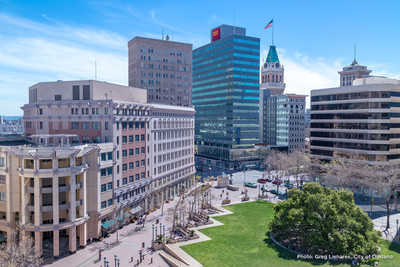
This was the same setting as the Art and Soul Street Festival we work every summer -- only less of it. I spent much of the day looking around Frank Ogawa Plaza and, as usual, thinking about how far Oakland falls short of its potential. (Wiki seems to have gone to some trouble to not show any decent photos of the place so I'll include two below, the first shows my main view on Saturday -- though I was at ground level -- and the other shows the visual focus of the plaza, the handsome Oakland City Hall, during Art and Soul.) 


Sadly, many of the retail spaces in the area are vacant. Partly this is because few people live in the area and the people who work near here are only here for work. Another reason, and a reason I wouldn't have a business here, is that since at least the Occupy days this area has gotten vandalized and or looted any time people have gotten upset about anything. 

One relatively nondescript building on the plaza I had never really noticed before is the Rotunda. I just looked it up and it's gorgeous inside, and apparently primarily a wedding venue.

If Jerry Brown, during his years as mayor of Oakland, had just allowed unlimited residential zoning within a two block walk to a BART station, downtown Oakland could be as vibrant as SF by now. Actually I doubt that -- Oakland can always find a way to screw itself.

Next - 110. Tainted blood and sticky buds

Friday, January 20, 2017

108. Creating fiction


Previous - 107. More social contract


Quatre Bras

While looking for something else (number of horses Marshal Ney lost at the Battle of Quartre Bras, still unknown), I noticed something interesting about Ney's conduct of that battle -- a battle I'm sad to say I've read very little about, because the other three battles have always seemed more interesting to me. What's interesting is that he used horse artillery very well. This is surprising because, at Waterloo, it's like he completely forgot such a thing existed. Now I'm wondering if the French lost Waterloo at Quatre Bras when their horse artillery was expended. 

As I've written before, at this time horse artillery was the most elite unit in the armies of the day. They combined the increased knowledge and training (and intelligence) needed to operate artillery in general, with the boldness of cavalry, and required a very large number of well trained horses to pull the guns around the battlefield at the speed of cavalry. They were like a combination of today's Delta Force "operators" and the crews that operate the Little Birds that often carry them into the fight. 

So what horse artillery did the French have at Quatre Bras?

2nd Bty, 4th Horse Arty (four 6 lb., two 6" how.)
3rd Bty, 2nd Horse Arty (four 6 lb., two 5.5" how.)

And at Waterloo?

Old Guard Horse Artillery - 399 men, 4 batteries, 24 pieces + 73 men, 1 battery, 6 pieces

So, yes. The only French horse artillery at Waterloo were not under Ney's command. Here's a key quote, "[French] Horse artillery was scarce to boot. Most of it had been ordered to reinforce the massed battery by General Lallemand, commander of the Old Guard foot batteries." -Source


So Quatre Bras was a classic Pyric Victory for the French. They won but at a cost so high that they were at a disadvantage a few days later at Waterloo. It could also be argued that Lallemand bore some responsibility for wasting his horse artillery, but you could also blame Napoleon for not committing his Guard earlier. Or you could blame Napoleon, or maybe Soult, for not detaching the Old Guard horse artillery so that Ney could have used it.

All that being said, I still keep to my previous idea that it was in fact the mutual hatred of Napoleon's Marshals that was the undoing of the French in this campaign. But at least now I can take back what I've said about Ney's failure to employ horse artillery during the battle, he apparently didn't have any under his command to employ. 


Trump

I avoided as much of the inauguration as I could today -- and I never assume politicians mean what they say -- but if Trump really means any of what he said today about jobs he's going to have to toss David Ricardo onto the ash heap of history. I would put up with a good deal to get that outcome. And who but a "populist" (nominal) Republican could achieve such a thing? He could be like Nixon with China... though maybe in reverse as it comes to China. 

Also, given our foreign policy over the past 16 years, a little "America First," and let the rest of the world sort itself out, may not be the worst idea. It's hard to see how he could do any worse than George W. Bush. Maybe he can even get the Navy to reduce the number of carriers they think they need.

In either of these cases, I'll believe it when I see it.


Absalom

p303 ...It was Shreve speaking, though... it might have been either of them and was in a sense both: both thinking as one... the two of them creating between them, out of the rag-tag and bob-ends of old tales and talking, people who perhaps had never existed at all anywhere, who, shadows, were shadows not of flesh and blood which had lived and died but shadows in turn of what were... shades too...

So, just as this is not just a novel about a family in Jefferson or just a novel about Race -- or even Race and Class in the South -- you also have to add that it is a novel about the creation of fiction. Like the beginning and end of that Alain Tanner film -- where the camera begins by passing through the film crew to the actors and the action, and then at the end pulls back out so we again see the film crew -- here the author gives us characters spinning the tale he is telling out of thin air... alternatingly ice cold and then hot and humid. There is no illusion that he is telling a "true" story, except in so far as "truth" is what we, like Devi, dream up.

Which means, now I think about it, that the story they are creating is also their story. This cooperative fiction should be telling us something about them. Of course to get that I would have to read more of the novels that feature them as characters. It's either cunning or cruel to force me to read more novels to confirm my suspicions here.

p308 Still Shreve, now talking about the octaroon, "...Men seem to have to marry some day, sooner or later. And this is one whom I know, who makes me no trouble. And with the ceremony, that bother, already done. And as for a little matter like a spot of negro blood --" [sic, I think " should be '] not needing to talk much, say much either, not needing to say I seem to have been born into this world with so few fathers that I have too many brothers to outrage and shame while alive and hence too many descendants to bequeath my little portion of hurt and harm to, dead; not that, just 'a little spot of negro blood --'...."  

So this is, I believe, the first hint we have of the "little spot of negro blood." To join the boys in their plotting, I do find it surprising that the mother, given the circumstances of her being set aside, would allow her son this alliance. And does this presume that the lawyer didn't know about the other "spot of negro blood?" Did the lawyer-client relationship extend to winking at something like that in the Old South, I wonder. So we have Bon in a relationship just a shade darker (see what I did there?) than Sutpen's but handling it just a little differently, not setting aside the octaroon but rather the institution of marriage as it came to her. Had the marriage with Judith have come to pass, would the octaroon have taken it better than Bon's mother? This treatment would seem to be if anything a little worse. Unless you were Mormon. Also, isn't it interesting that we are never even given a name for "the octaroon?" She seems to be treated shabbily by everyone. I would love to read a feminist examination of male-female relationships in this novel. The juxtaposition of "Penelope" and Milly in that crucial scene is no accident. For Sutpen marriage has more to do with animal husbandry than anything else. 

And I can imagine Charles Swann reading about Bon's possession of the octaroon with considerable interest. Not just a marriage contract but a chattel contract as well. Then he would really be assured of always getting a good cup of tea. Though the Russians wouldn't care for this, as the opportunity for laceration would be sadly reduced. Or so one would imagine. 

Troy

Yesterday while rooting in my backpack for something, I discovered The Trojan War: A Very Short Introduction, by Eric H. Cline. I can't recall who gave me this, probably someone in my book club. I started reading it today. It is, so far, a decent summary of what is currently known (as of 2013) about the various accounts of the Trojan War and about what historical facts might lie behind these tales. It's always concerning when Herodotus is mentioned as a source of information, but so far the author seems to be doing a decent job. Though I would have emphasized the use of this story in Attic Tragedy. 

It is a little odd, I admit, that I (with my interest in history in general and military history in particular) think the story of the House of Atreus is more interesting than the tale of the war that is at the heart of all their travails. And isn't that just a tiny bit like the situation I just described in Absalom? Take a sketchy account of a long ago war and spin it into gold by adding in betrayal and sacrifice and revenge and still more revenge. 

There's a famous quote about how no one would have known of Hector's virtues if the Greeks had not come to plunder Ilium (even the Stoics wouldn't have made such an heartless claim); but I would say a tragic tapestry woven of the tales of Iphigenia, Cassandra, Clytemnestra, Electra, and the rest is almost worth the death and destruction described in the Cycle. Maybe it even justifies the slave economy that Attic tragedy was built on.

As much as I love The Odyssey (and especially that final ur-action scene at the end where Odysseus reclaims his kingdom with the assistance of Athena, I feel that The Odyssey is a pointless tangent that takes us away from the main story of what those wacky Atreus kids will do next. 

Next - 109. Oakland

Thursday, January 19, 2017

107. More social contract


Previous - 106. Cincinnati & Traveler


Social contract

The other day I ran into an interesting article about the current political situation in the U.S. of A. (see here) that got me thinking again about the social contract and the viability of democracy. I've never been that sold on democracy since I don't have that much confidence in the sense of the common man. The "genius" of democracy is supposed to be that, collectively, we can make better decisions than we would be able to make individually. Time will tell how that works in the 21st century, but I still haven't given up hope.

Last summer I was open to voting for Sanders, though I was not a Sanders enthusiast. At one point I was considering the possibility of voting for Trump in the primary here to prevent Ted Cruz from getting the nomination... and I still stand by that preference. (For the record, I voted for Sanders in the primary because I thought he had the best chance of defeating Trump. I still stand by that choice as well, though I was pleasantly surprised by Clinton winning the popular vote in the general election. However, I suspect a great many of the most ignored Americans don't bother to vote. If everyone was required to vote, I suspect Trump would have won the popular vote as well.) I voted for Clinton in the general election because there's no way I could have voted for the Golden Cheeto, but I have to acknowledge that Clinton would have done nothing to make the problem -- that we've not been dealing with since at least the 1970s -- any better. The Clintons, Bushes, and even Obama, have all been part of the problem. 

The problem, I now think, is the failure of America to abide by crucial aspects of the social contract, in particular the requirement to give a shit about the success of the average American. This applies to the "forgotten" white middle and lower classes, but also to the now feral people I see on the streets every day. Also people of Color! Even the best liberals have only been interested in the common people -- or their rights and status -- in general, not in the success of individual people. 

Will Trump address this? Probably not, at least not successfully -- though both religious and fanatically political associations are often quite good at this, so he still could surprise me -- but I would like to hope that the Left will respond by taking up Sanders' banner and sincerely trying to address and even solve this problem. Though to be honest, I'm no more optimistic about this than about Trump. But that's what needs to happen.

There's a famous quote about the U.S. needing periodic revolutions (should have been by Thomas Paine, but I can't find it at the moment). The point being that the American Revolution ought not be a one and done proposition. As a Burkean conservative, I have reservations about this, but it's true that governments at least require periodic reforms. The tendency of man is to sink into policies that favor the wealthy and clever (like Sutpen, I suppose) and screw over the common people. Since it's unreasonable, apparently, to expect the favored to notice this and level the playing field, it seems to be the role of the common people to finally say, "enough," and force the favored/ruling classes to give in. That is what I see happening with Trump.

Viewed in this way, I have to say it is indeed genius. What better way to say "This is how little we think of your Bushes and Clintons and 'qualified' leaders. We're going to put an orange, business failure/ entertainer in their place." The Democrats tricked us all with a very attractive candidate (Obama) last time and we fell for it, but he was really just more of the same as far as his policies went. Better than Bush or Clinton, but not substantially better. I'm tempted to borrow Sarah Palin's lipstick on a pig quote here.


Entropy 2

Take an economic system. Say you're Sutpen raising cotton and you produce bales worth an amount $X. These bales are shipped to Cressbrook Mill where the cotton is spun into thread. Now, thanks to the work of capitol and those orphans, the cotton is worth $X+Y. If it is then transported to California where it is dyed indigo and turned into jeans (ignoring for the moment that transport costs were too high for this in the 19th century) you get a product that is now worth $X+Y+Z. 

I admit that it would be difficult to continue this entropy reducing trend unless you have access to a time machine that could bring worn out jeans to, say Tokyo today, where they might have an inflated value. Or you could have a skilled quilter turn the worn jeans into a prized quilt. So it gets increasingly difficult and in fact unlikely.

This is almost the lesson of the "Cradle to Cradle" idea for recycling. Cradle to Cradle is an economic or resource equivalent of a perpetual motion machine, a state of affairs where entropy stays constant.


Absalom

p294 ...Not two of them [Shreve and Quentin] in a New England college sitting-room but one in a Mississippi library sixty years ago... and they -- Quentin and Shreve -- thinking how after the father spoke and before what he said stopped being shock and began to make sense [that Charles Bon was Henry's brother], Henry would recall later how he had seen through the window beyond his father's head the sister and the lover in the garden, pacing slowly... to disappear slowly beyond some bush or shrub starred with white bloom -- jasmine, spraea, honeysuckle, perhaps myriad scentless unpickable Cherokee roses -- names, blooms which Shreve possibly had never heard and never seen although the air had blown over him first which became tempered to nourish them. It would not matter here in Cambridge that the time had been winter in that garden too, and hence no bloom nor leaf even if there had been someone to walk there and be seen there since, judged by subsequent events, it had been night in the garden also. But that did not matter because it had been so long ago. It did not matter to them (Quentin and Shreve) anyway, who could without moving, as free now of flesh as the father who decreed and forbade, the son who denied and repudiated, the lover who acquiesced, the beloved who was not bereaved....

This is such interesting fiction. Everyone busy composing the story. Or rather the author busy composing versions of the story from a variety of perspectives and giving those character/perspectives leave to re-imagine the setting. You can even imagine them all working together to dream up the best story and best presentation of the story.

I wonder if anyone has ever tried to tell the actual story as concisely as possible. I bet you could do it in a page or two. Where Martha Grimes gets distracted by characterization, Faulkner seems to get distracted by the telling of his stories... and how Southern is that. Unlike with Grimes, I'm pretty confident Faulkner knew exactly where he was going to end up. The telling is like a seduction. 

p302 "...who would in return surrender all his miseries and follies and misfortunes to the lice and fleas of Coke and Littleton..." Sir Edward Coke? I really have no idea what this means.

Next - 108. Creating fiction

Wednesday, January 18, 2017

106. Cincinnati and Traveler


Previous - 105. Tower of Power


Absalom

p269 ...though nobody ever did know if Bon ever knew Sutpen was his father or not, whether he was trying to revenge his mother or not at first and only later fell in love, only later succumbed to the current of retribution and fatality which Miss Rosa said Sutpen had started and had doomed all his blood to, black and white both... the next Christmas came and Henry and Bon came to Sutpen's Hundred again and now Sutpen saw there was no help for it, that Judith was in love with Bon and whether Bon wanted revenge or was just caught and sunk and doomed too, it was all the same....

I am so ashamed. Here's a lesson I thought I had learned from reading Parade's End and yet I had forgotten it until now. The lesson was to really pay attention to horses when they are described in any detail in books set before the automobile became the dominant means of transport. The horse Sutpen rides into this novel on is described as roan. Here is the definition for "roan horse:" "Roan is a horse coat color pattern characterized by an even mixture of colored and white hairs on the body, while the head and "points"—lower legs, mane and tail—are mostly solid-colored. Horses with roan coats have white hairs evenly intermingled throughout any other color.

In the section of the book I'm reading now, when Sutpen returns to Jefferson -- with the headstones --during the war we are repeatedly told Sutpen is riding a black stallion. (An odd choice for a war horse, I believe.) 


p277 ... [Quentin] Am I going to have to have to hear it all again he thought I am going to have to hear it all over again I am already hearing it all over again I am listening to it all over again I shall have to never listen to anything else but this again forever so apparently not only a man never outlives his father but not even his friends and acquaintances do...

I can't tell if that "to have to have" is a typo or not. 

And so we come to the retelling of Sutpen's second reverse in the battle between men and women. When Rosa reacts as anyone else would have known she would. While I don't really follow how Charles Bon was played into his part in this tragedy -- or how he himself could have known how to position himself, the situation with Rosa is simple enough. But what is the significance of Sutpen's relationship with women generally? I don't see that gender played any part in the story of either Race or Class in the South, aside from the usual desire on the part of women to support what ever side they happen to fall into. I'm clearly missing something here.

p286 Sutpen's black stallion and the mare produce a male foal, a horse "...the spit and image of his daddy when I rode him North in '61...." And Milly, Wash's granddaughter, I presume, gave birth to what? "horse or mare?" Shreve suggests a son, which makes no sense. 

p290 ...[Wash Jones, according to Quentin's father] 'Brave! Better if narra one of them had ever rid back in '65' thinking Better if his kind an mine too had never drawn the breath of life on this earth. Better that all who remain of us be blasted from the face of it than that another Wash Jones should see his whole life shredded from him and shrivel away like a dried shuck thrown onto the fire... And Wash slaughters his own granddaughter and great granddaughter -- well at least that it was a mare makes more sense, if that's the word I want here. And so it does come down to the boy-symbol after all.

Rare books

Two of the oddest -- and also most interesting -- works in my library are a self-published account of the beginning of the Pacific War in the Philippines -- by a U.S. Army doctor who had moved to Manila Bay a bit before the Japanese invasion, given to me by a friend whose family had been neighbors of the man after the war. (He survived the Bataan Death March and all the years of captivity.) And a multi-volume history of the American Civil War first published in 1911 that some friends gave me for Christmas one year. (The Photographic History of the Civil War the Blue and Gray Press) One of the more curious features of this latter work is the section on war horses of famous generals. Really, it's about famous horses because it seems that people during and after the war were interested in these horses. They would have had their own Twitter accounts. 

Chapter 11, "Famous Chargers", includes photos and bios of many of the horses. Grant, for example had at least three mounts at the end of the war including the most famous "Cincinnati." Even Lee had other horses in addition to "Traveler." It appears that most of these mounts were geldings though at least one of Grant's was indeed a stallion. 

Here's a passage about General Meade's horse, "Baldy," that is worth quoting, 

...He was wounded twice at the first battle of Bull Run, before he came into General Meade's possession. Left on the field for dead at Antietam, he was later discovered quietly grazing, with a deep wound in his neck. Again, at Gettysburg, a bullet lodged between his ribs and rendered him unable to carry his owner again until after Appomattox. "Baldy" was a bright bay horse, with white face and feet. This bullet-scarred veteran followed General Meade's hearse to his last resting-place in 1872, and survived him by a decade....

Entropy

I'm having a problem understanding the concept of entropy. But I've come up with a metaphor that I think might work for me. Still not sure. My idea is to apply entropy to military science.

A classical army -- in theory -- was directed by a commander and everyone did what that commander directed. But as the size of armies increased it was necessary to divide the total force into divisions, each with a sub-commander following the overall direction of the commander. As this process continued, it became more and more complex with lower level leaders (centurions, for example) in place to keep each component of the force in order.

As armies grew to much larger size in the Modern period, armies were divided into corps which were in affect armies in their own right, but following the direction of the army commander through the work of the chief of staff. This level of complexity increased yet again during the Great War when nations fielded army groups instead of individual armies.

Then, in response to the stalemate on the Western Front (resulting from the maturation of industrialized warfare with machine guns and advanced artillery and explosives) new infantry tactics evolved requiring a more complex command structure at the lowest levels, with captains, lieutenants, and even sargents playing a crucial role in directing field movements.

Today, the increasing role of elite (or special) forces approaches the point where each individual soldier plays a role in the direction of the force. (This trend is magnified by a technological trend to connect individual fighting vehicles, aircraft, and even individual soldiers into a distributed communications network where they all share data and where decisions may either be made by any individual or, alternatively, by staff or even political officials far away but linked into the same network.)

To summarize, military decision processes have gotten more and more complex and it's hard to see how they will ever get simpler. So ever increasing levels of entropy.

Here's something from Wiki that makes me feel a little better,

This implies that there is a function of state which is conserved over a complete cycle of the Carnot cycle. Clausius called this state function entropy. One can see that entropy was discovered through mathematics rather than through laboratory results. It is a mathematical construct and has no easy physical analogy. This makes the concept somewhat obscure or abstract, akin to how the concept of energy arose.

If, on the other hand, you think of a military force -- call it an army -- in the same way you think of a heat engine, the military potential of the army should drop as it is warn down over time by casualties and illness and simply the friction of use. This would seem, intuitively, to be true, but is not an invariable law. I've written before how the "military potential" of Caesar's legions or "Stonewall" Jackson's corp tended to increase even as their numbers and condition dropped. Instead of being expended, they turned into a more experienced, more cohesive force that larger, less experienced units could not resist.

And it occurs to me that, in this respect, a military unit is a bit like a steel sword blade. It's almost as if the energy -- in the form of heat and hammer blows -- that goes into the creation of the blade is conserved. The more "work" that goes into either forming the blade or training the unit, the greater potential each has. I suppose education works the same way, at least in theory. Though, interestingly, the potential of physicists, if you judge by their Nobel worthy production, does seem to drop over time -- as in a heat engine -- rather than increasing as with a military unit or a sword. At least in this metaphorical sense, entropy can either increase or decrease (in violation of the 2nd law of thermodynamics) depending on the circumstances.

I should be adding really confusing notes to Wiki science entries. It would be like an entirely new form of trolling.


Next - 107. More social contract

Tuesday, January 17, 2017

105. Tower of Power


Previous - 104. Goethe in Derbyshire


Just weird

Sometimes it seems like I only read the paper (SF Chron online) so I can make snarky comments. Last night a headline caught my eye about two people being hit by a train in Oakland. I pay attention to anything involving transit and especially trains. Also, the stupid things people do around train tracks are a constant source of wonder and amusement. 

What raised my ire in this headline was that it gave the location of this accident as "near the estuary." Could you be more vague? Reading what little they had in the initial story (it had just happened), they eventually got it down to Embarcadero and Clay Street. As soon as I read the words "train" and "accident" and "Oakland" my first thought was Jack London Square, because both freight and passenger trains run down the middle of a surface street which forms the land border of Jack London Square. It's what I like best about the place. 

So now, reading the story last night, I'm thinking, if "Jack London Square" is too long for the headline they could have said "Yoshi's" -- a very well known Jazz club that was my first thought when they narrowed it down to Clay Street. I then posted my snarky comment. 

As the evening progressed more information came out. It turns out that the two people hit by the train were members of the band Tower of Power who had been crossing Embarcadero against all the warning lights and barriers to get to Yoshi's where their set was about to start. They crossed behind a freight train only to find themselves in front of a passenger train. 

To continue with the theme of what a dick I can be, my first thought on learning that the band was involved was to recall, from my time sorting trash back stage at all the concerts we work, how musicians seem to think rules don't apply to them. The little people can sort their trash or pay attention to railroad warning lights. Tell that to Mr. AMTRAK diesel locomotive.

Powell street

I'm pretty sure I've talked about the way the cable cars out on Powell street have mechanical over-ride switches -- down in the slot -- that turn the lights green for them as they approach an intersection, and then switch it back to red as they leave the intersection. For the past year the City has done a good job of keeping the switches functioning, but this week, after all our storms, I noticed one of the switches (that turns the lights back to green for Bush Street after the cable car leaves the intersection) wasn't working. I was going to report it to the City, but when I came home that day there was a crew inspecting the slot. I mentioned the situation to one of the crew members who showed no indication he knew what I was talking about. I figured they would still notice the problem when they got to that part of the block. Apparently not. It's three days later and the lights are still off -- stranding traffic heading downtown on Bush whenever a cable car passes heading north. It will be interesting to see how long it takes before someone else figures out what the problem is.  


Absalom

p259 "... It was something about a bill of lading, some way he persuaded Mr. Coldfield to use his credit: one of those things that when they work you were smart and when they don't you change your name and move to Texas... Because Mr Coldfield never did believe it would work, so when he saw that it was going to work, had worked, the least thing he could do was to refuse to take his share of the profits; that when he saw that it had worked it was his conscience he hated, not Supten -- his conscience and the land, the country which had created his conscience and then offered the opportunity to have made all that money to the conscience which it had created... he would not be present on that day when the South would realize that it was now paying the price for having erected its economic edifice not on the rock of stern morality but on the shifting sands of opportunism and moral brigandage....

And now we're back in Derbyshire and Cressbrook Mill. Good, moral people investing their money on, there, industrial schemes, and, here, the slave based economy of the South. Striving for wealth. Creating a middle class (bourgeoisie) based on trade and commerce and exploitation. Not wanting to think about the price Mephisto always demands in the end.

p269 "...Only Father said that [the "boy-symbol"] wasn't it now, that when he came to Grandfather's office that day after the thirty years, and not trying to excuse now anymore than he had tried in the bottom that night when they ran the architect, but now he was old and knew it... telling Grandfather that the boy-symbol at the door wasn't it because the boy-symbol was just the figment of the amazed and desperate child; that now he would take that boy in where he would never again need to stand on the outside of a white door and knock at it: and not at all for mere shelter but so that that boy, that whatever nameless stranger, could shut that door himself forever behind him on all that he had ever known, and look ahead the still undivulged light rays in which his descendants who might not even hear him (the boy's) name, waited to be born forever without even having to know that they had once been riven forever free from brutehood just as his own (Sutpen's) children were --"

"Don't say it's just me that sounds like your old man..."

...Yes. Maybe we are both Father. Maybe nothing ever happens once and is finished. Maybe happen is never once but like ripples maybe on water after the pebble sinks, the ripples moving on, spreading, the pool attached by a narrow umbilical water-cord to the next pool which the first pool feeds, has fed, did feed, let this second pool contain a different temperature of water, a different molecularity of having seen, felt, remembered, reflect in a different tone the infinite unchanging sky, it doesn't matter: that pebble's watery echo whose fall it did not even see moves across its surface too at the original ripple-space, to the old ineradicable rhythm thinking Yes, we are both Father. Or maybe Father and I are both Shreve, maybe it took Father and me both to Make Shreve or Shreve and me both to make Father or maybe Thomas Sutpen to make all of us.

Just following an intuition (or random association here), but I can't help sliding from this pebble in a pool metaphor to my recent interest in standing waves as either a visual metaphor for Quantum states or as pointing to an alternative way of understanding quantum uncertainty. Quentin, his father and grandfather as states of a waveform. Existing -- or possibly existing -- in not-quite time in the medium of the South. Anyway...

p262 "Yes, the two children... [Judith and Henry, he just alluded to Clytie but ignores her now] And Grandfather said there was no conscience about that, [his repudiation of his first wife and child] that Sutpen sat in the office that afternoon after thirty years and told him how his conscience had bothered him somewhat at first but that he had argued calmly and logically with his conscience until it was settled, just as he must have argued with his conscience about his and Mr Coldfield's bill of lading... how he granted that by certain lights there was injustice in what he did but that he had obviated that as much as lay in his power by being aboveboard in the matter... and Grandfather not saying 'Wait wait' now because it was that innocence again, that innocence which believed that the ingredients of morality were like the ingredients of a pie... and once you had measured them and balanced them and mixed them and put them into the oven it was all finished and nothing but pie... could come out..." 

And here we get into the question of his first wife's unsuitability without ever actually saying what that unsuitability was. And of Sutpen's inability to understand how she might not have been quite satisfied with the settlement they "agreed" to.


Next - 106. Cincinnati & Traveler