Showing posts with label WW2. Show all posts

Wednesday, July 13, 2022

383. The British North Africa Campaign


Link to Table of Contents


Pandemic Update 


4/26/22 - Day 770/315
The new case rate has more than doubled since the low point on 3/12. The number of people in intensive care is still very low -- so this is what living with the virus looks like. Everyone has test kits now so if you get it you can quickly respond and get the treatment drug. Assuming you aren’t one of the many people with their head up their ass about COVID. 

I have no problem with this and I think our Mayor Breed has handled the pandemic perfectly. The situation with the “homeless” is impossible so I don’t judge her for that failure -- why should she be any different than all the mayors that came before her.

It’s my impression that viruses tend to become more infectious but less deadly over time -- could be wrong -- but I wouldn’t object to a more deadly variant to thin the anti-vax herd. Especially if it hits before the next election or even the one in 2024.


In non-COVID news, the Peet’s here has been so bad about stocking croissants that I finally looked for other sources in the neighborhood and found three. I tried one this morning (of course today Peet’s had croissants) and it was much better. Not sure if it was $2 better, but it was a nice change of pace. I will enjoy sampling the other two. And then the chocolate versions... the place I tried today even properly calls them Pain au Chocolat. I may end up opting for a combination of Peet’s pastries plus hitting one of the other, better places, when they are croissant free.


I had a great idea of repurposing my A History of Europe material on Medium, but then discovered that it isn’t yet in the public domain -- still at least a decade.


The British North African Campaign Re-examined

When you study the North African campaign in WW2, especially the British phase prior to Torch, it would seem that the British undermined their cause by diverting forces to Greece (March 1941) and then to Syria (June 1941). You might think that, if only they hadn’t done those things they could have performed better against the Germans (and Rommel). But what if this isn’t true? What if the British were being really cunning?

The logic behind the British North African campaign was the same as the logic behind the Peninsula Campaign during the Napoleonic Wars. The comparatively weaker British army would fight on land at a point that was easiest for them and hardest for their enemy. The Axis powers had to transport men and supplies across the Mediterranean Sea to North Africa where their ships and planes could be interdicted. The more successful the Germans and Italians were, the more troops and supplies they would need and the more difficult their logistics became. Finally, there was nothing west of Alexandria that the British really cared about. Winning or losing Cyrenaica meant nothing.

When you look at the situation in this way, then every time the British took Cyrenaica they made their logistical situation harder and risked the Germans realizing that this whole campaign was not really worth the trouble. So, by weakening their forces and setting up Rommel for a great victory, they were also pulling more Axis men and supplies into North Africa and stretching out the Axis lines of communications. If the British had sat down and picked a best spot to fight the decisive battle against the Axis in North Africa, El Alamein would have been an obvious option. Their own logistical situation was ideal while the Axis powers were stretched to the limit. And by November 1942 the Americans had arrived and were about to open a second front in the far west. It was time to put an end to the “game” and secure Africa prior to the invasion of Italy.

If this analysis is correct, then Churchill (I think it’s fair to give him credit here, he was a racist and a drunk, but he wasn’t stupid) played the Germans like a fiddle. 


The Bee Tree
The bush/tree outside my kitchen window is actually in the neighbor’s garden. I only see the top and side. If you had asked me, I would have said it blooms starting in March but at least this year it is only now, in May, really in full bloom. The blooms are not that impressive, but the bees seem to like them. As of this week it is buzzing with bees most of the day. I do wonder where the bees come from. I’ve even noticed a few bumble bees recently.The only hives I know of are over eight blocks away... I take that back, there may be one only a block away. I will have to check the next time I’m walking over there.

The blooming should be over some time next month at which point I will trim the bush back substantially as it has grown about two feet this spring and brushes against my building.

Our stubborn little tree in a large pot out in the alley is fully leafed out now. There are two branches at the top that seem to be dead and I’m wondering if I should prune it back now and how far. Last year it was really slow to green but this year it popped out early and looks pretty healthy. Pretty amazing considering what it has gone through over the years.It lives on my bath water, for the most part -- actually the water I catch while waiting for the stream to get hot when I take a shower. I would put in a pump to give me instant hot water without any waste, but that would require both electrical and plumbing work in a very small bathroom. Saving the water for the garden is probably the smarter solution.. 

Day 785/330 5/10/2022 Pandemic
The numbers are interesting. The new case numbers are almost as high as the Delta peak, but they are not going up at the same rate -- and nowhere near the Omicron rate -- and the hospitalization rates are still quite small. Lots of famous people are testing positive -- Steve Kerr, the Warriors coach is the latest --, but with minimal symptoms. If Omicron cleaned out the pockets of the unvaxxed, then maybe it is under control. I’ve stopped eating indoors and am taking extra precautions at times, but life is going on pretty much as normal. We are greening all the usual events -- I’m trying really hard to dodge working Bay2Breakers, I may have to play the “I’m 70!” card again.


For weeks I was trying to get caught up with a backlog of recommended pieces to read. I was just not making much progress. So I sorted through my inbox deleting all the old links it looked like I would never get around to. Now I’m caught up and wouldn’t mind looking up some of those links. Sometimes you just can’t win. So I’m going to reread my blog of A History of Europe starting at the beginning, or nearly the beginning.. Something I’ve been meaning to do in any case.


My second world traveling friend has contracted a mild case of COVID. This time in Italy. Everyone seems to be going to Italy.


Day 792/337 - 5/17/22
Noticed something I can’t explain while riding the bus just now. A young woman trotting barefoot in the mid-Market area caught my eye. The second time the bus caught up with her I noticed more: She was wearing a skirt and matching top but didn’t have any sort of bag or even a pocket; while her clothing looked normal, there was something about her fixed gaze that looked off. My guess is some sudden mental health breakdown. In a way, this is more disturbing than all the usual raving lunatics I see all the time.


Day 794/339 - 5/19/2022
Good looks

Since my “office” is in the same block as the Max Mara shop, I am teaching myself to appreciate those clothes Martha Grimes is so fond of. And I do like them, as clothes. A very simple, understated look that obviously is expensive to achieve. But I can’t say it’s a look I would prefer to see on an attractive woman. Perhaps my opinion would change if I actually saw them on attractive women.

There are a couple “looks” I have noticed recently and liked. There’s a simple jeans with a top look where the jeans are worn without a belt. I’m not sure why it works but it does. And there’s a somewhat older look where a woman wears long sleeves that cover most of her hands, only exposing perhaps half of her fingers. If she has nice hands, it is a great look. Again I don’t know why. And I’m still seeing that jeans with tall boots look that has worked for so long now. 


Ran into a thought provoking piece on Medium examining the various responses to the COVID pandemic and questioning some of the decisions that were made. Basically, she was thinking that perhaps the Swedes had it right all along and we shouldn’t have locked down in 2020. 

If you compare the experiences of NYC and SF, I think most people would agree that SF handled the situation better. The cost of locking down sooner was economic. The cost of waiting too long was in deaths and the overwhelming of the hospital system and resulting burnout of those workers. It would be interesting to compare the rate of essential hospital worker turnover in both areas. The nurses here think they are short staffed, but I don’t think they’ve ever been slammed like nurses in other areas have been. 

Yes, there is a high economic cost associated with this. Businesses here are still dying even as others are reopening or opening for the first time. Was the economic cost too high given the low fatality rate of the disease? How high would it have to be to justify the cost? Unfortunately, there’s no way to know how high the fatality rate will be before the fact so this calculus doesn’t really get you far. If you acted on the assumption that it would be just another flu, and then it turned out to be much more deadly you would be screwed. Though, given that a substantial portion of the population would rather see thousands of people die every day than get a free vaccine, you also have to question if all those potential deaths would be that much of a problem.

Our new case numbers are quite high right now, and I’m taking even more precautions than I was a month ago, but I’m still out every day and I do not want to see the city locked down again. The hospitalization rate is up, but the Intensive Care rate is still surprisingly low given that most of the cases are from the unvaccinated. And just in the past three months I finally know people, three at last count, who have caught mild cases of the disease. Now it really is more or less like the flu and my only regret is that it isn’t thinning the herd of more of the “hesitant.”

But we really should be planning for the next time, and not just the next surge. I continue to think that pandemic cases should be limited to specific facilities. The majority of hospitals should be able to operate normally. The hours nurses can work should be limited to prevent their burning out. People should be encouraged to remain at home if at all possible. Oxygen and other supplies and advice should be provided -- perhaps also a visiting nurse service -- but people (especially unvaccinated people when there is a vaccine -- should be kept out of the hospital as much as possible. Perhaps we need a form of pandemic hospice which may or may not end in death.

As for the economy, this is basically a natural disaster, like an earthquake or fire or hurricane. There should be governmental aid to help businesses. The biggest problem for business is when the customer base dries up as is the case here in the Financial Districts and Union Square. But this, again, is similar to what would happen in a major natural disaster. Tourists and conventioners and workers are going to be scarce after all the buildings burn down. 

This get especially complicated and I have no idea how to deal with it, but businesses need to be able to suspend operation for a reasonable length of time. Ruining retail business is not in the interest of landlords or the city. One thing that would improve the situation here is more residential units in the commercial/shopping districts. I would like to see at least 30% residential. This would guarantee a basic level of business even during a pandemic. The neighborhoods here in SF have suffered, but not nearly as much as their customer base has only decreased a little rather than a lot.


Wednesday, April 20, 2022

379. The 42nd Infantry Division in the "Other" Battle of the Bulge


Day 631/176 - 12/8/21
I’ve discounted my old printer to free and still no takers. I have gotten rid of the first batch of Christmas items and I will be posting the second batch later today. I figured they would be easy to unload. 

The weather is also changing, finally. I’ve been running my space heater after 8pm of late and even reversed my ceiling fan. It is supposed to get colder with rain this weekend -- kind of looking forward to that. Much of my time is now taken up reviewing this blog and reformatting previous blogs into a edited down, paper format. For whom am I doing this? Not sure. Myself mostly. It would be interesting to see it all in something like manuscript format.


Day 636/181 - 12/13/21
I’ve been looking at the current pandemic numbers in SF compared to last year at this time. Quite a change. Now that we are several weeks after Thanksgiving I think the numbers are significant and they are quite reassuring. The most important number -- intensive care hospitalizations is currently one fourth what it was a year ago and isn’t even in a clear upward trend. The case numbers are in an upward trend, but it is only a fraction of last year: 79 now compared to 272 last year. I think the hospitalization numbers even include some patients from the dumb as dirt counties where the hospitals are over-filled. Why is it so much better given that we have not one but two more infectious variants than last year? The main factor is that we are mostly mask-wearing sheeple. The other factor, especially when it comes to hospitalizations, is that most of us are vaccinated.

I know that many people are not being as careful as I am, but on the whole we seem to be being careful enough. I remain optimistic that the omicron variant will be our ticket back to normalcy, but until that is confirmed, I’m being overly cautious and only lusting in my heart for meals at my two favorite restaurants.


Day 653/198 - 12/30/21
It’s been a while. The latest Omicron phase of the pandemic is now going exponential here. The numbers are astonishing considering how careful we’ve been all this time. We are now looking at daily new case numbers that are about double our previous highest numbers. I even now know someone who has had it -- they were vaxxed so it was like a mild cold with a bad headache. The news from South Africa is that this version of the virus spreads so quickly it burns through the population in only a few weeks. And that certainly is the way it looks now. 

I’m being even more careful -- what I’m calling defcon 2 -- but I’m still working at the Bank Cafe as much as I can because it is also very cold and the air here is both filtered and heated. 

We are not locking down to the extent you might expect, but that is because SF is highly vaxxed so we think we can get by with a lot of cases without overwhelming the hospitals. Unfortunately, the numbers we have are so delayed, and hospitalization is itself so delayed following infection, that we won’t know if we are making a big mistake until it is far too late. Just today the hospitalization numbers finally turned up noticeably and our numbers are still from before Christmas. I think the Mayor is playing this right, but we won’t know for sure until two weeks to a month from now.


The "Other" Battle of the Bulge 

Recently I ran into an interesting piece about WW2 in Europe history on Medium. The author was the son of a soldier in the US Army’s 42nd Infantry Division -- while I’m the son of a platoon sergeant in the 40th Infantry Division -- so I wanted to be supportive, but the account he gave was deficient in a number of ways.

At the end of 1944 the divisions that had lead the breakout from Normandy and the race to the West Wall were largely spent. The fighting at Normandy, during Market Garden, and especially when the Allies reached the West Wall resulted in substantial casualties. Fresh divisions were flowing into France and Belgium and Luxembourg, but it would take time to fully activate and train these units. The 42nd Division is an interesting example of this.

At the time of the 2nd WW, the US Army’s primary fighting unit was the “Regimental Combat Team.” This consisted of an infantry regiment supported by Divisional assets like artillery, tank destroyer units, cavalry, and the like. When (Wacht am Rhein) the German offensive in the Ardennes started, reinforcements from 3rd and 7th Armies to the south were rushed north to counter the German attack that started the Battle of the Bulge. Units like the 101st and 82nd Airborne had been regrouping following Market Garden, so they were readily available -- though unprepared. Other divisions had to be pulled out of the line and replaced with whatever units were at hand. Near Strasbourg, the 42nd Division had not yet been formed, but the three infantry regiments were on the scene, so they were thrown into a quiet sector in the hope that not much would happen and they would gain a little experience before the rest of their Division arrived. It was a reasonable thing to try, but the Germans had other plans. Wacht am Rhein was the main but not the only German offensive planned for the winter of ‘44-’45. Operation Nordwind was a follow up operation to attack a similar Allied “bulge” in Alsace. It would prevent the Allies from sending additional units to the Bulge while giving the German’s a second shot at penetrating the Allied lines and disrupting their plans for 1945. Reichsführer-SS Heinrich Himmler was actually in command in this sector.

Now I need to reference “Band of Brothers.” Many people are familiar with the series and or the book, which is wonderful, but it gives a misleading view of what a normal infantry battalion was capable of. Parachute infantry are specially trained to act independently and the assumption is that they will usually be surrounded by the enemy. Here’s a very telling example of the difference between parachute infantry and regular infantry: My father was the platoon sergeant for a weapons’ platoon in the Pacific Theater (40th Infantry Division). The assumption was that his company would be fighting as a group and if they needed mortar or machine gun support they could call on the weapon’s platoon. With parachute infantry you couldn’t make that assumption so each platoon included a weapons section. It wasn’t as powerful as my dad’s platoon, but it would give the platoon some degree of support. The 101st was always delighted to get artillery or armor support, but they never counted on it. A regular infantry division did. So when the unsupported regiments -- that were not yet the 42nd Division -- were hit by the German attack at the beginning of 1945 they fell back in some confusion. In some cases, their losses were heavy. But they did manage to fall back and contain the German attack. One of the regiments -- the 222nd -- fought the final delaying action before the 7th Army units returned from helping save the day in the Ardennes and proceeded to drive the Germans out of the positions they had gained in January.

By the time the Allied attack into Germany started, the 42nd Division fully existed and its regiments had even been tested in battle. The “other” Battle of the Bulge achieved nothing in the end. 


Saturday, February 9, 2019

321. Mid-century Battleships


Link to Table of Contents


Mid-20th Century Battleships

I’ve written before about how often military units are not used in the way that was intended -- a mountain division first seeing action on a Dutch island that was entirely below sea level except for some levees, or a Panzer division sent to the front as infantry when their tanks were intercepted by the enemy. Similar to this is military equipment used in ways not foreseen like B-25s used as strafers rather than as high altitude bombers, or US Army pursuit planes used for ground attack. But there’s also a spectacular naval example of this same phenomenon.

For several generations battleships were developed as a modern version of the traditional line-of-battle ships from which they derived their name. They would sail in lines and fight similar lines of enemy ships. The Battle of Jutland is the best example of what was intended. By the end of 1941 the US Navy (USN) had built up a force of seventeen battleships for use in this manner. The Imperial Japanese Navy (IJN) had a similar force of ten ships. Due to the naval treaties following the Great War and the effects of the Great Depression, several of these ships on both sides were quite old and already considered obsolete. The IJN shortage of ships was one of the reasons they attempted to level the playing filed by sinking the USN battle fleet at Pearl Harbor. 

In the short term, they removed seven BBs from the US fleet -- so that the numbers now stood at USN ten vs IJN ten. In the long run they only succeeded in removing two BBs from the fleet while the other five returned to service and three returned as vastly improved warships. Meanwhile the USN was steadily adding newer and more capable BBs to their fleet while the IJN concentrated on producing two super battleships.

But what I want to look at here is how the ships were actually used. After Pearl Harbor the USN had two new, fast BBs which could be used to contain German BBs in the North Atlantic, before they were transferred to the Pacific where they acted primarily as platforms for Anti-Aircraft Artillery (AAA) in defense of the aircraft carriers that had become the prime naval weapons of the war. This fast BB force grew to six and finally to ten by the end of the war. Only once, in desperation, were the new BBs thrown into a surface engagement against the IJN.


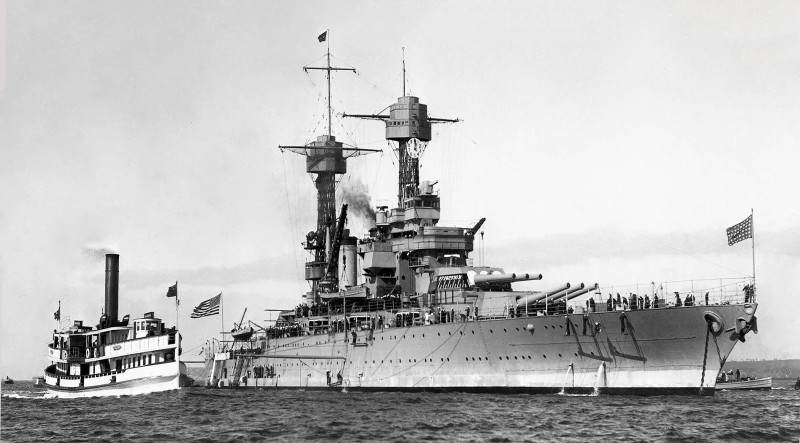
USS Washington - One of the first modern, 16" BBs and the victor at 2nd Guadalcanal


Immediately after Pearl Harbor, the USN also had one ridiculously old BB (the USS Arkansas), 


USS Arkansas - The last of the USN 12" gun BBs


two very old 14" armed BBs (The USS New York and USS Texas), four standard Great War era BBs, and a single improved, post WW1 BB (the USS Colorado). In the Pacific some of these ships were held out as a desperation guard in case of a Japanese assault on the West Coast -- which the IJN didn’t have enough oil to mount. While the remainder of the ships were used to protect convoys in the Atlantic. Even ships like the Arkansas were ideal for this role as, while slow, they were faster than a convoy, which could only sail as quickly as its slowest ship. They acted as an effective deterrent to any German surface raider. This is the way the USN BBs spent 1942 while the ships sunk or damaged at Pearl Harbor were raised and repaired.


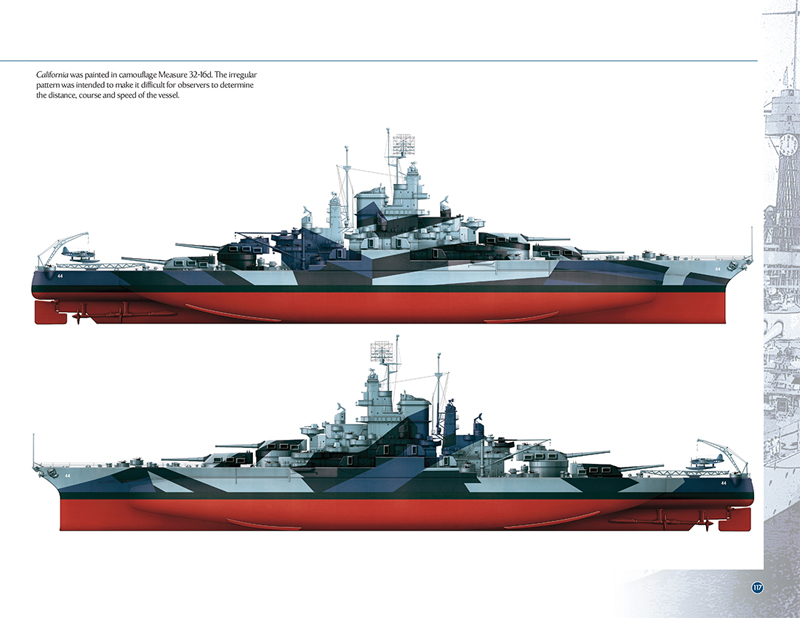
USS California - A typical 14" BB before Pearl Harbor 


USS California - As rebuilt after Pearl Harbor. 


When the Allies started the series of amphibious landings in both theaters of the war, which were the defining aspect of WW2 for the US and the UK, the older BBs, now edging up in numbers as damaged ships returned to service, found a new role in shore bombardment. From Casablanca and Tarawa through the invasions of the South of France and Okinawa, BBs protected the landing forces while battering enemy positions ashore. Both the new and the old BBs blasted Iwo Jima before the invasion, but the new BBs, despite their more powerful guns, were less successful in the role than the older ships with more practice in this aspect of naval warfare. It was only during the Battle of Leyte Gulf that the older BBs on both sides finally met each other in a traditional naval battle, and by that time the short term IJN advantage of Pearl Harbor had been made good and the result was a massacre. (One of the ironies of the war is that the IJN, in keeping with Western notions of a “Decisive Engagement,” always called for the “annihilation” of their enemies. They did achieve this at the early Battles of the Java Sea, Sunda Strait, and the destruction of Force Z. But after those early months of the war, the most obvious cases of “annihilation” were suffered by the IJN carrier force at Midway and, especially, by the Southern Force at Surigao Strait during the Leyte Gulf battles.)

So during the whole of the Pacific War battleships only did what they were created to do on two nights.


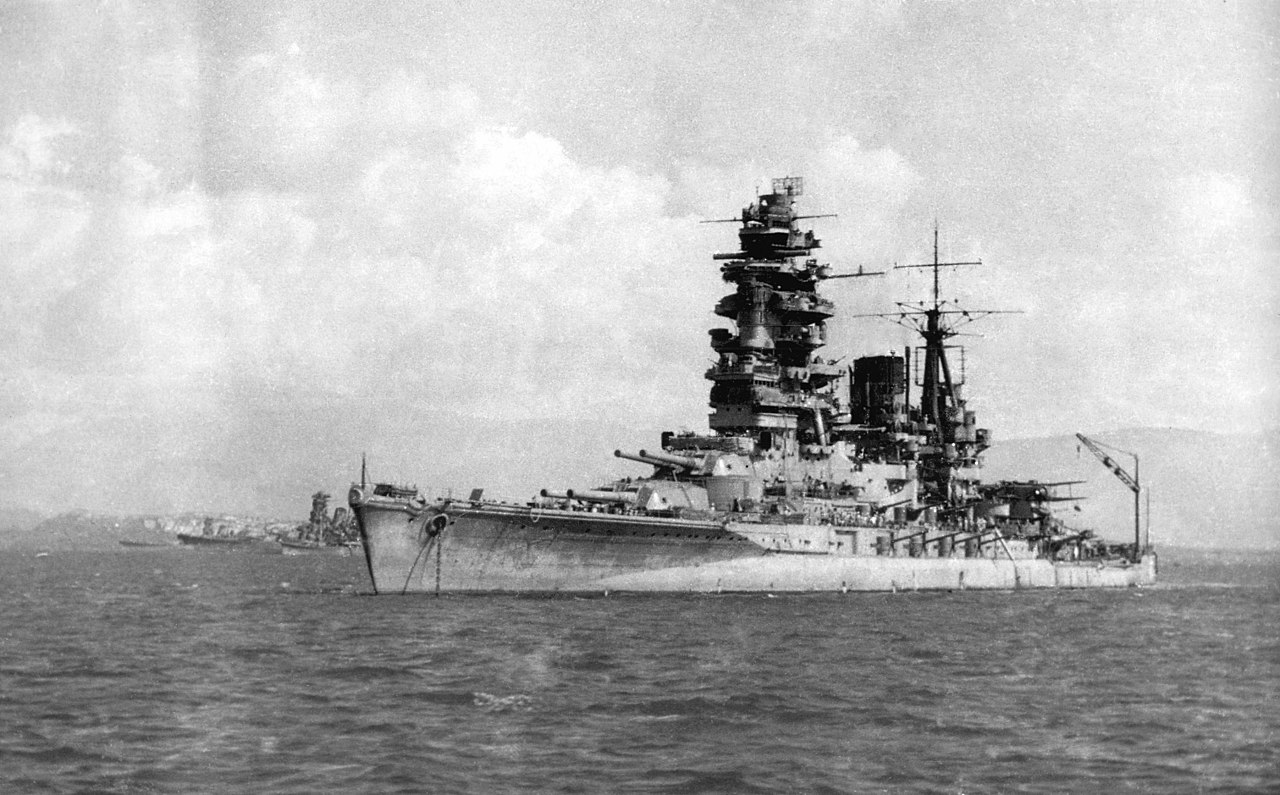
While the older USN BBs had busy and productive service histories, six of the older IJN BBs did almost nothing but consume oil. The other four older IJN BBs were, technically, not battleships at all but rather battlecruisers. Though very powerful ones. 


Kongo - Designed and built during the 2nd decade of the 20th century, this class of 14" armed ships performed well throughout the Pacific War. 


These were the only IJN BBs that were worth the investment the nation spent on them. They were fast enough to keep up with the aircraft carriers, so they could serve as escorts like the USN fast BBs, and in a pinch, they could be risked to support IJN operations in the constricted waters of the Solomon Islands -- though two of them would be sunk there, so the risk would not pay off.

Still, the four Kongo class ships would see action from the beginning of the war to the last IJN fleet actions, while the other battleships would be expensive, oil guzzling assets that were carefully conserved until it was too late, and then proved incapable of even "annihilating" little Taffy 3 at the Battle Off Samar. Though they did look impressive.


Haruna - IJN equivalent of the USS Colorado class


Yamato - super battleship


Wednesday, November 21, 2018

306.Quick trip to Portland


On the Coast Starlight, again


Wednesday
I think I’ve remembered most of the important things about riding Amtrak. Like dressing warmly and bringing snacks, as the snack offerings are abysmal. It wasn’t until after I boarded that I recalled Amtrak's habit of riding over the worst rails while you should be sleeping. We’ll see if they do this again. (Not particularly.)

This train seems less crowded than I expected. I thought there were only a few seats left when I finally bought tickets. We’re already to Carquinez Strait, my favorite part of the trip on the bay. Or between the bays. So far I haven’t thought of anything I’ve forgotten. I was thinking of bringing my scarf, but that was a contingency thing. I may miss it tonight, actually.

We’re pulling into Martinez. A place I’ve only been to with K_____. I’m not sure how I would even get here aside from on the train unless I rented a car. There is probably an AC transit bus but it probably takes days.

What I didn’t bring is a book. There was one I was thinking of bringing, but it was rather heavy and I do plan on visiting Powell’s. Possibly tomorrow and certainly on Saturday before I depart. 

I don't have WiFi. So of course there’s something I would like to research. Before I left home I determined that the U.S. built about 10,000 Tank Destroyers during WW2 and I’m dying to know how many similar AFVs Germany built. They had tank hunters and an array of assault guns but I suspect the numbers were more modest. The U.S. vehicles were not as good in some important ways, but in other ways they were better. As with destroyers, the IJN had more powerful ships but the USN ships were “good enough” and more numerous. (Ready? It's more complicated than I thought, but the short answer is that I was wrong. The Germans fielded three different classes of armored vehicles besides tanks: 3,535 Panzerjagers; 5,350 Jadpanzers; and about 10,000 StuGs. What makes this confusing is that while all these vehicles had better antitank guns than the USA vehicles, the StuGs in particular were intended for use as assault guns in support of infantry. This is a role the USA tank destroyers also filled, but, aside from the advantages of a turret over pointing the whole vehicle at the target, the USA guns were not as good in this role either. But, the standard M4 Sherman tank, with a 75mm gun, was excellent in the infantry support role, and the version with a 105mm howitzer was even better in the assault role. Only 1,641 of these were manufactured, but the total number of M4 tanks was a staggering 49 thousand and change. )

Also just before I left home I watched a video, a new favorite YouTube historian has produced, about the USS Texas. I’ve written about these antique USN battleships before; they would have been scrapped or used as target ships in the 1940s, as the new battleships joined the fleet, but because there was a war on they were kept in service. The Texas had served with the Royal Navy’s Grand Fleet at the end of the Great War and then went on to provide fire support for the Allied landings at Casa Blanca, Normandy, and the South of France. And then she sailed to the Pacific and did the same thing at Iwo Jima and Okinawa. She even made three Magic Carpet trips after the war bringing soldiers home from the Far East.

And unlike the Nevada and West Virginia, she didn’t require much investment during the war. They added lots of AAA and had to replace her gun barrels because she fired so many rounds at enemy targets. These targets would have included the Panzer concentrations around Caen that were devastated by the naval artillery. To the best of my knowledge this role was not something the USN anticipated before the war.

Thursday
Well, I sort of slept. And breakfast was good. Sat with an older (88) man from Vancouver, BC and we’ve been yakking ever since. Sorted out all the world’s problems and gave each other travel and life advice. He used to sing barbershop but doesn’t read music. Meant to ask him why, but he launched into a story about DC and I forgot. I was no prodigy, but reading music isn’t THAT hard. Why, if music is that important to you, wouldn't you take the time to learn? This would apply to Tori Amos as well.

The train crossed over the Oregon border during breakfast. I even saw what I think was Mt Shasta. I swear I recall waking up in my sleeping car bed well into Oregon but that seems to be impossible. Beats me.

Arriving in Portland the train runs next to the tracks for one of the TriMet MAX LRVs, the one that goes past where I stay. I also noticed the stop for where I was planning to have my vegan pizza dinner that day. I love Portland.

Friday
I’m at my now longtime favorite Fehrenbacker Hof in Goose Hollow for breakfast. This is one of my favorite neighborhoods in the world. Mostly because it reminds me of my college days, though I can’t explain why. Last time I was here the Hof was closed so I had dinner at the place just next door. And that was good too. If I lived in Portland I would spend way too much time here. And it would be more expensive than the Bank Cafe where what little I can order is cheap. Here I want almost everything. 

One small complaint/similarity, they are playing music from the ‘60s. A little different music, Credence and Jimi, but still... 

Sweet Jesus, I just noticed my computer automatically logged onto their WiFi. Yes!!! I’m home.

My breakfast just arrived and while I was eating they did play a newer song. And then I realized it was from the ‘90s, so, still the better part of three decades old. I’m just particularly sensitive to five decade old songs.

I’m avoiding going to Powell’s until tomorrow after I check my bag at the train station. One, Powell’s is a good thing to do near the train station. Two, it keeps me from getting stuck in a book while I’m here. That would be a waste of a visit, after all. 

The air quality is getting even worse back in SF due to the fire. I’m starting to wish I had decided to stay longer, but that gets tricky with the trash situation. Still, breathing is something I enjoy doing.

I need to buy nail clippers (the thing I forgot to pack) so just looked to see where the Walgreen's were. In SF you don’t have to go more than a couple blocks to find a Walgreen's. There’s one two blocks from me and five more within six blocks, maybe more. Here there is one in the entire downtown (west of the river) area. Strange. And it’s not like there are many CVS or RiteAid locations. It’s like all the pharmacies decided to leave this market alone.

Had lunch with D___ and G__ at a brew pub with vegan food. I had heard about the Reuben sandwich so two of us ordered that, and we also shared an order of tacos. Everything was good. Was lovely talking to them again. D___ is retiring from teaching next month so it will be interesting to see how she deals with that.

For dinner I went to Bye and Bye, for a third time. Turns out they also have a vegan Reuben, which I wish I had ordered, but I went with the spaghetti and meatballs instead. No complaints, but it would have been fun to have compared the two Reubens.


I would love to have comparative statistics on construction of buildings of greater than four stories in Portland and SF over the past thirty years. I wouldn’t be surprised if more units were built in Portland. And the ratio of residential to commercial in the two markets would also be interesting. My guess is the ratio of residential would be far higher in Portland.


Saturday
It turns out mid November is a great time to visit Portland. It’s a festival of leaves. Enough are still on the trees to give you the beauty part, but more are on the ground. Today was windy and they were blowing in drifts. And the smell was heavenly. 

My pre-train day went pretty well. I had a breakfast snack at Powell’s and lunch at Sizzle Pie. I made a quick trip to the Pearl Hardware Store and bought breathing masks for when I get home, since the smoke has still not cleared. The only down side was that, for the second time, I took the streetcar to the closest stop to Union Station, which is not really the best way to get there. I had to walk blocks out of my way. I think there is a way to do this, but that would require boldly dropping down into streets the destination of which are not obvious. Maybe I should try to do this next time when I’m not actually catching the train.

Powell’s was it’s usual wonderful self. I love that they have these large, formal label/dividers for nearly every philosopher you’ve ever heard of. The selection of Foucault titles was pretty daunting. I couldn’t find anything “about” David Ricardo, but I didn’t look that hard. The area with tables/shelves of featured titles was a little disappointing. I though they would have groupings more to my thinking, but they were mostly groupings convenient to the bookseller. Not that I didn’t find anything I wanted to read. Since size and weight was a primary consideration, I had to pass over some of my first choices, but ended up with Carrie Fisher’s The Princess Diarist. She’s always fun to read.

I had remembered the cafe in Powell’s as being a bit funkier. It was okay, but certainly not as nice as the Hof. Sizzle Pie is great for the pizza but otherwise a pain in the ass. I guess when you stay that busy you don’t have to think about improving things. Not that different than Tartine except that at Tartine I don’t recall my shoes being stuck to the carpet.

Looking out the window at the cafe in Powell’s I noticed a new tall building with four small wind turbines on the roof. I went by and got the name of the company that had worked on that. With luck I can contact them by email and ask some questions. They were spinning like mad today. (No luck.)

Just grabbed a reservation for the last seating at dinner. As I recall, breakfast is awkward as we arrive in Emeryville fairly early. I could be wrong about that but I wouldn't mind having breakfast at home in the morning.

Paragons. Because of C___’s travels in the subcontinent, I’ve been thinking about the Buddha and other paragons. Which got me thinking of Stan Lee: isn’t he a kind of paragon of living a full and productive life? Reaching enlightenment is an achievement, I suppose, but isn’t it also a form of cheating? Penetrating Maya and seeing beyond this reality is like finding the answers to all the quiz questions in the back of the book. What’s more interesting is what people do while playing the game without cheating. This reminds me a bit of that "The Other Side of the Hedge" short story. 

How many of the “homeless” would be good monks under different social circumstances? Some of them are of limited intelligence and have emotional issues, so prime candidates for faith. Would a religious structure like that of the Buddhist monks in South and SE Asia provide structure and meaning to their lives? I should ask C___ about this.

With permaculture, what could you do with 40 acres and a mule?

Perhaps one reason I think of Portland as being Midwestern is that two of the terminuses (termini?) of the MAX system are Cleveland and Milwaukee. But then there’s also Beaverton and, my favorite, Clackamas.

For my sins there are a plethora of little kids on this train, and most of them are in my car. I may be spending the night in the lounge car. Or possibly a bathroom. One is having a screaming fit as I type this. Why would so many kids be traveling in mid November? Thanksgiving! Didn’t think of that.

Another interesting meal in the dining car. A couple that had moved from Seattle to a barge in the Netherlands. She had once lived in Noe Valley and he had once lived in the San Fernando Valley. And a younger guy from Sunnyvale. The Silicon Valley. The Valley table. 

Sunday
The Princess Diarist. Not her best, but good. She says the elephant in the room was his family or the nature of their relationship, but I think the real elephant was her bipolarity (?) You can’t let that out of the bag and then pretend like you haven’t. The problem isn’t just Harrison, though it probably was him too, but, as she says herself, everything going on in her head.


I’m back in SF, North Beach in fact. It’s smoky but I’m not going to shave my beard if the weather is breaking in a couple days. I didn’t sleep well last night, of course, but I napped for a couple hours after getting home. Now I need to get organized again. Just enough of a trip to get me out of my rut, I hope.


Monday, November 7, 2016

71. Election 2016 + Alice


Previous - 70. A new book

Preparing to vote


I spent a large portion of Sunday working through my Voter Information Pamphlet & Sample Ballot. At least I have an easy choice at the top of the ballot, but the rest is a total mess. I like my candidate for U.S. Senate and State Assembly. I have to vote for Pelosi, my U.S. Representative. I refuse to vote for my City Supervisor but can't really vote for the person running against him either. In the other races I have to choose the lesser evil -- as at the top -- or follow endorsements for the minor offices with candidates I've never heard of. Such is democracy. And that's the easy part.

Next we come to the State and City Propositions. There are 17 State Propositions but I've only voted (yes or no) for 13 of them -- the others I either can't make sense of or I could go either way on. Then there 25 City and BART or School District propositions where I've voted for 22. 

I'm proud to say that in a number of these cases I've voted against my inclination because the Proposition would set a bad example or cause problems in addition to what it's intended to fix. In some cases it's really hard to know if voting yes or no would reflect my true opinion or achieve what was possibly intended. And of course they throw all these Propositions at us because our elected officials can't do their jobs and settle this themselves. In some cases I'm hoping I'm sending a message about what I really want or don't want, but in other cases I'm not sure what message, if any, I'm sending. 

And if Tuesday goes as I expect, no one will be paying much attention to these local issues anyway.


A Century of Wisdom

I'm up to Chapter three and now Alice and her young son are in a camp -- though a very nice one where she continues to perform on the piano. 

Back in Prague she was raised in a quintessentially bourgeois-Jewish family with Franz Kafka as a close family friend. Most of her immediate family escaped to Palestine on the last train out of Czechoslovakia. She, and her husband and child, remained behind with her mother for what seemed like good reasons before Munich.

What do I mean by "quintessentially bourgeois-Jewish family?" They were well educated, very musical, well connected, involved in trade. Her mother was raised Orthodox, her father was a merchant. A year or two ago I would have thought nothing of this, but now I can't help viewing them -- along with Primo Levi's family in Turin and Oliver Sacks' family in London -- through the eyes of Dostoevsky and Ford. Thus I have to ask, To what extent were the Jews hated for being ur-bourgeois as opposed to being religious. (Sorry for the German prefix to a French adjective.) 

I know this sounds far-fetched, but stick with me a moment. I've never paid much attention to what anti-semites were saying, going all the way back to that Austrian red-neck Morton covers in A Nervous Splendor. So what do I know? First, there's Fernand Braudel's argument that the origin of European capitalism is intertwined with the history of the Jews displaced from Iberia after 1492. Then there's an account I read a long time ago of anti-Jewish riots in the south of Germany back in some earlier century. (Sorry I can't be more specific.) There was a pattern to the violence against the Jews back then: The wandering Jews would settle in a community and offer credit. Things would be fine for a time but then the economy would go south, and when the local Christians could no longer keep up with their payments, it would be discovered that some Jew or other had tricked a Christian into smuggling a wafer (the body of Christ) out of a church and giving it to the Jew who then proceeded to torture it. The Jews implicated were attacked and the rest of the Jewish community fled. 

Now this sounds completely nonsensical, of course, but what I read into it is that religion was just a tool the locals used to attack people they had a grudge against for economic reasons. Dostoevsky and Ford are not blatantly antisemitic, but it is clear in both The Brothers Karamazov and Parade's End that Jews are a part of -- and possibly a symbol of -- the bourgeois values they see as undermining the natural, Tory order. And, with Braudel in mind again, this is not wrong. (Mann is less interested in this line of reasoning -- Naphtha not withstanding -- because he was raised in an equally bourgeois, though, gentile, family.) 

I really don't want to do the research -- read antisemitic writings of the time, and Nazi dogma -- but I'm curious about how much the Nazis were opposed to other aspects of bourgeois life like science and technology and the importance of merit vs birth. 


A Faustian history of WW2


It would be impossible to pick the strangest section of Part 2 of Faust, but the battle section right after Faust returns to Germany from Greece would have to be in the running. If we accept that Faust (with Mephisto's assistance) represents the bourgeois spirit, then you can almost see this passage as an allegory for the Allied victory in both theaters in WW2. Wait, stay with me for just a minute...

The Allied victory was based largely on technological/scientific magic: The Bomb is the most obvious example of this, but there's also crytoanalysis, radar (by the end of the war radar sets small enough to fit in artillery shells), and the by then routine magic of modern industry with the exploitation of coal, oil, and everything else that can be mined from the Earth. 

And it's worth remembering that deception played an important role in both Faust's battle plans and in the Allied battle plans (the British at the 2nd Battle of El Alamein and the American crossing of the Rhine being two good examples.)


Faust - Part 2 - Act IV Scenes I-III (Headland:Battle)


FaustNow, powerfully, streams pour on streams,10725
Sweeping from gorges with redoubled gleams,
A river now throws up an arching veil:
Pours over the rocky level in a tide,
Runs foaming down, on every side,
And, stepwise, hurls itself into the dale.10730
What use their fine, heroic resistance?
The vast wave roars, and fills the distance.
I shudder myself at this wild waterfall.
MephistophelesI can see nothing of these watery lies,
They only serve for fooling human eyes,10735
I delight instead in wonders that befall.
In companies, their men plunge down,
The fools imagine that they’ll drown,
While free to breathe, on solid ground,
With swimming strokes, they run around.10740
It’s bewildering them all.
(The Ravens return.)
I’ll praise you to the noble Master: but see,
If you’d like to display your own mastery,
Hurry to the glowing smithy,
Where the dwarf folk never weary,10745
Hammering sparks from steel and stone.
Ask for, once you’ve chattered first,
A fire to shine: sparkle, and burst,
The finest that man’s ever known.
It’s true that far off lightning flashes,10750
And stars that fall in sudden dashes,
Can happen any summer’s night:
But lightning in the tangled bushes,
And stars that fizzle in the rushes,
They’re not such a common sight.10755
Don’t trouble about my command,
Ask first, then afterwards demand.
(The Ravens fly off. All takes place as ordered.)
Darkness cloaks the enemy!
Their footsteps meet uncertainty!
Everywhere are wandering flares,10760
And those sudden blinding glares!
It’s all beautiful indeed,
Now some noise is what we need.

Next - 72. Election night 2016