Showing posts with label Martha Grimes. Show all posts

Friday, April 22, 2022

381. Way of all Fish and Ukraine War


Link to Table of Contents


Pandemic continues 


Day 725/270 - 2/12/22
The Pandemic - At the moment the latest surge has peaked and crashed but the new cases numbers seem to have flattened at just under 100 per day. I suspect this reflects the transmissibility of the current variants. I was hoping to see the numbers fall to around 50, but it looks like this is the best we can expect.

Life is largely returning to normal regardless. This too is a little concerning, but I feel the same way. Two years isn’t that long but there’s no assurance things are going to change drastically in the near future, so we may as well try to resume our lives while some of our favorite businesses are still hanging on. There is talk of an even better vaccine that may counter all variants, but that is just talk so far. So at this point I’m with all the idiots who just want to return to the way things were. With reservations, of course. I’m writing this at my office, the Bank Cafe, and I seem to be the only one here wearing a mask. And I’m thinking about buying pull-up equipment rather than returning to my gym.


My Birthday
This week would have been my father’s Birthday -- 102nd, to be precise. And just past the end of the week is his death day -- now 23 years in the past. I’m thinking about that because my birthday is coming up in a few weeks and I will be nine years shy of the age my dad died. My health is much better than my dad’s, but I also don’t have my mother around to call 911 if something dire happens. My point is, it wouldn’t be at all shocking if I were to die in my seventies. This is a thought to give one pause. No previous decade came with this fine print.

I continue trying to balance taking care of myself -- working on my fitness and improving my diet in small ways -- with seizing the day. One of the main perks of our being past this latest COVID surge is that I’ve returned to my favorite breakfast place on a weekly basis -- though I try to hit them during the week when they are less busy instead of my previous preference for visiting on the weekend when they are the most crowded. It’s going to be a while before sitting elbow to elbow at a crowded counter is going to be an attractive option. And I’ve returned to my favorite Burmese restaurant, where I will be on my dad’s Birthday and Deathday.

The week of my birthday I will hit a number of other favorite places that I have been avoiding the past two years. There is still only one of my favorites that I know to have gone out of business... I just checked and their other location is still open! So I may go there as well.


Day 735/280 - 3/22/22
In my review of my blogs I’ve made it to the start of the pandemic... and Proust. Almost exactly two years ago but it seems like longer, or only yesterday. And the new case numbers seem to have found a floor around 80, which is a little worrying. My hardware store was having a big sale and I stocked up on 3M N95 masks, both the good ones and the kind with the valve. I’m now thinking I may try going to the gym while wearing an N95 with a valve. My guess is that most people aren’t wearing masks there, so I really don’t need to be concerned about protecting them. And if I don’t do this I really should give up and buy pull-up bars for the building. But after two years, I need some months on the Gravetron machine to get back to where I can pull-up my own weight.

I don’t think I’ve mentioned the war in Ukraine. I’m so happy to say this has nothing to do with the USA for once. (According to Chomsky, that statement isn't true. He claims the USA tricked the Russians and Ukrainians into the war. Maybe. There are so many conflicting views about the "real" reason for the war. My theory is actually cheating, but I think also true. The war is the result of Ukraine agreeing to give up their nuclear weapons.) It is so odd that the YouTube history channels are all covering the Battle of Stalingrad and even the 2nd German conquest of Kharkiv just as the Russians are battering the place to ruins yet again. Given how frequently Ukraine gets destroyed, it’s a wonder everyone still thinks they want to possess it. Given that everything gets destroyed every few generations anyway, maybe they should try rebuilding with paper or cardboard.

Over this past weekend I got together with my old brunch club for what has become our annual gathering at someone’s house instead of out at a restaurant. And I’ve eaten out at actual restaurants with two other friends.Trying to seize the day -- or the dip -- before case numbers start rising again. 


Day 742/287 - 3/29/22 
I’ve now progressed in rereading my blog from less than a year ago. It’s actually fun to read about those early heady days after I was first fully vaccinated... before we knew there were still more surges and variants to come.

Some things have not returned to normal, I still can’t use my reusable cups at the Bank Cafe -- I tried today and was told that Peet’s was allowing this but the bank still wasn’t. (As of this week, 4/17/22, I can!)

I’ve been cleaning out the electronic mess of my home desk. Removing my old desktop computer for recycling forced me to finally clean and reorganize everything. I’m using regular office butterfly clips to control the cables. It is still a bit of a mess, I would need easy access to the back of the desk to really get things the way I want them, but it’s much better than it was. My laptop, speakers, and printer can all be powered individually so they are only “on” when I need them. I was hoping to do the same thing with my router, but that is powered by my back-up battery. I would have to manually disconnect and reconnect it every day -- probably not a good idea and it would also prevent my using my computer during the night or first thing in the morning. Like the egg I’ve decided to eat once every three months, this will just have to be the rare unnecessary electrical excess I allow myself. Similarly, I still haven’t taken the final water saving step of turning off my shower head when I’m lathering up. That’s probably coming soon, but tends to involve also keeping my bathroom a little warmer. 


The Way of All Fish by Martha Grimes

This is the first book I’ve checked out from the Mechanics Institute Library. I adore Martha Grimes and I loved Foul Matter, the first novel in this series, but I hadn’t bothered to pick up the new one until now. While I’m having fun reading it... and I’m reading it as slowly as possible to extend the pleasure... I can’t say it’s her best work. There seems to be a randomly flailing around aspect to many of her mysteries, but this one seems even worse than usual. On the other hand, she’s managed to toss in her beloved Tamiami Trail (from the Emma Graham novels) and references to both George Gissing and The Magic Mountain. The first was surprising enough and I still don’t know where she’s going with the latter. A seance is coming up, but I’m not sure if the character is even aware of the seance sequence in the book. If not, this would be even stranger, so I’m going to assume that’s where Grimes is heading. (No, still a mystery.)

Mostly she has her characters smoking, drinking, and eating. (They also love expensive clothes) And one of them, of course, is having a hard time writing... almost identical to a similar character in Foul Matter. Perhaps Grimes likes to play with writer characters who are having more trouble than she is. Her character in one of the Jury mysteries who literally chained herself to her desk to write, is my favorite example of this. And in a mystery this is killing two birds with one stone as you know how that’s going to turn out.


As 3/12/22 now seems to have been the low point after our recent winter COVID surge, I am really tempted to seize the day now rather than later. But my birthday is coming up in less than a week, so it seems like opening your Christmas presents early. So, I’m considering celebrating my final fetal days instead of my birthday. When you think about it, from the perspective of the fetus the birthday was when life started going downhill. This new way of looking at things works especially well this year as I’m also celebrating the final days of my sixties. Why would I celebrate entering a decade my chances of surviving are only fair?


Wednesday, July 12, 2017

174. God's Presence


Previous - 173. Augustine, not a Cynic


God's Presence

This section of the chapter is almost exactly a page and I skimmed through it the first time because, blah blah blah. But, it is the core of this chapter and of all the chapters that have to do with religion (especially Day, but also Perkins and (Ida) Eisenhower and even Johnson. You can even add Eliot when you take into account her childhood.) 

p196 The second large observation [the first being "...though people are born with magnificent qualities, original sin had perverted their desires..."] that flows from Augustine's internal excavation is that the human mind does not contain itself, but stretches out toward infinity. It's not only rottenness Augustine finds within, but also intimations of perfection, sensations of transcendence, emotions and thoughts and feelings that extend beyond the finite and into another realm...

As Reinhold Niebuhr put it, Ausgustine's study of memory led him to the "understanding that the human spirit in its depth and heights reaches into eternity and that this vertical dimension is more important for the understanding of man than merely his rational capacity for forming general concepts."


The path inward leads upward. A person goes into himself but finds himself directed toward God's infinity. He senses the nature of God and his eternal creation even in his own mind, a small piece of creation... 


p197 ... Human life points beyond itself. Augustine looks inside himself and makes contact with certain universal moral sentiments. He is simultaneously aware that he can conceive of perfection, but it is also far beyond his power to attain. There must be a higher power, and eternal moral order.


As Niebuhr put it, "man is an individual but he is not self-sufficing. The law of his nature is love, a harmonious relation of life to life in obedience to the divine center and source of his life. This law is violated when man seeks to make himself the center and source of his own life."


This is the counter-argument to Voltaire and the Enlightenment. To the entire middle-class value system and world order. 

On the other hand, it isn't so different from early Greek, mystical, thought where the cosmos was not just atoms and the void. Or like any other form of pantheism. You could even plug in the Dionysian religious underlying order that Nietzsche argued for in The Birth of Tragedy

But then there's the sociological/cultural anthropological way of viewing this: We have evolved to have mystical (positively reinforcing) reactions to sharing religious feelings with our primary group. Since mystical states can be induced or inhibited by chemistry, we can only say what we experience without concluding much about an underlying reality as a basis for these experiences. Even so, it may still be true that true happiness for many, if not most, people requires we follow the conclusions of Augustine and Niebuhr. Not that that much limits our options, since this would allow for most any kind of mystical religion as well as the secular cults of National Socialism and Communism. The Aztecs (I'm guessing), Mussolini, and Mao were also good at selling this notion of not making yourself the center and source of your own life.

Martha Grimes, again

I was wrong about never having read The Lamorna Wink. I have read it, but probably 14 years ago and I'd forgotten most of the early details because I had been rushing through trying to find some plot -- never a good idea with Grimes.

I'm still, slowly, working my way through and something related to what I wrote last time, but very sad, struck me this evening. Richard Jury has finally shown up now that we're down to the final quarter of the book, so we had the first scene with Jury and Plant. The sad thought I had was that, when Martha Grimes dies (or stops writing) we, her readers, will lose not just herself, but all these characters she trots out every mystery plus the whole Emma and Hotel Paradise tribe. The shear number of cats and minor characters that depend on Ms Grimes for their continued existence gives one pause.  

Fortunately, what she's written can't be unwritten, so they will continue to live on in that sense. And, really, how much longer can Emma remain 12? But this does make me concerned for her health.

Next - 175. Agency

Saturday, June 24, 2017

163. It's been a while


Previous - 162. Becoming Wise

Link to Table of Contents


Sorry to leave you hanging if you were at all interested in Becoming Wise. This pause was not planned.

Becoming Wise

p162 Western Christianity lost some of the cleansing power of mystery when it became a bedfellow with empire and later, again, in its headlock with science. I sensed a discomfort in my grandfather at his own large and active mind, a nervous reluctance to acknowledge things the Bible did not or could not explain. For they might be delivered over to science's godless certainties, and then they were lost to the faithful forever...

p163 As this century opened, physicists, cosmologists, and astronomers were no longer pushing mystery out, but welcoming it back in...

p226  Shane Claybourne claims that "spittin' image" is shorthand for "the spirit and image." I like that. But does it really work if no one remembers that's what it means?


What I'm getting in all this is that Tippett -- even more perhaps than Lamott -- sees faith as a tribal human characteristic. It's something that binds groups together, often in opposition with other groups. The Amish and Ultra Orthodox Jews and Wahabi Arab women are like the tribal peoples who wear neck-rings or lip-plates. The fashions they use to distinguish themselves from others are arbitrary -- as are all fashions. What is important is that they adhere to the tribal fashion.

The tricky part when it comes to religion is, how to you sell the fashion to the young of the tribe without making judgements against outsiders? Can you say, "This is completely meaningless and stupid but it's this thing we do"?

And beyond that, can you say, Our religion and our God is this wonderful thing we've made up and we're better for believing it, but, you know, don't try to peek behind the curtains?


And she never does even touch on the problem of evil. To be fair, the kind of faith described in the previous paragraph doesn't require confronting that problem. Religion is simply one of the ways we deal with the evil we run into. If your God is pretend you can sidestep so many tiresome meta-ethical problems. 

She does talk very briefly about people who were recent victims of evil, secular martyrs. (Secular in that they didn't suffer and die for their faith, exactly.) Still, I don't think -- in a book like this -- you can just pass over evil without comment. 

Dostoevsky was not arguing for a pretend God, so he, through Ivan Karamazov, spent a great deal of time talking about evil. But did he come up with a neat explanation or justification? Didn't he just leave it at mystery? Both Dostoevsky and Tippett I think hope the problem will go away when people get in touch with their inner vulnerability. To which Michel Foucault says, "Ha!" Or to stick to The Brothers Karamazov, Pavel, de Sade's stand-in (or the straw-man representing de Sade), says, "Ha!" 


Martha Grimes mysteries

Here's something I can't explain, when I put back the books on my "featured fiction" shelf, there wasn't room for them all. I had to pick a title to remove and noticed a Richard Jury mystery, The Lamorna Wink that I didn't remember. I'm reading it now and I really don't think I've read it before. I'm around a third into it and so far Jury has not really been in it, it's all about Melrose Plant. 

In every Jury mystery Grimes has to visit her characters in Northants and in London, and we just wrapped our short visit to London where everyone, including Cyril the cat, are mostly just waiting for Jury to reappear. 

I'm not complaining, I was wondering when we would see Cyril, and it was nice to finally get some crucial backstory on Melrose. There's a murder and a disappeared person and we still haven't a clue what Jury is doing in Ireland. All that is fine, I'm reading slowly and just enjoying going where Grimes wants to take me. 
 

Photo update

Time passes. Here's how Salesforce Tower has progressed,


Before.


Now.

And here's how the work on the Van Ness BRT is coming along. The median is entirely removed and paved over except where the few trees are being preserved. It looks pretty silly,


Before.


Now.

The Road to Character by David Brooks

I'm still not sure how best to deal with this book. This is why I have not been posting for a while now. I want to build up a backlog so I can post regularly once I start up again, but wasn't sure how much detail I wanted to get into. 

This book is building up and cross-pollinating in a way that I'm not even sure is conscious to the author. Either he is being very stealthy about bringing up some interesting theological concepts, or he is accidentally bumping into things that I see connections between but he doesn't. The smart thing would be to wait until I've read it all and then go back and blog as I make a second pass through the material... so that's off the table.

I'm going to go ahead and post what I have as I complete my first pass with the understanding that I will be coming back to some of this later. My other problem is that Christian minutia relating to Augustine and Jansen (that I have so little interest in parsing) seems to be as central to this as are the more interesting (to me) religious ideas of Dostoevsky and Tolstoy. And if I can paraphrase Clausewitz, this book could be viewed as The Magic Mountain's "regieren" by other means. And with Brooks arguing Naphtha's position. 

Again, I can't tell how conscious the author is of all this. I'm pretty sure Dostoevsky would be appalled by some of the people presented as exemplars. Though this would be less true of Naphtha. (I'm almost at the end now and am even more puzzled by Brooks's actual position. Either he's oblivious or using misdirection to prevent us from seeing what he's actually arguing for.)

In any event, I can promise you a return of the Port Royal gang, or at least some of their core ideas, yet another questioning of the secular, bourgeois world order, another pass at George Eliot, and some great stuff about Montaigne -- who keeps popping up, or rather who has occasionally shouted something or other from off-stage, but now can finally take a bow.


Next - 164. The Road to Character

Friday, December 30, 2016

99. Absalom again


Previous - 98. Thoughts on the South


Link to Table of Contents


Absalom

p59 ...In a grim mausoleum air of Puritan righteousness and outraged female vindictiveness Miss Rosa's childhood was passed, that aged and ancient and timeless absence of youth which consisted of a Cassandralike listening beyond closed doors, of lurking in dim halls filled with that presbyterian effluvium of lugubrious and vindictive anticipation, while she waited for the infancy and childhood with which nature had confounded and betrayer her to overtake the disapprobation regarding any and every thing which could penetrate the walls of that house through the agency of any man, particularly her father, which the aunt seems to have invested her with at birth along with the swaddling clothes.

That's quite a sentence. As fond as I am of Cassandra, I don't see the connection here. The name "Cassandra" seems to connote something different for Faulkner than it connotes for me. And "presbyterian" seems to be a synonym of "Puritan" suggesting much the same upright qualities as "methodist." I am fascinated by the pairing of religious abolitionism in the north with the similarly religious nature of the South. I've never been able to parse the devout Christianity I associate in particular with General Jackson and his army. Perhaps there is a presbyterian aspect of this as it reflects community values as expressed by elders of that community, and not any global -- and certainly not an Ultramontane -- religious sensibility.

In the very next paragraph we learn that he had a child with one of his slaves and named her Clytemnestra. One of the advantage of rereading is that I can say that this is puzzling. That Quentin's father should invoke the House of Atreus is natural enough -- even if I don't see the actual connection -- but where would Sutpen have encountered these stories? And, dropping back down to Faulkner, what is that name supposed to suggest here? These are awfully loaded names to drop in at random. 

And I should perhaps remind the reader that I rate the story of the House of Atreus right up there with the invention of God and religion when it comes to human achievements. 


p61 ...He named Clytie as he named them all... Only I have always liked to believe that he intended to name Clytie, Cassandra, prompted by some pure dramatic economy not only to beget but to designate the presiding augur of his own disaster, and that he just got the name wrong through a mistake natural in a man who must have almost taught himself to read...

That doesn't help me at all. Since Clytie doesn't even have a voice in this book, how can she be a Cassandra?

If you think of this novel as a piece of music, it would be so frustrating to listen to. Themes continually begun only to be interrupted and not to be completed until the very end.


Chapter IV

There's a throw-away line here that I didn't pay much attention to my first reading, p88 "...He [Quentin] could almost see her [Rosa], waiting in one of the dark airless rooms in the little grim house's impregnable solitude. She would have no light burning because she would be out of the house soon, and probably some mental descendant or kinsman of him or her who had told her once that light and moving air carried heat had also told her that the cost of electricity was not in the actual time the light burned but in the retroactive overcoming of primary inertia when the switch was snapped: that that was what showed on the meter...."

This reminds me of one of James Thurber's characters (family members?) who was afraid that electricity was leaking out of her outlets if the outlets weren't all filled. I think I have that right. I think Faulkner tosses this in just to remind us that Miss Rosa has survived into a very different age. (Thurber was just demonstrating what characters he was related to.) 

Miss Rosa would have seen (or perhaps not) the rise of the Age of Railroads as well as the introduction of electricity. Not to mention the introduction of the germ theory of disease and Darwinism. Quentin is at Harvard a few years after Einstein published his Special Theory of Relativity, though I doubt that was front page news in rural Mississippi. My point (assuming I have one) is that none of all that "progress" has had much of an effect on "the disease" which is still rampant -- much the way obesity is currently so prevalent and yet so widely ignored. The diabetes statistics are acknowledged, but seemingly without comprehension. We invest in bariatric seats for theaters and bariatric gurneys for hospitals -- and those forklifts to get patients into and out of hospital beds -- and now we don't even have George Carlin around to "joke" about the problem.

...She would be wearing already the black bonnet with jet sequins; he knew that: and a shawl, sitting there in the augmenting and defunctive twilight [in my imagination Martha Grimes swoons as she reads this and spills her drink onto her Max Mara dress]... She would emerge with it [her umbrella] when he called for her and carry it invincibly into the spent suspiration of an evening without even dew [momentarily revived only to swoon once again], where even now the only alteration toward darkness was in the soft and fuller random of the fireflies below the gallery...

This is not the first time fireflies have been mentioned. I'm a little surprised someone so immersed in Mississippi would be aware of the importance of this detail. In Louisville we called them lightning bugs and they were one of the things I most enjoyed seeing again when I returned some years ago -- but I don't actually recall them in Alabama when I visited my "kin" there back in the 1960s. Did I not see them there or did I simply not notice them, the way we don't usually notice the air we move about in? 

It occurs to me, since I brought up Martha Grimes, that this novel is organized a bit like a mystery. We start with some of the facts. We get a theory -- a suspect -- that seems to make sense but is, of course, wrong because it is too early to be right. It's only later, when we get more facts and the insight of a better detective, that we figure out what actually happened.

p110 [Normally I give the page on which a paragraph starts if it continues on to another page, but since this paragraph started on page 108 and continues to page 113 I'm giving the page on which this passage occurs] "...So I [Quentin's father] can imagine him [Bon], the way he did it [told Henry about his Octaroon mistress/wife], the way in which he took the innocent and negative plate of Henry's provincial soul and intellect and exposed it by slow degrees to this esoteric milieu, building gradually toward the picture which he desired it to retain, accept..." Very like what Faulkner is doing with us, his readers.


I like how little Faulkner writes about the war -- since that isn't really his topic -- just enough to account for where the menfolk have been off to for those years. A wound at Shiloh. Service with the Army of Northern Virginia and, at the end, with Joe Johnston's army delaying Sherman's army. (I looked up Shiloh because the name reeks of Old Testament context. I hadn't realized how important it was in Jewish history, but I don't see any particular connection to our story.)


Chapter V

Here's something that puzzles me now. p134 ..."I [Rosa] had only to lock the house and take my place in the buggy... beside that brute [Wash Jones] who until Ellen died was not permitted to approach the house from the front..." So Sutpen's goal was not to stop this tradition but rather to be the one deciding who could come in from the front? He was not a social improver but simply envious. He wanted to be the rejector rather than the rejectee. Sutpen was a true upholder of Southern culture, just as his son Henry would prove to be the ultimate supporter of that culture. And Henry's exit, symbolic of the true end (I wish) of that culture, must needs be dramatic -- atop a funeral pyre of an equally symbolic antebellum plantation house.

p136 ...it stood [Sutpen's mansion], not ravaged, not invaded, marked by no bullet nor soldier's iron heel but rather as though reserved for something more: some desolation more profound than ruin, as if it stood in iron juxtaposition to iron flame, to a holocaust which had found itself less fierce and less implacable, not hurled but rather fallen back before the impervious and indomitable skeleton which the flames durst not, at the instant's final crisis, assail...

I think the credit here goes to Faulkner for my anticipating this foreshadowing of the ending we have no way of knowing about at this point in the telling of this story. I thought I was getting ahead of myself, but I find I was right where he wanted me to be. 

There is an important passage, too long to quote, at the beginning of this chapter about Rosa's reaction to Clytie, as she rushed into the house and is stopped in her tracks by her hand. Then there is this, much later in the chapter, p153 "...here [at Sutpen's Hundred] I had for company one woman... who was so foreign to me [Clytie] and to all that I was that we might have been not only of different races (which we were), not only of different sexes (which we were not), but of different species, speaking no language which the other understood, the very simple words with which we were forced to adjust our days to one another being even less inferential of thought or intention than the sounds which a beast and a bird might make to each other...."

p156 ...Clytie, not inept, anything but inept: perverse inscrutable and paradox: free, yet incapable of freedom who had never once called herself a slave, holding fidelity to none like the indolent and solitary wolf or bear (yes, wild: half untamed black, half Sutpen blood: and if 'untamed' be synonymous with 'wild,' then 'Sutpen" is the silent unsleeping viciousness of the tamer's lash) whose false seeming holds it docile to fear's hand but which is not, which if this be fidelity, fidelity only to the prime fixed principle of its own savageness; -- Clytie who in the very pigmentation of her flesh represented that debacle which had brought Judith and me to what we were and which had made of her (Clytie) that which she declined to be just as she had declined to be that from which its purpose had been to emancipate her, as though presiding aloof upon the new, she deliberately remained to represent to us the threatful portent of the old."

Chapter VI
p176 ...she [Rosa] wouldn't have had to go out there and be betrayed by the old meat and find instead of a widowed Agamemnon to her Cassandra an ancient stiff-jointed Pyramus to her eager though untried Thisbe....

As much as I love classical references -- especially to the House of Atreus -- I don't find any of these associations particularly apt. And Shreve the undergraduate, who's speaking here, gets less credit than Sutpen for at least meaning well. Someone else is compared to Cassandra and I still do not see it.

p178 I quoted this passage before where Shreve compares Sutpen to Faustus, but now I'm thinking Sutpen also reminds me of Fyodor Karamazov -- "...until she realized that he was not hiding, did not want to hide, was merely engaged in one final frenzy of evil and harm-doing before the Creditor overtook him next time for good and all..." Sutpen shares Fyodor's lust for life with Faust's striving to construct a new world, at least for himself. Also, it is precisely the man he wouldn't let approach his house by the front door who takes a literal scythe to him.

I just went to Wiki to confirm a suspicion that Faulkner had no clue about farming (seems true) and noticed "Callie" Barr, "(the black woman who raised him from infancy)." My dad, growing up in Louisville after the Great War, had his own Callie Barr. I still have pictures of them together and he sent letters to her, as well as to his mother, while stationed in the Pacific during WW2. One of the things I've never understood about Southerners is how so many of them were raised by women like Callie, who they may well have been closer to than to their own mothers, and yet still end up racist rednecks. (I never saw any evidence of this in my dad, but then he was a city boy from a city that had sided with the Union.)


Next - 100. Glee

Thursday, October 20, 2016

61. Fadeaway Girl


Previous - 60. 24-40

Reading


Back at the same seat in Peet's on Market Street. The woman next to me at this counter/table asked me to watch her stuff and I said sure. And at first I was just doing the usual Interwebs stuff so I was paying attention to her belongings -- or at least I would have been aware if anyone came by and messed with it. But then I switched to reading a chapter of Martha Grimes's Fadeaway Girl (but also here) and someone could have sawed her part of the counter off and taken it with them and I probably wouldn't have noticed. It was a short chapter, too. And only the one because we are down to the dregs of the world of Emma Graham and I'm trying to drag it out as much as I can. 

I think this is only the second time I've read this volume, anyway I don't recall much of the plot. And the chapter I was reading was actually plot heavy, for a change. Though even here it was more about what Emma was feeling than about what was happening. But at least what was happening was germane to the chain of crimes the novels are pretending to be about. 


Market Street

Back 24 years ago when I lived way up Market in Fox Plaza, I couldn't help noticing how the buildingsx along this diagonal street, Fox Plaza in particular, frequently created eddies of trash at entrances and other points where the shape of the building interacted with the near constant (and often fierce) wind in just the right way. Today they have to model new buildings to optimize (or minimize) the way they block the wind, but back then they just built and then tried to ignore the negative results. After all, it was some janitorial employee making minimum wage who had to pick up the trash that collected in every recess of the building.

There is a similar recess at the entrance of this Peet's, but what I see constantly blowing in, sometimes through and other times coming to rest, are the people of the streets. There is a complete revitalization of Market Street scheduled for not too far in the future. The current street-scape is a result of the construction project that put BART and Muni Metro trains underneath the street in the 1960s and 1970s. Since then little has changed, but everything has aged. Hallidie Plaza, for example, was a part of that same transit project and in the years since they have had to remove all the benches and trees to reduce crime and "blight." 

The excruciatingly creative types who will be crafting the new street design will be doing a cunning dance as they attempt to tart up the Mid-Market blocks -- where Twitter and Uber and Dolby have been encouraged to settle -- while discouraging the camping of the more feral elements. I don't envy them. The Seattle Public Library approach is probably the best, give them an area to inhabit that is convenient to them while not essential to the people with more work-a-day interests. But that requires the designers (and client) be realistic and honest. I would guess that this, instead, will be a design process within a world of pretend. In any case, it will be interesting to see what they come up with.


Next - 62. Braunstein + Trump

Wednesday, October 5, 2016

54. Kevin Durant + Fleet Week +


Previous - 53. More HSB + Ethics


Novel padding

I'm now over half through the fourth of Martha Grimes's Emma Graham novels. On this, my second (or third?) reading of this book, I'm noticing how much time the author spends reminding the reader of things mentioned in previous novels. I suppose this is so people who haven't read the previous books -- or haven't read them recently -- won't be entirely lost. For me it's a bit irritating. I still don't have any kind of ebook reader, so I don't know what that experience is like or what options are available, but one thing that should be an option is a version of books that are part of a series with the reminders left out. 

I assume the author goes through the book after it's finished and adds these little reminders everywhere she mentions something that happened in a previous book. I would want her to completely finish the editing of the book before adding that padding and distribute the padded and un-padded versions separately. Or you could get them both for the same price and read the one that suits you.

My alley

For a week or so it looked like all the construction in my neighborhood was wrapping up at the same time, but that has turned out not to be the case. The alley is now filled up with trucks working next door. I'm not sure what they are doing, but truck-loads of debris are coming out of the building. It seems like a volume larger than the building itself has been hauled away over the course of the past three or four months. My neighbor says she was almost hit by a toilet flying out of a window -- which suggests major remodeling. (Though the City is also pressing everyone to replace old toilets with low-flow models. After I wrote the above I came home and found a huge pile of bags of debris piled up along the side of our building -- in that nice paved area they wouldn't let our contractors use to get materials to the rear of our building.) 

To my surprise, it looks like our timing this summer could actually have been worse. I'm even thinking we might want to put off the pending landscaping and painting until after this project -- what ever it is -- is complete. Now if I can only find someone to give me an idea when that will be. 

Fleet Week

This is also Fleet Week. The Blue Angel practice flights over the city will start tomorrow and the weather forecast is perfect for them, with the skies clear and the temps slowly getting warmer until late Sunday when it changes again. This could turn out to be the (relatively) hot weekend we dodged for HSB. Since Nike isn't holding their Women's Half Marathon this year (and we don't seem to be greening the Salesforce convention for once), Fleet Week could be the last event on our calendar. I could live with that.


End of season mid-course correction

After getting a double hamstring cramp on Monday (something I do not recommend), I have a new "Anti-cramp Plan" that will go into effect next Monday. Instead of my usual routine -- sleep in late and do little but moan and bitch -- I've scheduled a, too early, massage and then I'm going to the gym to both workout and stretch the hell out of my hamstrings. (I will finally give those foam roller things a try.) If nothing else, this should surprise the hell out of my hamstrings. We'll see if this really is better than simple rest.


Kevin Durant+

At the gym this morning I caught part of Stephen A. Smith's rant about Kevin Durant going to the Golden State Warriors. (Smith is an ESPN personality famous for articulate rants on sports related topics. Durant is considered one of the three best players in the league.) His position was that, by switching from the second best team in the West to the best team, Durant has ruined the regular season, since there will be no real competition for the now even more dominant Warriors. This after Golden State annihilated the Clippers in the second pre-season game of the year. 

I can see Smith's point, and maybe I would be more sympathetic if it wasn't my team that benefited from this change, but I don't really see preserving competion as high among the factors deciding where a player wants to be. This may also reflect my interest in greatness. 

I've always been a Giants baseball fan, but I collected the baseball cards of all the players from the great Yankee teams of the 1950s. Who wouldn't have wanted to play on those dominant teams? The same goes for the SF 49er football teams of the late 1980s and early 1990s. When all the pieces fall into place like that, each player has an opportunity to rise even higher through the synergy of greatness. 

Both Kevin Durant and Steph Curry may suffer statistically this season as they share the same basketball court -- there's only one ball to go around, after all -- but they will be part of something phenomenal. You would have to be insane to pass that up because it makes the season less exciting for ESPN. If that's even true. I think people are going to come out to see the show. 

And yes, I'm going to bring this back to military history. People will say, well of course GSW is blowing everyone off the court with the talent they have now. But most of the new personnel they've picked up since last season went for smaller paychecks just for the opportunity to be part of what should be a history making team. The talent came because all the other pieces were in place.

In military history I see the same dynamic with Alexander, Caesar, Napolean in his prime, the U.S. Pacific Fleet in WW2 (5th Fleet, but not 3rd Fleet because a piece was missing there). When it works it looks so easy. You say, well of course they won, look at all the advantages they had. Yet other military organizations with similar advantages have been failures. 

The GSWs, besides picking up those new very promising pieces, also lost many of the players that helped them last season. And for the second year in a row they lost the first assistant coach to a head coaching job elsewhere in the league -- this also happened to the 49ers in their glory years. This is not unlike the attrition armies and navies suffer in war. Will the GSW organization prove robust enough to adjust to all the changes. Will new players and coaches rise to the new opportunites? For me that will be more interesting to see than mere team competition during the regular season.


Next - 55. Medium

Friday, September 2, 2016

31. Grids & Grahams


Previous -  30. Less chatty


Surprises where street grids meet

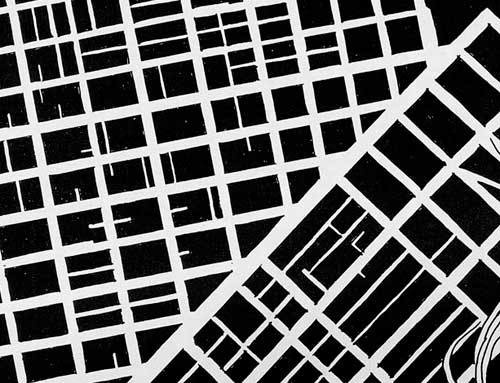
San Francisco has a typical American street grid, though not quite properly oriented north-south as you would expect. But then a diagonal street, Market, was tossed in with a completely different grid to the south (in SOMA). Besides creating a whole series of devilishly complicated intersections, this merging of grids does a couple interesting things.


This is a fun image. This shows Market separating the SOMA grid at the lower right from the Union Square/Financial District grid at the top left. You can use Maiden Lane and Commercial street to orient yourself if you know SF. Claude Place is missing along with my alley and at least one other mid-block street.

First, as Jane Jacobs pointed out, it creates perspectives ending in architecture on almost every street downtown -- at least when looking in one direction. The lack of streets that seem to run on forever is a key factor in making SF look compact and "different" for an American city.

The second, and I'm sure unintended, consequence of the  grid collision, is that it's hard to anticipate where something in the other grid is going to appear from the perspective of the grid you are in. And that -- long lead in -- is what I want to talk about.

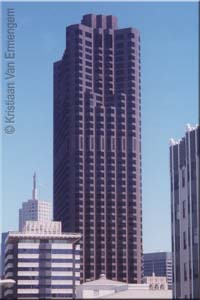
The new Salesforce Tower is rising over where the old Transbay Terminal was, and when completed will be the tallest building in SF. Most of the tall buildings in town lie between there and where I live, so I assumed it would not affect the skyline for me. Wrong, as it turns out.

Recently it has reached a height where I can see it, still rising, in a gap between two nearer towers as I walk on Bush street just below where I live. (Where I took those "French" photographs.) A block above (literally) on Pine, the skyline is dominated by what was the BofA Building -- a massive, dark presence only a few blocks from me. 


But down on Bush you can hardly (if at all? You can see it from one sidewalk but not from the other.) see that structure due to the hill and other buildings, and now Salesforce is getting ready to take it's place as orientation point for SOMA and downtown. 

And I'm serious about the "orientation" aspect. Once it gets its decorative tower cap it will become a visual guide to where the Transbay Transit Center and that whole "new" area of town is and, consequently, where you are in relation to it. It will serve to end, at least in part, the disorientation of the grids. At least I think it will. There's a tiny chance that what I'm seeing is a lesser building also going up in the same area. If it is that building instead (which I really doubt) then Salesforce Tower is blocked and the effect I want wont come to fruition. Time will tell.

Belle Ruin

Yes, I'm still reading this as slowly as I can. Getting close to the end now and there's only one more book. 

Martha Grimes published Double Double: A Dual Memoir of Alcoholism which I have not read. I'm interested, but I have the feeling I have everything I need to understand her in the Emma Graham novels. I don't really want to know if she is less like Emma than I think. But what got me thinking about this was a passage in Belle Ruin with a bit more detail than usual about Emma's mother.

While every cab driver and diner patron in this fictional world develops more and more of a character, Emma's mother does not. She stays a mystery outside of her cooking. As readers, we have to encourage Emma's independence and isolation -- we don't want her mother suddenly acting parental -- but it is odd and totally unexplained. She's like a cloaked character at the center of the book. In a sense everything revolves around her either as cook or mother or hotel co-owner, yet we can hardly see her. We know more about the cat.

I'm guessing if I read Double Double I would probably get some insight into this, but do I want to know too much? Now I'm sounding like Emma, with her round-about method of gaining information and not asking questions of the most obvious people.


Next - 32. Mann + retrofit

Saturday, July 23, 2016

1. In which we begin


Link to Table of Contents


New blog

I've published three previous "blogs" but I've always cheated before. These were projects I created and edited over time and then finally published in blog format. This time I want to do something in real time. I may come back later and edit, but I will publish whatever I think of writing on a given day. Spontaneity will be my watchword. (That may be a better name for the blog.) (Reading this years later I'm sorry to say that not only did this "real time" aspect not happen, but I had even forgotten that was the plan. Maybe I will try getting back to this.)

I'm sure I will also alter the format as I proceed.


Starting...

You'd think this would be the place for me to describe what all is on my mind at the moment, but I'm here in part to escape all that, so, no.  I will say that it's a lovely summer in San Francisco -- which means it's been cold to sort-of-warm with our usual mid-day sun book-ended by fog blowing off the Pacific. Yesterday the marine layer was particularly low and dense and when I walked out into our alley, just after 7am, the air smelled of the beach. Quite wonderful. 

I used to think that maybe someday I would move to Seattle or Portland for the even cooler and rainier weather, but whenever I'm up there it is sunny and hot; so now I think of moving out to the west edge of SF bordering the beach. The Outside Lands are like a different city, and it takes forever to get out there by bus or light rail. It still has a beach town vibe -- though one wonders how long that can last the way SF is getting built up.


Martha Grimes & Emma Graham (hint: like Superman & Clark Kent)


I'm also near the end of one of my favorite books, Cold Flat Junction by Martha Grimes. I think this is my third reading. At this point I'm only allowing myself to read one short chapter at a time, so as to draw out the time I have before the book ends. There are two sequels to this, the second book in the series, but I think this is the best of the four so I'm savoring it. 

If I was teaching creative writing, I would assign The Elegance of the Hedgehog by Muriel Barbery to teach the concepts of foreshadowing and misdirection. Then I would forbid my students to read Martha Grimes' Emma Graham novels because they so spectacularly violate all the rules of novelistic conservation. (There's probably a good technical term for this, but I can't be bothered to look it up because I'm just so spontaneous.) What I mean are the conventions in novels -- and even more so on screen -- that if you introduce something (a gun, say) you have to use it, and if you introduce a character -- give that character a name and a personality -- they have to play a role in the plot of the story. 


It's like Martha Grimes' books are haunted by characters that sprang up almost against the author's wishes and who then not only refuse to leave but demand additional scenes. My fallback position, since I couldn't really forbid the reading of these novels, would be to use her as an example for characterization. Delbert, the taxi driver, is my favorite example of this. I was surprised to discover this reading of Hotel Paradise, the first novel in this series, that Delbert didn't yet have a personality in the first book. His only role is to transport Emma from place to place in the interest of her investigations, so there's no reason he should have a personality. But, slowly, he has gained one. It seems that with every ride we see him a little more clearly and I know by the end he will be one of my favorite, mostly irritating to Emma, characters while serving no purpose at all (aside from his driving) in furthering the plot.


Really starting...

Well this is not auspicious. I've been so involved in the real world problems I'm trying to avoid, that it's now been a week since I wrote the above. I completed Cold Flat Junction and immediately moved on to Belle Ruin -- for me the equivalent of lighting the next cigarette with the dying embers of the prior one.

But this time I'm really going to do it.


Presidential election


I'm not looking forward to the next three months -- and I'm not referring to the problems facing my HomeOwners Association, but rather the Presidential election. I avoided almost all the coverage of the Republican convention besides what flashed at me on The Onion, YouTube, and Facebook. So far the begging for Democratic contributions is annoying me as much as the Republican oratorical idiocy. 

It's beginning to look like America may need to consider something more like a city manager/mayor form of government. We may need a high visibility office for everyone to see while the actual work of government is done by a more professional federal manager. Mind you, I don't think this is actually possible, I'm just saying it would make sense. This is also a way of saying that we need a legal guardian since we seem no longer capable of making important decisions for ourselves. Historically, this is interesting -- though painful to observe.


To cope with my HOA problems I really ought to be drinking more or abusing drugs -- like a normal person. But that doesn't work very well for me (so far) so I seem to be eating out more instead. Partly this is because there has been an amazing racket coming up from directly below my unit the past several weeks, as concrete and dirt and old walls were removed and then replaced with new ones after studs and joists and posts and beams were all fastened together in a truly impressive way. The racket should be coming to an end next week. 


Unfortunately, three of my neighborhood hangouts -- where I would normally be hanging out more -- are owned by the unit owner I'm attempting to force to vacate his unit so we can complete our seismic work. Normally I never see him, but the day after I sent out an assertive email he walked into the pizzeria where i was eating. Awkward. Since then I've avoided his establishments. 


I'm doing a really bad job of avoiding this topic, aren't I? 


Berkeley Kite Festival


Next weekend is the Berekely Kite Festival, one of my favorite events. Work-wise it's problematic: The event is stretched over a large area (on top of an old landfill on the edge of the Bay) and Berkeley city crews pick up the bags of trash we collect and don't much care where they go. We have to fight to get our sorted compost in the dedicated compost truck. This is even more of a problem at the end of the day as they make their final pass through the event with the trucks picking up all the remaining bags. 

But, the kites are spectacular in the (usually momentarily) blue sky mid-day, with SF and the Bay to the west and the Berkeley Hills rising to the east. As with Berkeley 4th of July (on the other, south, side of the Marina) it isn't easy to get in and out of this event, you end up walking a long way, but it's worth the trouble. The International Dragon Boat Races on Treasure Island is even better (and easier to access), but that's still two months in the future.


Apple Stores


We're still years from the opening of our new (Central) subway, which runs almost underneath my building, but the new Apple Store opened some weeks ago now. 


I much prefer the look of the store in Portland, 


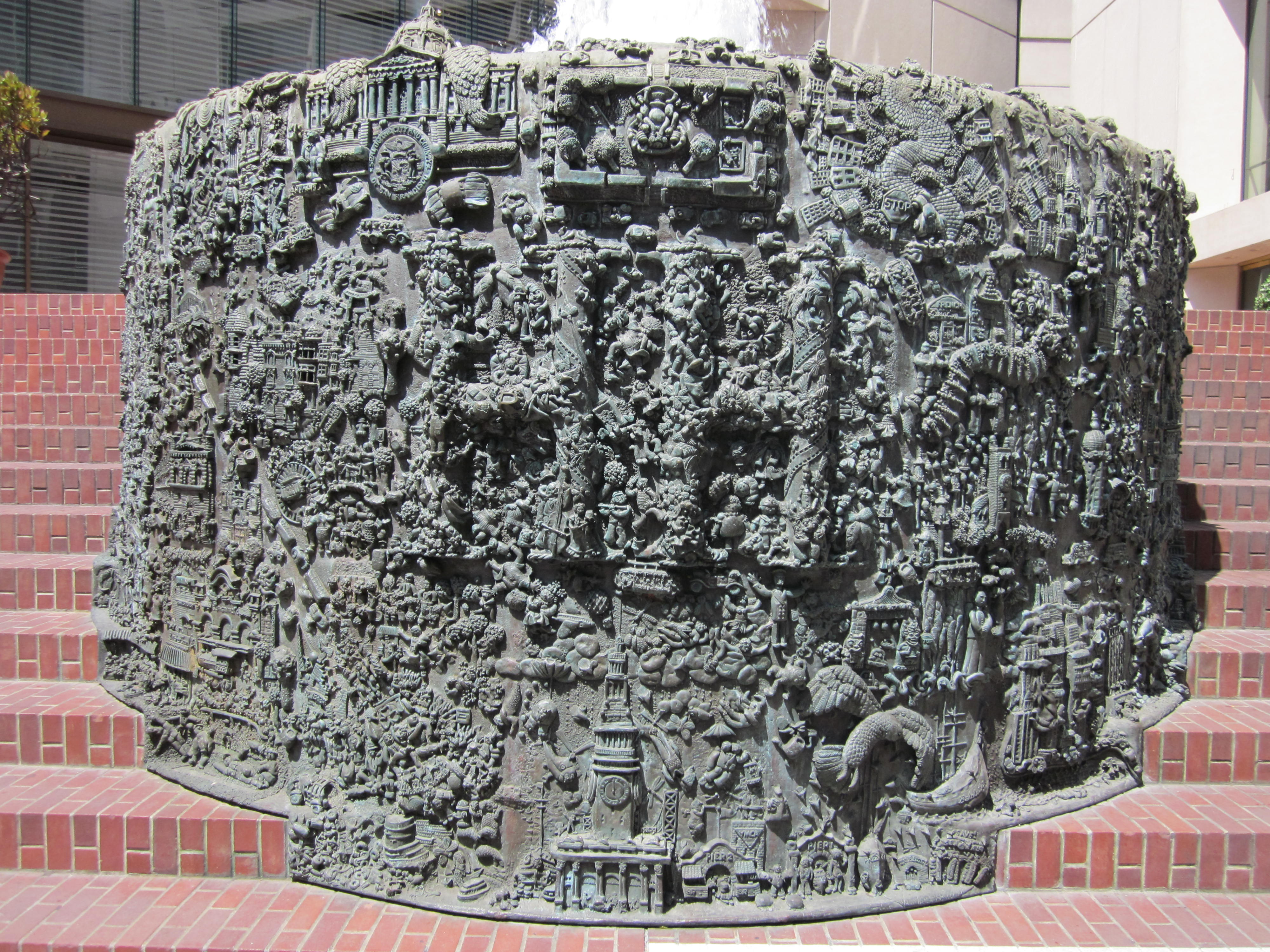
but this location (by Foster + Partners) features massive, multi-story, sliding glass doors that open the store to both the sidewalk and Union Square to the south, and a courtyard, featuring a Ruth Osawa fountain I'm very fond of, on the north. 


I have no reason to be in the store (my only Apple product is my original iPod Nano with a battery so dead I have to leave it plugged in all the time) but I did stroll through once just to see what it was like. 

Every time I pass it's packed with people -- doing what I'm not sure. I wish Google would take over their old store location, down Stockton at Ellis, for Chromebooks. I wouldn't mind having access to a Genius Bar for Chrome and Chromebook questions. Not that I have that many at the moment.


...Now

Next - 2. Change