Showing posts with label San Francisco summer. Show all posts

Wednesday, September 5, 2018

298. Greening plus Digital photography.


I've been distracted of late and these notes have been sitting on my computer waiting for me to move them here. Now is that time.

Greening Moto Bay

It occurred to me last night, as I pulled load after load of heavy trash bags and our eco-stations’s wood stakes and collapsed boxes from the bay end of the huge pier 30,32 complex to our trucks near the Embarcadero, that I have been failing spectacularly this year in my scheme to work the middle of events, and not the start or end.

The good reasons for this scheme is that it would make best use of my roving-sorting-and-pulling skills. The real reason is that the starts are boring and annoying, and the ends are such hard work. Some events are too short to have a separate “middle” shift. Sometimes there are middle shifts, but not for my pay grade. And I’m in a bind here in that I do want to be around for the final station sort, especially when there’s a major food vendor component. That’s where my roving sorting skills really do pay off, as they prevent unsorted vendor bags from being hauled back to our dumpsters or trucks. 

But yesterday’s event, Moto Bay, had very little food so my skills were largely wasted. This was our first time with this event, so we didn’t know exactly what to expect. This, I suspect, was also why our "A" crew was working it. And the setting was lovely. These piers are just south of the Bay Bridge with a great view of the new SOMA downtown, the Giant’s stadium, and what there is to see of the developing Mission Bay neighborhood modestly rising to the south. And as we were closing down around 10pm, the fog was rolling in dramatically.

Still, after the third heavy toter load from the far end of the pier, I was ready to hand this job over to our younger workers. I did manage to get away before 11pm, fifteen minutes early. 


In praise of Today

And by “Today” I mean all the newfangled things that people so often like to nit pick, and in particular my little Samsung digital camera. I tend to buy the low-end of high-tech gadgets, since I tend to not really use them that much. This camera is a perfect example of this tendency. It was the cheapest option that seemed to do the things I needed for a particular project (no idea what it was, as this was years ago). And then it mostly set in a drawer for years as I’d gotten out of the habit of photography. 

But photographs turn out to be a wonderful way of documenting things around my building, so I started taking pictures again for HOA purposes. And then for myself. I never bothered to really learn the ins and outs of this camera -- and Samsung doesn’t exactly make it easy to figure out. I only recently turned my flash back on and was shocked by how much improved the indoor photos were. I only shoot in low resolution mode since I only display my photos on the computer, and am more interested in simple documentation than in resolution -- but I can shoot fairly high res if I wanted to.

So, while taking some vastly improved flash shots of our laundry room today -- people (not including myself) are keen on having it painted -- it occurred to me that this is, almost beyond doubt, the best camera I’ve ever owned. The 10x optical zoom is better than anything I ever had for my 35mm cameras. I can do macro photography much easier than with my 35mm cameras. This camera only has a display screen on the back so framing a shot is similar to a view camera -- which I’ve always preferred. And it goes without saying that the ability to view and delete shots you’ve just taken makes life so much easier than with a film camera. Likewise, the free editing options of Google Photo are superior to anything I could have done in the darkroom in the past. It’s possible I can’t play some of the depth-of-field games I used to play with my film cameras, but I don’t actually know that for a fact -- since I’ve never tried/studied the documentation that carefully. 

All I have to do to seal this matter, is think how much easier it would have been to photograph weddings with cameras like this. And beyond “easier” it would have been low stress as the nightmare all wedding photographers of the past lived with was the possibility of failing to properly load the film so that the film wasn’t actually advancing in the camera as you worked -- so that at the end of the day you had nothing on film. And yes, this happens. Not to me for a wedding, but it did happen to me at least twice on other “once in a lifetime” photo opportunities. 

And I haven’t even mentioned that this camera is small enough to carry in my pants pocket, and I now usually carry a little USB cord with it in my backpack to I can upload to my computer, edit, and send out links from anywhere. (Sending out the links does require WiFi access.)


Tea and fitness

This morning I had a terrible time getting out of bed and off to the gym. It was a cold Sunday morning and my bed had never felt so warm and comfortable. When I finally arrived at the gym I noticed that it was exactly 10am and the outside temp was 56F. Old people seem to be always cold, something I’m rather looking forward to, as I tend to get overheated, but I have yet to detect any indication that this is happening to me. My threshold for feeling cold remains 60F. How much is this tendency to feel cold simply the consequence of taking blood thinning medications, I wonder.

I’m at my new favorite Peet’s -- deep in SOMA -- but I think this may be the last time. My bus luck getting here couldn’t have been worse, and then I arrived to find it packed. I’m sitting on a stool again.


Wednesday, November 1, 2017

218. Consciousness of God is self-consciousness


90 degrees F in Berkeley

I had not planned to come to Berkeley today. It was supposed to get up into the mid 80s so I decided to take the bus to Emeryville where I could hang out in the air conditioned Barnes & Noble Bookstore, viewing design porn, while eating snacks and using their WiFi. It was such a simple plan.

It only took an hour or so to get through what design magazines they had -- nothing I was tempted to buy -- so I got out my list of books to read and started looking for something to buy. Boy did I strike out. The clerk, who was actually helping me, happened to mention that I was more likely to find these titles at Moe's (in Berkeley). 

And I thought, "well, of course." And then I thought, "And I could have lunch at The Butcher's Son!" (that wonderful vegan deli on University.) By chance, the bus that brought me to Emeryville also goes to central Berkeley, so I got back on. Lunch was fantastic.

Moe's was a mixed bag. I did find The Tale of Genji -- or at least a truncated version of the original. I'll see how I like it. But I struck out on all the other books on my short list: Experiences In Translation by Ecco, Reflections On Violence by Sorel, and The Life of the Mind by Arendt. While looking for those I did recall another title I had been looking for, and actually found The Essence of Christianity by Feuerbach. 

Then I walked over to Caffe Strada (I'm surprised it's still here, just off campus) where I'm sitting in the shade drinking iced tea and sampling my new books. The Feuerbach is almost Scholastic in its dullness. (And, yes, this is the George Elliot translation.) The Tale of Genji looks more interesting. 


The Essence of Christianity

by Ludwig Feuerbach - Prometheus Books, 1841

The first eleven pages seem to me unreadable. I almost wonder if this isn't intentional, to drive away any but the most determined reader. Or, as in my case, someone willing to skim and skip ahead. 


The Essence of Religion Considered Generally
p12 ... In the perceptions of the senses consciousness of the object is distinguishable from consciousness of self; but in religion, consciousness of the object and self-consciousness coincide. The object of the senses is out of man, the religious object is within him, and therefore as little forsakes him as his self-consciousness or his conscience; it is the intimate, the closest object. "God," says Augustine, for example, "is nearer, more related to us, and therefore more easily known by us, than sensible, corporeal things." The object of the senses is in itself indifferent -- independent of the dispositions or of the judgement; but the object of religion is a selected object" the most excellent, the first, the supreme being: it essentially presupposes a critical judgement, a discrimination between the divine and the non-divine, between that which is worthy of adoration and that which is not worthy. And here may be applied, without any limitation, the proposition: the object of any subject is nothing else than the subject's own nature taken objectively. Such as are a man's thoughts and dispositions, such is his God: so much worth as a man has, so much and no more has his God. Consciousness of God is self-consciousness, knowledge of God is self-knowledge. By his God thou knowest the man, and by the man his God; The two are identical. Whatever is God to man, that is his heart and soul; and conversely, God is the manifested inward nature, the expressed self of a man -- religion the solemn unveiling of a man's hidden treasures, the revelation of his intimate thoughts, the open confession of his love-secrets.

Wow! And this was published in 1841. Forty years before The Brothers Karamazov

It would be interesting to read this passage to a person of faith while they were in an fMRI machine to see how their brain would light up like a pinball machine. The confirming circuits ("my religion expresses my inner being") alternating with the conflicting circuits ("my religion has no basis outside my self"). The most devout (and particular) Protestants are no different from football fans devoted to their home club. Though perhaps a club of people suffering from Celiac Disease might be a better metaphor, since football clubs exist independently of their fans. Celiac Disease (and any support groups) exist only if there are people with the required internal deficiencies. 

Which is why I'm cautious of blaming cults for the beliefs of their adherents, as the cult only exists because the adherents hold those beliefs. Obviously there are exceptions.

My edition of this books runs to 339 pages, with Appendices, and yet I'm not sure I really need to read any more. I'll at least give Feuerbach and Eliot the credit of skimming ahead, but this was what I was looking for.


I'm really not finding much else (through p35) I need to quote except for one tiny thing I couldn't over look,

p34 ...The understanding shows us the faults and weaknesses even of our beloved ones; it shows us even our own. It is for this reason that it so often throws us into painful collision with ourselves, with our own hearts. We do not like to give reason the upper hand: we are too tender to ourselves to carry out the true, but hard, relentless verdict of the understanding. The understanding is the power which has relation to species: the heart represents particular circumstances, individuals, -- the understanding, general circumstances, universals; it is the superhuman, ie., the impersonal power in man. Only by and in the understanding has man the power of abstraction from himself, from his subjective being, of exalting himself to general ideas and relations, of distinguishing the object from the impressions which it produces on his feelings, of regarding it in and by itself without reference to human personality. Philosophy, mathematics, astronomy, physics, in short, science in general is the practical proof, because it is the product of this truly infinite and divine activity. Religious anthropomorphisms, therefore, are in contradiction with the understanding; it repudiates their application to God; it denies them. But this God, free from anthropomorphisms, impartial, passionless, is nothing else than the nature of the understanding itself regarded as objective.

Thanks to our new friend the Internet, I was able to quickly look up the German text for this passage and, yes, I find:

...er ist die übermenschliche, das heißt: die über– und unpersönliche Kraft oder Wesenheit im Menschen...

So Nietzsche may have popularized the concept of the Übermensch, but it looks like it originated with Feuerbach.

p35 God as God, that is, as a being not finite, not human, not materially conditioned, not phenomenal, is only an object of thought... To the imagination, the reason is the revelation of God; but to the reason, God is the revelation of the reason; since what reason is, what it can do, is first made objective in God...

After this, the book goes into some minutia of Christianity that I'm not that interested in. I'm sure there are things here worth reading, but I'm going to pass. This brings to a close my reading of Ludwig Feuerbach. I am happy I thought to look for this at Moe's.


Monday, September 11, 2017

199. Opera In the Park


Opera In the Park

I think we can all agree that the only reasonable conclusion is that the people managing this event read my last blog post and were offended by "Caterwauling in Sharon Meadow." I don't know why. Here's what happened.

It was yet another of our freakish, one day, Sunday heatwaves. Not a cloud in the sky and the SF official high temperature was over 90F. I took some photos of Sharon Meadow when I arrived at Noon, with the expectation of taking another set later in the day when the crowd had filled in, instead, the crowd was sensible enough to hide in the trees bordering the meadow all day. It was actually kind of amusing: Were they driven into the trees by the caterwauling, or were they ashamed to be seen at an opera event?


View from the cool of the trees with stage on the left and part of Hippie Hill on the right. The bike storage area in foreground.

My plan had been to take my lunch break right after the intermission, and then be ready to man an eco-station before the music came to an end. (Recall how I cleverly read the situation last time and was in the right place at the critical time?) Unfortunately, it took me longer to sort and clean out the big eco-station that was in the crowd during the break, and then to work my way through my area getting all the other stations in order before I took my lunch break. By the time I made it to our HQ (behind the dumpsters, as usual) it was after 3:30 and the concert was scheduled to terminate at 4pm. I was only half way through my sandwich when they wrapped up with some stirring tune or other and the crowd started streaming out. And at least half our crew had followed me to lunch.

I aborted my lunch and fought my way through the departing salmon to the eco-station that traditionally gets hit hardest. Because it was a double station, and I had just cleaned it out on my way to lunch, I was able to keep it functioning -- though the wine bottle filled recycling bags got too full to pull easily.

The good side of this being a too calm, 90F day, was that the wind didn't blow all the trash around at the end of the day. 

Book Club

We met today to discuss The Light of the World. I really did like the book, and it's something I can recommend to more people than usual -- though probably not to the person I know who's situation is most like the author's, as I have no idea if this would be helpful or not -- but I ended up with a record low quantity of notes for discussion. There was nothing about the book that I would have changed. There were a couple things I wished I could ask Ficre, and I'm still curious about that poem by Lucille Clifton, but otherwise there's not much to say.

Or there is, but I'm not comfortable bringing it up with people who are in married relationships. Is it better or worse to find your soul mate if you're then going to lose that person? The odds of finding that person are always slight, but Ficre and Elizabeth seemed to know almost immediately what they had and never grew out of it. Or to put it in the terms of Le Petit Prince, is it worth it to learn to be tamed if you're going to be left on your own later? 

I don't think Alexander would choose to have acted differently, but there is no equivalent for the survivor to what Clifton wrote in her poem about the person dying, 

"...there was all around not the
shapes of things
but oh, at last, the things
themselves."

And even that boon is imaginary. A wished for eschatology. Another story we tell ourselves so that we feel better about what we don't understand and never will.

Thunderstorm!

Not much rain, but we are getting some lightning and thunder. This hardly ever happens here so is always exciting... until the power goes off. Doesn't happen every year, but when it does it is around now, as it's a function of hurricane season. The best year for thunderstorms, since I've lived here, was 1999, the summer after my dad died. One night the show seemed to go on for hours.

Tuesday, September 5, 2017

197. The dying of the light of the world


House

Now I'm watching the second season of House (they didn't have season one), but what I want to talk about is opening credits. The NCIS credits are fine, but nothing special. Castle credits have better music and a more artistic visual presentation -- I'm sure a lot of thought and talent went into creating them. But the opening credits for House are perfection.

The music is a sample from a Massive Attack song that I like better than the song. The visuals are so simple and elegant, just a few well chosen still frames. It looks like a really talented person threw it together over a couple hours, instead of being the work of a committee that went through a dozen iterations. (I stress "looks like" here.)

With the other shows, I would click through to where the show resumed, after watching all the way through once, but I've yet to do that with House. I watch the credits all the way through they are so well done.


Weather

It was still over 80 F when I went to bed last night, so I ran my ceiling fan all night. But this morning there are clouds in the sky and it's cooler. 

Now, a day later, it's even cooler, but still not normal. Our marine layer is due to return tomorrow. This has made for a distinctive Labor Day weekend, so unlike the rest of the summer. Makes for an odd sort of staycation where home (SF) has felt like someplace else, and routines have been broken because of the heat. There were a few occasions when I sought out places with air conditioning, but more often I've found places where I could be exposed to the non-icy air -- especially late afternoon, early evening. My windows at home have been open for days on end -- almost unprecedented, at least for this year.


Nob Hill

Speaking of home: Last week someone in my San Francisco History group on Facebook posted a photo of Nob Hill -- a block away from my building -- from the 19th century. It drove me nuts. I knew there was something wrong with it but it took me way too long to realized that it was flipped horizontally.

I wonder if the ability to flip an image in your mind, and make sense of it, is related to the ability to read upside down? I wonder if Temple Grandin could have flipped it instantly and "seen" rather than slowly deducted the way it should have appeared. 

In my defense, all the buildings are different now and I only had the slopes and cable car tracks to work with, but those are pretty clear clues. And I now know that the site that is due to be turned into a new condo project, has been extensively excavated -- but that is true for most of this part of Nob Hill. Another photo from that group showed the hill before it was excavated for the Flood Mansion and Fairmont Hotel. I'm still looking for a good view of the area around Pine and Mason, but none of the Nabobs built mansions there, so it doesn't usually appear in photos. I'm pretty sure Pine street would have been entirely inside the hill originally. I would love to know how thick the walls and ceiling of the tunnel would have been.


The Light of the World

Finished. I slowed down at the end because I didn't want it to end. While it's Elizabeth Alexander's book, it is mostly about Ficre Ghebreyesus. I'm pretty sure, had I ever met him, we would have talked each other's ears off, we are both interested in so many things. But what makes the story even more interesting is the ways we are unlike.

He was far more social than I am, so much the family man both in the nuclear and the extended and virtual sense. I envy that aspect of his life, in the same way I envy the exciting sex lives of the famous and beautiful -- without particularly wanting to join in (seems like an awful lot of work. I'm just lazy.)

What I would like to talk to Ficre about is colonialism. For him, Italian culture seems to have been almost as important as his highland, Eritrean culture. This is something I'm not likely to get through Elizabeth, as her version would be filtered through her African American perspective. 

But her writing is lovely and I hope to read more of her poetry -- though poetry isn't usually my thing. I will be re-reading as much as I can in the next five days. And on the sixth day I'll be working Opera In the Park, or "Caterwauling in Sharon Meadow," as I tend to think of it. 


House, take two

What I wrote above about the opening credits was entirely from memory, and was nearly entirely wrong. There are a couple short video clips in the sequence. The "stills" are really animations, though sometimes involving still images. In other words there was a great deal more work here than I was thinking. Still very well done but not something even a genius could do in a couple hours.


Saturday, September 2, 2017

196. Days of ozone


Today was our second straight hot day. After only having a couple single days where the temperature reached into the 80s F, it has now blasted past the 90s into the 100s. Yesterday it was 106 -- the highest recorded temperature in the city's history, and today it was 102. I would have guessed it was in the 90s. 

The air quality is bad enough that I finally opened a bottle of artificial tears I've been holding on to for a couple months. The heat is supposed to break tomorrow.


The Light of the World by Elizabeth Alexander

p94 What a joyous memoir. The book is sad but also such a delight to read. The author, a poet, includes a poem by another poet about the death of her husband, in the voice of the dying husband, which closes with these lines,

...and I saw with the most amazing
clarity
so that I had not eyes but
sight,
and, rising and turning,
through my skin,
there was all around not the
shapes of things
but oh, at last, the things
themselves.

From "the death of fred clifton" by Lucille Clifton

Since I don't read German I can't tell how close Kant may have gotten to expressing this in such lovely and evocative language. But I would be very surprised. Perhaps poets should be assigned to philosophers the way the blind get guide dogs. 

Alexander elaborates about the poem,

...as Fred Clifton moves closer to true knowing, as he sees with "the most amazing/clarity." Death itself is like a snake shedding its skin. Fred Clifton describes "rising and turning/through [his] skin." A new self reveals itself when the old carapace has shed and died, as though we live in exoskeletons with something truer underneath.

Death comes with a gift in the poem; our loved ones tell us here that what we see with our eyes is different from what we know: "The things/themselves." "Oh, at last" is the moment of exaltation in the poem. Lamentation and exaltation are simultaneous here.


This is my 50% expectation that death is like waking up.


Postscript to South of the Slot

All the metrics for success are now middle class ones. If you aren't doing well enough in terms of income and home ownership to meet that standard you are defined as a failure. 

The urban renewal movement following WW2 (personified by Robert Moses in NY and Justin Herman here) set out to eliminate all pockets of non-middle class culture. Here, in the Western Addition, this took on a racial appearance as the neighborhood had become black during the war, after the Japanese were interned. But South of the Slot, the distinction was not racial but class. And the gentrification of that area is now being followed by the gentrification of the few remaining lower class neighborhoods on the southeast side of town, under cover of improving the housing stock and transportation options.

From what little I've read, this class extermination was even more obvious in the UK. "Progress" was defined so that it naturally required the elimination of an entire way of life.

Swimming In Creepy Waters

Another book title. (Suggested by K.)
I have no idea what this would be, perhaps the story of someone working in government during the Trump administration? Or the inside story of the Summer Olympics in Rio? 

Next time, "Semiotics for Dummies." (Also suggested by K.)

Thursday, August 31, 2017

195. Summer to end of summer


Not exactly the Rocky training montage

At the gym yesterday I was thinking that we're down to the last month and a half of Greening season -- only a month until International Dragon Boat Races, which is my warm up for Hardly Strictly Bluegrass. The good news is that I'm on the mend. My mysterious ulnar nerve problem seems to be resolving itself, and the rest has helped my wrist. My back is slowly improving. I will not be back to full strength by the first week of October, but I should be fully functional. Given the year I've been having, that's a win. At this point I'll be happy if I end the season with all my limbs connected and my faculties intact.

I would love to start a more intensive training period for September -- I'm not happy about the strength I've lost since I've been nursing my back and nerve -- but that would be risky at this critical time. Better to take it slow now and possibly crank it up a bit after HSB.

Summertime

Today the inland (hotter) areas of the Bay Area are supposed to hit the mid-100s F; tomorrow the mid-110s -- Phoenix heat. Meanwhile I'm still sleeping under double comforters. Aside from a number of Sundays (always Sundays, so far) when the SF temp has slipped into the 80s, it has been consistently cold this summer. That will probably change soon, maybe as soon as tomorrow, but SF has been almost too cold for me this year. (Let's see what I have to say at the end of October.)

TV

I've been catching up with my TV the last several weeks. I bought (and then resold) seasons 12 and 13 of "NCIS," so I'm only two seasons behind now. The show (the show runner, I'm guessing) is very good at using its bully pulpit. At least a couple times a season they highlight some good cause related to Navy and Marine service people or veterans. Not only is it a good thing to do, but the show's audience is not going to complain, even if it does take time away from the "entertainment." It's a win-win, but you probably still have to have a show this successful to get away with it.

This week I'm wrapping up "Castle," the 8th and final season. The show has a lot going for it, but I think it's been limping along ever since Castle and Beckett got together. (I wonder if part of NCIS's success is how Gibbs has never really changed?)

The writing this season has been sloppy. There have been two episodes inspired in part or in whole by psychology experiments (including the Stanford prison experiment) but one of them makes no sense by the end of the episode when you finally know all. Aside from my trick of picking the villain by the casting, I'm usually not that concerned with figuring out Who Done It, but if you had been attempting that with the experiment episode you would have been mislead and confused.

Still, when they just let Castle be Castle, the show is as good as ever. 

Hobart Building

Something has bugged me ever since I moved to SF...


See that blank wall in the center of the photo? That's the side of the, otherwise attractive, Hobart building, that was never intended to be seen. 


Some closer views of the tower.


Before the International Style hit SF, the intersection where Montgomery ("The Wall Street of the West") hits Market was a place of beauty. 

All that remains of these three buildings is the base of the one in the middle.

First Wells Fargo took down the building next to the Hobart and replaced it with a much smaller building next to their new tower (briefly the tallest in town). 


Then Crocker Bank sacrificed the top of the building across Montgomery so they could build their own office tower at the other end of the block. 


New Crocker tower at left with Galleria in between.

Combined, these changes meant that the blank side of the Hobart was revealed and that it was also visible for blocks.

There is now a plan to rebuild atop the base of the old Crocker building -- now a Wells Fargo, housing my safe deposit box -- and this may (or may not) help by blocking the view a bit. But, short of building something more fitting abutting the Hobart, I think something could be done with that blank wall. Something matching the granularity of the Hobart tower. Maybe. Anyway, some kind of mural.

Later that same day...

Just went out for a late lunch and to take some of the photos of the Hobart building above. Stepping out of the air conditioned Bank Cafe, I got a nose full of ozone. It's already warmer -- though not at all hot -- but the change in the air chemistry tells me that the wind has shifted and we are now swimming in air from the east and north rather than the usual air off the Pacific. Besides given me a Proustian flash of past time (the San Fernando Valley in the 1960s), this means we might indeed hit the 90s in the next several days. The horror! It will be a novelty to no longer sleep under blankets until the fog returns. And speaking of weather...

Hurricane Harvey

I've gotten sucked into a Facebook discussion of Harvey (the storm, not the rabbit) and to what extent this is a sign of climate change. (Now, I'm wishing that giant imaginary rabbits might become a sign of climate change.)

Of all the obvious indications and consequences of man-made climate change, I think this is one of the worst examples to point to. Hurricanes are just too unpredictable and it would not be unrealistic for someone to point to the 1900 storm that devastated Galveston as an example of previous storms that were on the same scale. And I continue to hold my position until someone can craft a convincing argument that the other weather pattern that boxed in Harvey, and sent it meandering around Houston and then back into the Gulf, was a consequence of higher air or water temperatures. That other weather pattern is what seems to set this incident in a new category.

But someone posted a link to a counter position HERE that I think is very interesting, without changing my view. Actually I'm kind of shocked I didn't make this connection to the Houston/Beaumont area as the Mecca of the petroleum economy/society. And he doesn't even mention Spindletop, which I would have done. It really is almost too perfect.

We humans are not very good at reason, but a storm is a kind of logic even a fool understands. Some percentage of the people flooded out this time will come to the conclusion that living on this coast is not worth it. (There are supposedly about 100,000 Katrina evacuees still in the Houston area. I would love to know what kind of decisions they make now.) Even the people who decide to stay this time will be less likely to stay next time, especially as funding for repeated inundations is reduced. And companies -- even energy companies -- may be less sentimental in their decisions than the average person. 

How many more storms will it take to convince a significant percentage of the population? I don't know. And how to make the transition from making better decisions about residence placement to making lifestyle changes that reduce the likelihood for even more destruction in the future? I have no idea. I still think that's more likely to be driven by economic factors relating to electric vehicles becoming cheaper than gas powered vehicles. We are much better at making that kind of comparative decision. (Though that's the sort of decision process that led to the off-shoring of so many jobs and the Wallmart-ization, and now the Amazon-ization of the retail economy.) 

And I fully expect a large percentage of the people who flee to higher ground will continue to deny climate change. Because stupid monkeys.

Tuesday, August 1, 2017

180. Kite Festival 2017


Previous - 179. What's wrong with TRTC?


During my break I've been writing things that are more like normal blog posts but not posting them, thinking I would wait until I have material for daily posts for some time. But I'm now rethinking that.

I think I will try giving priority to the moment, and then fill in with other things when I need to. Of course now I need to catch up with some of the posts that were "of the moment" but no longer are. One good reason for this new, more spontaneous (less guarded and considered), approach is that it makes me uncomfortable. Chances are I'll get back into a book and revert to my old ways. But for now...


Summer

Northern California is having a bit of a heat wave at the moment which pulls in the fog making San Francisco a little colder than normal. This morning, before I got up, I was thinking that it is the end of July and I'm still under my winter comforter and wearing my winter pj bottoms (though not top, for a week or so). Even I look forward to those rare evenings when you can dine outside and not either freeze or get blown away by the wind. Those evenings will come in the next month or three, but this weather is the reason I would be reluctant to move away, even to Portland.


Organ recital

Also this week I've been thinking that, having turned 65 and become officially a "senior", it feels like my warranty has expired. My problems are all just continuations of things I've had to deal with for years (in several cases since high school), but they all decided to spike at the same time. The ulnar nerve thing is newish -- and it's one of those annoying health issues where it's hard to determine to what extent it's the nerve in the arm, hand, or the neck. 

My family (all my cousins, as near as I can tell) are blessed with the ability to generate lumps under the skin on a variety of parts of the body, the way oysters generate pearls. Three years ago I had one we were "keeping an eye on" suddenly go bad and get infected Thanksgiving week, when it was impossible to get an appointment with a doctor. To avoid that happening again, I decided to be proactive and have the latest -- in the same awkward location -- seen to yesterday. From past experience, I assumed Step One would be doing a biopsy followed by the minor surgery next week. If I had known she was just going to cut/push it out I would have waited until after this weekend, since I'm working Berkeley's Kite Festival on Sunday.

Both of my back issues should be much better by Sunday, and my ulnar doesn't bother me when I work -- same with my eye problem -- so none of this should really effect my life. 


Berkeley Kite Festival

And now we are really up-to-date. Yesterday was the Kite Festival and everything went just as I had hoped. No problem with my back, and the crew chief for both days was so happy to have me working on Sunday. I came up with a new way of interacting with the Berkeley garbage crew, who do the hauling, which I think we can copy in the future. We were even finished a little early, with everything sorted before the garbage trucks made their final pass. 

I have no idea why my back went "out-ish" last Tuesday, I wasn't doing anything, but as I did my usual thing Sunday -- including leaning down into containers to sort out trash and picking up and then dumping heavy cans of compost -- it struck me again how odd it is that this never bothers my back. There were a few cans I waited for help with this week that I would normally have attempted, but at the end of the day my back was fine. Maybe even better than when I started. I have my x-rays, so I know (approximately) what my vertebra looks like, but I don't understand why one thing trashes it while something else doesn't. I'm pretty sure if a back "expert" were to watch me work he would constantly be saying, "For God's sake don't do that." Yet, from the beginning it has always been something stupid like getting up out of a chair that causes me problems. Of course I do wear a lifting belt when I work -- against recommendations.

This park (Caesar Chavez) could have been created with kite flying in mind, and yesterday the weather and wind were just about perfect. We're not seeing the sun that much in SF, but the story is different even a few miles away across the bay.

The only drag was the new bus situation. Perhaps AC Transit got word of my proposed motto for Golden Gate Transit ("It's the Least that We Can Do") and wanted in on the action. Besides replacing the 51B with the 81 line, they've removed the two inbound stops that were convenient for me, so that I now have to walk all the way to the seawall -- as close to SF as you can get without getting wet -- before I can catch a bus home. I'm guessing AC Transit is trying to knock down the ridership numbers from the Marina even further so they can stop service entirely. That would probably be the end of my working events out there, so I hope I'm wrong. 

Whether through planning or just luck, I did have great connections home (after waiting a quarter hour for the driver to take his break). The bus took me to Ashby BART and I arrived on the platform a minute before the train I wanted arrived -- I was shocked as I normally have to wait 20 minutes for this train. And when I transferred to the SF bound train at the next station, that train was already waiting with doors open. 

Next - 181. Flower Piano

Monday, September 19, 2016

43. 94 F


Previous - 42. Apocalyse


Saturday

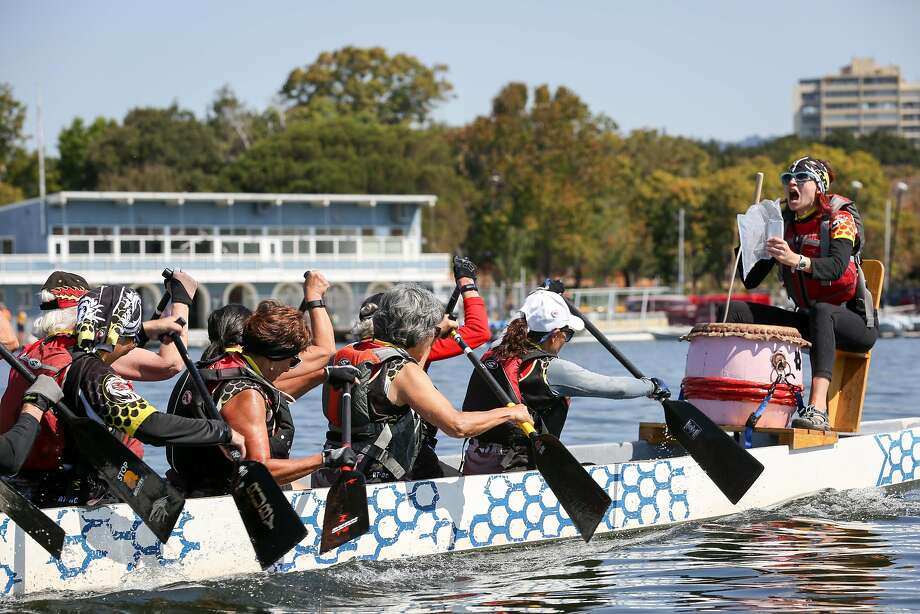
The first day of the Dragon Boat Races went pretty well. I was foolish to think it would be dramatically easier than in past years. Instead of the crews being in one paved area they were in two separate grassy areas divided by a road. One of the grassy areas had more trees than the other -- which would turn out to be important for the shade. But I'll get more into that when I talk about Sunday. Lake Merritt is a lovely place for boat races and this park is much nicer (and bigger) than I knew. Something else I've learned thanks to my Greening work. 

Cities and Burke & Jacobs

I was standing on the sidewalk in downtown Oakland -- in front of the new offices of the Oakland Tribune --- waiting for the shuttle to take me to the Dragon Boat Races, when I make a connection I don't recall ever making before. 


This is the old Oakland Tribune building.

Some of Oakland's finest surviving buildings were across the nearly dead street from me. Downtown Oakland, like many other traditional American downtowns, has never recovered from the economic devastation caused by the auto-age. These cities are like the failed states produced by the "Arab Spring" in that the consequences of making changes had dramatic unintended consequences. People, like Robert Moses or Le Corbusier or Mary Shelley's parents, think you can make extensive changes to complex systems -- even start over from scratch -- without considering Edmund Burke's conservatism and the need to make small changes while keeping an eye out for signs of system failure. 

Jane Jacobs was arguing for the same kind of conservatism for cities that Burke was for political states. Cities are actually trickier than states in that they are inherently dynamic and strict conservation -- preventing any change -- would be as bad as too much change. The same is true of nations of course, but cities need to change even faster if they are to thrive. 


Sunday

Day two of the Dragon Boat Races was an entirely different experience. For one thing, my sock/shoe insert strategy for working multiple days in a row failed miserably: It felt like I was getting a blister on the bottom of my left heel at the start of the day. (I have two weeks to work this out before the three days of HSB.) And then it was hotter than it had been on Saturday.

As I think I've said, San Francisco has not had a summer this year. We've had one day when it hit 80 F and for virtually all August it was below 70. On Saturday in Oakland -- always warmer than SF -- it was in the low 80s. When it felt hotter on Sunday I wrote it up to my working harder and the natural tendencies of San Franciscans to whine when it's over 80 or under 40. I worked to stay hydrated because I sweat profusely, but I didn't really think much about it aside from pausing, during a mid-afternoon hydration break, to realize I was really beat and still had four more hours (the hardest four hours) to go. Something about all this -- the heat and the park setting -- was reminding me of something but I couldn't put my finger on what it was.

My crew chief suggested I get a cold beverage at the volunteer food area and I enthusiastically took her up on this brilliant idea. (On Treasure Island the volunteer food/break area had been in a hot tent with views of nothing. Here it was on the second floor of the boat house with the best views of the event. There was even an outdoor, but under shade, terrace. It was really nice.) I grabbed my ice cold water and went to sit outside in the shade. 


This is a dragon boat on Lake Merritt but not from the festival. That is the boathouse in the background with the outdoor deck on the left. I was working in the trees to the left of what is shown here. Our dumpsters were awkwardly located near the building on the far right, which is much better than what was shown on the map we were given. Either my Chicken Little impression of the consequences of having the dumpsters so far away made them rethink their plans or the map was created by people not good with maps. I would lean toward the not-good-with-maps option.

As I said, I was working two crew areas (with bus traffic in between) and James had one of his people assigned to each area to keep things clean and to haul my sorted bags out to the road where they could be picked up (by James, usually). I had been wondering what had happened to the guy in one of these areas as my bags had started to pile up noticeably.  I found him listening to the Oakland Raiders football game up there in the shade. Smart... though not helpful. 

As a response to some boneheaded play by a Raider, he said something like, "That's the kind of thing you learn not to do in Pop Warner." And that's when the penny dropped and I realized what this day had been reminding me of. 

"Pop Warner" football is a program for pre-high school age kids. I played three years of Pop Warner football while living in the San Fernando Valley in the mid-1960s. The worst... worst part of the season was our training camp in mid-summer before the season really started. It was the equivalent of boot-camp but held in a lovely park in Encino. (This was the only occasion I had any reason to be in Encino, which was on the other end of the Valley. Why we trained there rather than at our usual facility in White Oak I don't know, but speculate it was so we didn't come to hate our regular practice field.) This was always at the hottest part of the summer with vile, mid-60's air quality. All I remember are hellish episodes of exercise and endless running with maybe a few blissful minutes collapsed in the shade under the trees.

Both Saturday and Sunday were "Spare the Air" days, and perhaps the program works because I didn't notice the smell of ozone, something I'm finely attuned to thanks to those years in the Valley. But the heat and lack of wind and the constant work (and sweating) were certainly reminiscent of those days almost 50 years ago. And then, when I got home, while drinking close to a liter of electrolyte water to keep the foot and leg cramps at bay, I learn that I hadn't been working in 80 degree heat but in an Oakland record (for the day) 94 F. That explains so much.

Our crew was one person short of what it should have been, and, because the worst trash doesn't come in until the vendors (and in this case the crew teams) breakdown at the end of the day (and the crews tend to party which delays things even more), I would have needed another half hour to get my sections shut down to my satisfaction. Some bags went directly into the landfill that I "could" have diverted. But for the most case, if I do say so myself, I totally rocked it, while also training one of James's people who sometimes also works for us. In part this went well because the crews didn't leave behind some of the most difficult trash I recall from previous DBRs, and in part because I was grabbing stuff from them throughout the day -- my plan for the year. 

In any event, when my shift was over I walked away (limped away, and I still had to walk quite a few blocks to catch a train home) not really caring about those final bags. I was at the open end of the landfill dumpster and was, I admit, tempted to look at the most recent bags to see if they were ones I had marked as sorted, but it was getting dark and I just wanted to go home, take a shower, and dig into that bottle of electrolyte water.

I almost forgot the highlight of the day. Cans and bottles of some beverages come in cardboard containers wrapped in plastic,


 The problem with this packaging for us is that the plastic goes in the landfill stream while the cardboard goes in either the recycling or compost. I've joked in the past that we should teach seminars in the occult science of removing the cardboard from the plastic (flattening cardboard boxes is the other skill vendors seem unaware of). Yesterday a high school aged rowing crew member came up to a station where I was working with one of these empty boxes and asked if it went in the recycling. I said yes, once you remove the plastic, which, and I give him credit here, he preceded to do. Only it was so pathetic. At one point I thought he was going to start crying. I even offered to finish it for him but he was determined. Though I did still have to flatten the cardboard.

I say it was the highlight of my day, because it made me laugh, but really it was sad. We are never going to win this battle to get people to properly sort their own trash.

And there was something else that made me laugh. The PA directed all the teams to their marshaling points by name. One crew was going by the team name "Boaty McBoatface."

Caption.


It's no secret I have an interest in military history and weapon systems. This leads to my viewing any number of YouTube videos and even commenting on them. Which then means I get a long stream of notifications of responses or other comments. Currently, we are more than a few days into a debate about the relative value of Sherman and Panther tanks during WW2. I'm using the popular names though most of the weirdos in these debates use the official designations -- though they may disagree even on that, and they aren't even as specific as I would like. It quickly gets very complicated. 

And the reason I'm bringing this up is because of an image I just saw of a B-24 bomber from the same period. You could argue (well, I could argue) that the B-24 and the M4, excuse me, Sherman tank have something in common. While no one would ever say they were the best bomber or tank of the period, they each played an essential role in wining the war. 

The B-24 is the ugly stablemate of the more beloved B-17. Most crews come to praise their aircraft, even if it wasn't what they would have chosen (I'm thinking of the P-47 here), but I don't recall hearing anyone say they loved the B-24. And yet it was, arguably, more important to winning the war than the B-17. It carried a heavier bomb load, but that isn't what made it so valuable in all theaters of the war. It was it's longer range that made it possible for the US and the UK to close the gap in the mid-Atlantic where German U-boats had previously been safe. And in the Pacific it could hit remote targets like Truk. 

It wasn't until almost the end of the war in Europe that the U.S. Army fielded a tank that was the equivalent (face to face) of the best German and Soviet Tanks, but the Sherman was operationally superior to everything else in almost every situation. You don't need to defeat Panthers and Tigers one-on-one to win a war. 

Just as the Japanese wasted precious resources on building super battleships they didn't really need, the Germans wasted their resources on building tanks that were a poor value for their army. I've heard that there is a Russian proverb, "Better is the enemy of good enough." The Sherman and the B-24 are perfect examples of "good enough." 

And, since we've come this far, it's worth noting that by the end of the war, the Sherman had been improved to M4A3 status which included a version with what was essentially a 105mm assault gun (in a regular turret) and the M4A3e8 (Easy Eight) version that mounted a decent anti-tank gun. The M4A3 family of vehicles may not have looked as cool as their German or Soviet equivalents, but they got the job done. 

Next - 44. Jacobs & George

Wednesday, September 14, 2016

41. Dusty


Previous - 40. Too busy


Summer in the City

The price we pay for almost five months without rain is dust. Yesterday I hosed off the front of the building. A couple days ago I did the same to the back. Just now I noticed all the dust on my windowsill and considered taking action, before realizing that this will be taken care of with the first rain of autumn. 

Remember when I was talking about the Saleforce Tower going up next to the Transbay Transit Center? (Soon to be the tallest building in San Francisco.) Here's the view from the intersection just below me, it's the building under construction next to the crane at right center of the photo, 


I still don't have a good sense of how tall it will be when completed, but I think we will have a good view from here. (The trees are on top of the massive Sutter-Stockton parking garage.) The building on the left has residential at the top, one of the first to do that in the Financial District. The shorter building -- with bay windows -- in the center used to be occupied by Charles Schwab but they've moved elsewhere, and the taller building behind it houses Citi Bank.The taller building on the right used to belong to Wells Fargo. 

Forty years ago I sold poems and short stories to commuters on the sidewalk just below that Wells Fargo tower (there is a BART entrance near the corner). Now it is directly across the street from my gym. When it was built it was the tallest building in SF (I believe). That was a time when Wells Fargo, Crocker Bank, and Bank of America were willing to jump through civic hoops to get an advantage on their local competition. Since then Fargo acquired Crocker and BofA moved to North Carolina. 


Next - 42. Apocalyse