Showing posts with label Edmond Burke. Show all posts

Thursday, January 19, 2017

107. More social contract


Previous - 106. Cincinnati & Traveler


Social contract

The other day I ran into an interesting article about the current political situation in the U.S. of A. (see here) that got me thinking again about the social contract and the viability of democracy. I've never been that sold on democracy since I don't have that much confidence in the sense of the common man. The "genius" of democracy is supposed to be that, collectively, we can make better decisions than we would be able to make individually. Time will tell how that works in the 21st century, but I still haven't given up hope.

Last summer I was open to voting for Sanders, though I was not a Sanders enthusiast. At one point I was considering the possibility of voting for Trump in the primary here to prevent Ted Cruz from getting the nomination... and I still stand by that preference. (For the record, I voted for Sanders in the primary because I thought he had the best chance of defeating Trump. I still stand by that choice as well, though I was pleasantly surprised by Clinton winning the popular vote in the general election. However, I suspect a great many of the most ignored Americans don't bother to vote. If everyone was required to vote, I suspect Trump would have won the popular vote as well.) I voted for Clinton in the general election because there's no way I could have voted for the Golden Cheeto, but I have to acknowledge that Clinton would have done nothing to make the problem -- that we've not been dealing with since at least the 1970s -- any better. The Clintons, Bushes, and even Obama, have all been part of the problem. 

The problem, I now think, is the failure of America to abide by crucial aspects of the social contract, in particular the requirement to give a shit about the success of the average American. This applies to the "forgotten" white middle and lower classes, but also to the now feral people I see on the streets every day. Also people of Color! Even the best liberals have only been interested in the common people -- or their rights and status -- in general, not in the success of individual people. 

Will Trump address this? Probably not, at least not successfully -- though both religious and fanatically political associations are often quite good at this, so he still could surprise me -- but I would like to hope that the Left will respond by taking up Sanders' banner and sincerely trying to address and even solve this problem. Though to be honest, I'm no more optimistic about this than about Trump. But that's what needs to happen.

There's a famous quote about the U.S. needing periodic revolutions (should have been by Thomas Paine, but I can't find it at the moment). The point being that the American Revolution ought not be a one and done proposition. As a Burkean conservative, I have reservations about this, but it's true that governments at least require periodic reforms. The tendency of man is to sink into policies that favor the wealthy and clever (like Sutpen, I suppose) and screw over the common people. Since it's unreasonable, apparently, to expect the favored to notice this and level the playing field, it seems to be the role of the common people to finally say, "enough," and force the favored/ruling classes to give in. That is what I see happening with Trump.

Viewed in this way, I have to say it is indeed genius. What better way to say "This is how little we think of your Bushes and Clintons and 'qualified' leaders. We're going to put an orange, business failure/ entertainer in their place." The Democrats tricked us all with a very attractive candidate (Obama) last time and we fell for it, but he was really just more of the same as far as his policies went. Better than Bush or Clinton, but not substantially better. I'm tempted to borrow Sarah Palin's lipstick on a pig quote here.


Entropy 2

Take an economic system. Say you're Sutpen raising cotton and you produce bales worth an amount $X. These bales are shipped to Cressbrook Mill where the cotton is spun into thread. Now, thanks to the work of capitol and those orphans, the cotton is worth $X+Y. If it is then transported to California where it is dyed indigo and turned into jeans (ignoring for the moment that transport costs were too high for this in the 19th century) you get a product that is now worth $X+Y+Z. 

I admit that it would be difficult to continue this entropy reducing trend unless you have access to a time machine that could bring worn out jeans to, say Tokyo today, where they might have an inflated value. Or you could have a skilled quilter turn the worn jeans into a prized quilt. So it gets increasingly difficult and in fact unlikely.

This is almost the lesson of the "Cradle to Cradle" idea for recycling. Cradle to Cradle is an economic or resource equivalent of a perpetual motion machine, a state of affairs where entropy stays constant.


Absalom

p294 ...Not two of them [Shreve and Quentin] in a New England college sitting-room but one in a Mississippi library sixty years ago... and they -- Quentin and Shreve -- thinking how after the father spoke and before what he said stopped being shock and began to make sense [that Charles Bon was Henry's brother], Henry would recall later how he had seen through the window beyond his father's head the sister and the lover in the garden, pacing slowly... to disappear slowly beyond some bush or shrub starred with white bloom -- jasmine, spraea, honeysuckle, perhaps myriad scentless unpickable Cherokee roses -- names, blooms which Shreve possibly had never heard and never seen although the air had blown over him first which became tempered to nourish them. It would not matter here in Cambridge that the time had been winter in that garden too, and hence no bloom nor leaf even if there had been someone to walk there and be seen there since, judged by subsequent events, it had been night in the garden also. But that did not matter because it had been so long ago. It did not matter to them (Quentin and Shreve) anyway, who could without moving, as free now of flesh as the father who decreed and forbade, the son who denied and repudiated, the lover who acquiesced, the beloved who was not bereaved....

This is such interesting fiction. Everyone busy composing the story. Or rather the author busy composing versions of the story from a variety of perspectives and giving those character/perspectives leave to re-imagine the setting. You can even imagine them all working together to dream up the best story and best presentation of the story.

I wonder if anyone has ever tried to tell the actual story as concisely as possible. I bet you could do it in a page or two. Where Martha Grimes gets distracted by characterization, Faulkner seems to get distracted by the telling of his stories... and how Southern is that. Unlike with Grimes, I'm pretty confident Faulkner knew exactly where he was going to end up. The telling is like a seduction. 

p302 "...who would in return surrender all his miseries and follies and misfortunes to the lice and fleas of Coke and Littleton..." Sir Edward Coke? I really have no idea what this means.

Next - 108. Creating fiction

Monday, September 19, 2016

43. 94 F


Previous - 42. Apocalyse


Saturday

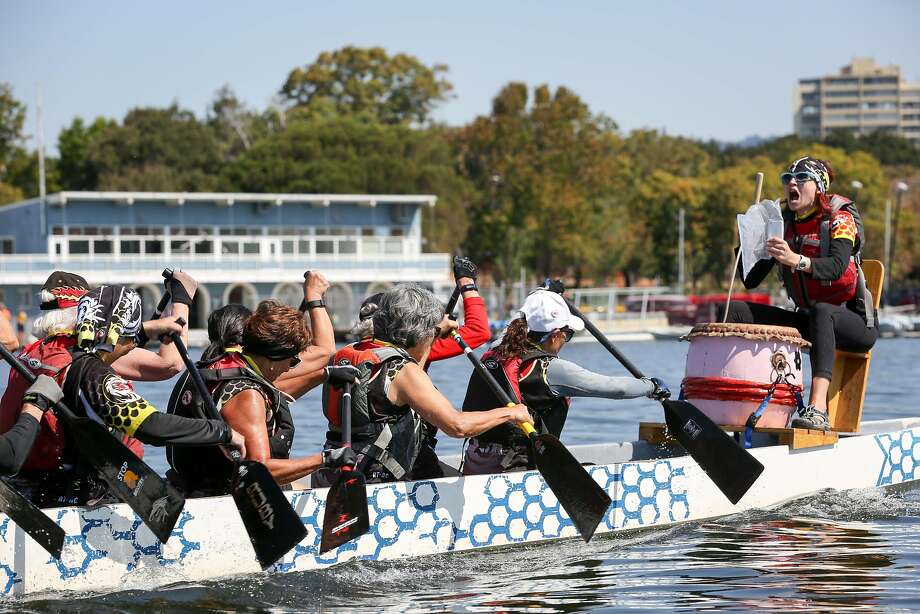
The first day of the Dragon Boat Races went pretty well. I was foolish to think it would be dramatically easier than in past years. Instead of the crews being in one paved area they were in two separate grassy areas divided by a road. One of the grassy areas had more trees than the other -- which would turn out to be important for the shade. But I'll get more into that when I talk about Sunday. Lake Merritt is a lovely place for boat races and this park is much nicer (and bigger) than I knew. Something else I've learned thanks to my Greening work. 

Cities and Burke & Jacobs

I was standing on the sidewalk in downtown Oakland -- in front of the new offices of the Oakland Tribune --- waiting for the shuttle to take me to the Dragon Boat Races, when I make a connection I don't recall ever making before. 


This is the old Oakland Tribune building.

Some of Oakland's finest surviving buildings were across the nearly dead street from me. Downtown Oakland, like many other traditional American downtowns, has never recovered from the economic devastation caused by the auto-age. These cities are like the failed states produced by the "Arab Spring" in that the consequences of making changes had dramatic unintended consequences. People, like Robert Moses or Le Corbusier or Mary Shelley's parents, think you can make extensive changes to complex systems -- even start over from scratch -- without considering Edmund Burke's conservatism and the need to make small changes while keeping an eye out for signs of system failure. 

Jane Jacobs was arguing for the same kind of conservatism for cities that Burke was for political states. Cities are actually trickier than states in that they are inherently dynamic and strict conservation -- preventing any change -- would be as bad as too much change. The same is true of nations of course, but cities need to change even faster if they are to thrive. 


Sunday

Day two of the Dragon Boat Races was an entirely different experience. For one thing, my sock/shoe insert strategy for working multiple days in a row failed miserably: It felt like I was getting a blister on the bottom of my left heel at the start of the day. (I have two weeks to work this out before the three days of HSB.) And then it was hotter than it had been on Saturday.

As I think I've said, San Francisco has not had a summer this year. We've had one day when it hit 80 F and for virtually all August it was below 70. On Saturday in Oakland -- always warmer than SF -- it was in the low 80s. When it felt hotter on Sunday I wrote it up to my working harder and the natural tendencies of San Franciscans to whine when it's over 80 or under 40. I worked to stay hydrated because I sweat profusely, but I didn't really think much about it aside from pausing, during a mid-afternoon hydration break, to realize I was really beat and still had four more hours (the hardest four hours) to go. Something about all this -- the heat and the park setting -- was reminding me of something but I couldn't put my finger on what it was.

My crew chief suggested I get a cold beverage at the volunteer food area and I enthusiastically took her up on this brilliant idea. (On Treasure Island the volunteer food/break area had been in a hot tent with views of nothing. Here it was on the second floor of the boat house with the best views of the event. There was even an outdoor, but under shade, terrace. It was really nice.) I grabbed my ice cold water and went to sit outside in the shade. 


This is a dragon boat on Lake Merritt but not from the festival. That is the boathouse in the background with the outdoor deck on the left. I was working in the trees to the left of what is shown here. Our dumpsters were awkwardly located near the building on the far right, which is much better than what was shown on the map we were given. Either my Chicken Little impression of the consequences of having the dumpsters so far away made them rethink their plans or the map was created by people not good with maps. I would lean toward the not-good-with-maps option.

As I said, I was working two crew areas (with bus traffic in between) and James had one of his people assigned to each area to keep things clean and to haul my sorted bags out to the road where they could be picked up (by James, usually). I had been wondering what had happened to the guy in one of these areas as my bags had started to pile up noticeably.  I found him listening to the Oakland Raiders football game up there in the shade. Smart... though not helpful. 

As a response to some boneheaded play by a Raider, he said something like, "That's the kind of thing you learn not to do in Pop Warner." And that's when the penny dropped and I realized what this day had been reminding me of. 

"Pop Warner" football is a program for pre-high school age kids. I played three years of Pop Warner football while living in the San Fernando Valley in the mid-1960s. The worst... worst part of the season was our training camp in mid-summer before the season really started. It was the equivalent of boot-camp but held in a lovely park in Encino. (This was the only occasion I had any reason to be in Encino, which was on the other end of the Valley. Why we trained there rather than at our usual facility in White Oak I don't know, but speculate it was so we didn't come to hate our regular practice field.) This was always at the hottest part of the summer with vile, mid-60's air quality. All I remember are hellish episodes of exercise and endless running with maybe a few blissful minutes collapsed in the shade under the trees.

Both Saturday and Sunday were "Spare the Air" days, and perhaps the program works because I didn't notice the smell of ozone, something I'm finely attuned to thanks to those years in the Valley. But the heat and lack of wind and the constant work (and sweating) were certainly reminiscent of those days almost 50 years ago. And then, when I got home, while drinking close to a liter of electrolyte water to keep the foot and leg cramps at bay, I learn that I hadn't been working in 80 degree heat but in an Oakland record (for the day) 94 F. That explains so much.

Our crew was one person short of what it should have been, and, because the worst trash doesn't come in until the vendors (and in this case the crew teams) breakdown at the end of the day (and the crews tend to party which delays things even more), I would have needed another half hour to get my sections shut down to my satisfaction. Some bags went directly into the landfill that I "could" have diverted. But for the most case, if I do say so myself, I totally rocked it, while also training one of James's people who sometimes also works for us. In part this went well because the crews didn't leave behind some of the most difficult trash I recall from previous DBRs, and in part because I was grabbing stuff from them throughout the day -- my plan for the year. 

In any event, when my shift was over I walked away (limped away, and I still had to walk quite a few blocks to catch a train home) not really caring about those final bags. I was at the open end of the landfill dumpster and was, I admit, tempted to look at the most recent bags to see if they were ones I had marked as sorted, but it was getting dark and I just wanted to go home, take a shower, and dig into that bottle of electrolyte water.

I almost forgot the highlight of the day. Cans and bottles of some beverages come in cardboard containers wrapped in plastic,


 The problem with this packaging for us is that the plastic goes in the landfill stream while the cardboard goes in either the recycling or compost. I've joked in the past that we should teach seminars in the occult science of removing the cardboard from the plastic (flattening cardboard boxes is the other skill vendors seem unaware of). Yesterday a high school aged rowing crew member came up to a station where I was working with one of these empty boxes and asked if it went in the recycling. I said yes, once you remove the plastic, which, and I give him credit here, he preceded to do. Only it was so pathetic. At one point I thought he was going to start crying. I even offered to finish it for him but he was determined. Though I did still have to flatten the cardboard.

I say it was the highlight of my day, because it made me laugh, but really it was sad. We are never going to win this battle to get people to properly sort their own trash.

And there was something else that made me laugh. The PA directed all the teams to their marshaling points by name. One crew was going by the team name "Boaty McBoatface."

Caption.


It's no secret I have an interest in military history and weapon systems. This leads to my viewing any number of YouTube videos and even commenting on them. Which then means I get a long stream of notifications of responses or other comments. Currently, we are more than a few days into a debate about the relative value of Sherman and Panther tanks during WW2. I'm using the popular names though most of the weirdos in these debates use the official designations -- though they may disagree even on that, and they aren't even as specific as I would like. It quickly gets very complicated. 

And the reason I'm bringing this up is because of an image I just saw of a B-24 bomber from the same period. You could argue (well, I could argue) that the B-24 and the M4, excuse me, Sherman tank have something in common. While no one would ever say they were the best bomber or tank of the period, they each played an essential role in wining the war. 

The B-24 is the ugly stablemate of the more beloved B-17. Most crews come to praise their aircraft, even if it wasn't what they would have chosen (I'm thinking of the P-47 here), but I don't recall hearing anyone say they loved the B-24. And yet it was, arguably, more important to winning the war than the B-17. It carried a heavier bomb load, but that isn't what made it so valuable in all theaters of the war. It was it's longer range that made it possible for the US and the UK to close the gap in the mid-Atlantic where German U-boats had previously been safe. And in the Pacific it could hit remote targets like Truk. 

It wasn't until almost the end of the war in Europe that the U.S. Army fielded a tank that was the equivalent (face to face) of the best German and Soviet Tanks, but the Sherman was operationally superior to everything else in almost every situation. You don't need to defeat Panthers and Tigers one-on-one to win a war. 

Just as the Japanese wasted precious resources on building super battleships they didn't really need, the Germans wasted their resources on building tanks that were a poor value for their army. I've heard that there is a Russian proverb, "Better is the enemy of good enough." The Sherman and the B-24 are perfect examples of "good enough." 

And, since we've come this far, it's worth noting that by the end of the war, the Sherman had been improved to M4A3 status which included a version with what was essentially a 105mm assault gun (in a regular turret) and the M4A3e8 (Easy Eight) version that mounted a decent anti-tank gun. The M4A3 family of vehicles may not have looked as cool as their German or Soviet equivalents, but they got the job done. 

Next - 44. Jacobs & George