Showing posts with label Donald Trump. Show all posts

Sunday, May 13, 2018

273. The east of Europe


Link to Chronology


Finally, back to reading Pirenne


A History of Europe by Henri Pirenne
University Books, first published 1938 but written during the Great War


Book Eight
The European Crisis
(1300-1450)

The Avignon Papacy, the Great Schism, and the Hundred Years War
  
Additional notes:
So thinking about how the Third Estate and then "The People" came to power in Europe, makes me wonder if we aren't in a variation on that theme today. And as always, you have to look for the group getting the short end of the stick to see who is going to struggle to gain power. At this time in history, that's people of limited intelligence and people with mental health problems. No idea what percentage of the population this would be, but, for the sake of convenience, let's call them the 49% (people of literally below average intelligence).

It's my belief that these are the people who have elected Trump, and that Trump represents them. Of course, Trump isn't really going to do them any good, except in so far as he makes the political establishment aware that they have to consider this constituency. What politicians are good at is attempting to act in the interest of any identifiable constituency. Politicians may be whores, but the good thing about whores is that they will service anybody if there's something in it for them.

Now all the mainstream politicians have to do is discover a new blend of policies that appeals to the 49% without offending their existing constituencies too much. It's what they should have been doing all along, because it's the right thing to do, but that kind of foresight would be remarkable in a politician. 

Trump, so far, is democracy working the way it should. This is a test of American democracy but probably no uglier a test than some that happened in the 19th century. Trump is also a test of the current balance of power between the three branches of government in the U.S.A. This is trickier because the Executive has accumulated so much power during the past century. It wouldn't be a bad thing if that process was reversed now, and I can also see that happening. There's still a chance that we will come out of this crisis with a more inclusive democracy and a newly limited Executive branch. I could live with that.


Chapter III

The Empire. The Slav States and Hungary

1. The Empire

p448 Germany, during the great interregnum, had assumed the political form which she was to retain down to modern times. It is not very easy to define her constitution, in which were comprised, without any real coherence, a monarchy which possessed none of the attributes of sovereignty, a multitude of ecclesiastical or lay princes, urban republics (Free Cities), and "immediate" (unmediated) nobles, enjoying complete independence... An anarchy in monarchical form: that perhaps is the best description of this extraordinary political entity... The necessity of an Emperor, who no longer corresponded to any existing reality, was imposed by tradition. And since the King of Germany was the Emperor-designate, to suppress him would have been to abolish the Empire. He therefore continued to exist...
...

p449 Rudolf of Hapsburg never found time, during his long reign (1273-1291, to go to Rome in order to receive the Imperial crown... 

...

p457 ... [Sigismond, House of Luxembourg, King of Hungary 1387-, King of Germany 1411-, Emperor 1433-1437] died... 1437, and his Kingdoms of Bohemia and Hungary passed to his son-in-law, Albert of Austria. Thus the vast territories of the House of Luxembourg were added to the Duchies of Austria and Styria. The aim envisaged by the House of Habsburg since its establishment in the valley of the Danube was achieved... All the efforts of so many kings to establish the power of their families had  the final result of promoting the Habsburgs to the rank of the most powerful sovereigns in Europe...

...

p461 ... If there were assemblies of the Estates, the bourgeoisie was nowhere powerful enough to counterbalance the nobility, which had the say in everything and enforced its will upon the country. A large proportion of the nobles were not the descendants of freemen... The peasants, who from the middle of the 14th century were entirely at the mercy of the nobles, were beginning to relapse into serfdom... [Footnote: In Flanders serfdom disappeared in the 13th century. In France it was largely abolished in the 14th century.] One of the most striking features of German life was this regression of the people into servitude under nobles of whom many were themselves of servile origin. Here and there the peasants resisted the nobles. The origin of the Swiss Confederation may be referred to such resistance: the three original cantons, Schwiz, Uri and Unterwalden, defeated Leopold of Austria at Morgahten in 1315. This was the beginning of a federation which was joined by Lucerne (1332), Zurich (1351), and Berne (1353), and which was further consolidated by the battle of Sempach, which was fought against Leopold III of Austria in 1386. 


I have to confess here that I thought Swiss independence was related to the rise of Calvinism. Perhaps it was the other way round: Calvinism was able to develop in Switzerland because of its independence from the religious authorities of the time.

p462 ...the economic life of the country, down to the middle of the 15th century, was very poorly developed... 

In the center of the country there were no important cities. On the whole, the greater part of the country was still rural...


2. The Slav States and Hungary

p463 ... The economic organization of this country [around Kiev after the 5th century] presented a character which was not to be found elsewhere in the territory of any other Barbarian people. It was essentially commercial. The Vikings, who where gathered round their princes in the fortified enclosures (Gorod) established along the Dnieper and its affluents, subjected the Slav population... In the spring of each year their boats assembled at Kiev and carried this merchandise to Constantinople.... When at the beginning of the 11th century the Scandinavians became Slavized, these commercial practices, together with the political exploitation of the rural population, did not disappear, but the aristocracy of boyars, at once military, mercantile and urban, dominated the rest of the nation...
...

p465 ... In 1096... [the Kuman] Khan advanced to the very walls of Kiev; and from that time onwards the attacks of these ferocious Barbarians never ceased. By the middle of the 12th century it was becoming impossible to resist them. The region of Kiev, hitherto so flourishing, was becoming impoverished and depopulated. When the Barbarians occupied the mouths of the Dnieper there was an end of the trade with Constantinople. Gradually the country was deserted, some of the inhabitants migrating to Galicia and Vollynia, and others, more numerous, moving off in a north-easterly direction toward the upper reaches of the Volga (Sousdal).


This migration from south to north determined the future of the Russian people... The Slav colonists of Sousdalia mingled with the Finns, who had hitherto been the sole inhabitants of its immense forests, and from that mingling of peoples modern Russia (Great Russia) emerged. At the same time a purely agricultural life replaced the old commercial activity. Henceforth deprived of all communication with the sea, the Russians were restricted for long centuries to a purely rural economy, which had no outlets. ...the fatality of circumstances made them abandon... [commerce] just when it was beginning to develop in the West... the towns of central Russia -- like the castles of the West in the early Middle Ages -- were merely the residences of the princes, their boyars, and their servants necessary for their maintenance... Novgorod alone, which was assiduously frequented, from the beginning of the 13th century, by the merchants of the Hansa, was a center of commercial importance, and this importance it owed entirely to the foreigner. It was a German factory in Russia...


p466 ...The Greek orthodoxy which the Russians brought from the banks of the Dnieper kept them isolated from Europe, while the civilizing influence of Byzantium... could no longer remedy the disastrous result of this isolation.


And then there was the Mongol invasion of the 13th century.

...In 1223 Juji, the son of Jenghiz Khan, conquered the whole region occupied by the Kumans between the Don and the Volga. His son, Batu, pushed further west, capturing Moscow in 1234 and Kiev in 1240... Their Khan contented himself with imposing overlordship upon the Russian princes and subjecting them to tribute... [Ivan III (1462-1505) annexes principalities around Moscow.] Ivan, allied with the Khan of the Crimea, made an end of what was still left of the Mongol domination. With his reign a new era of Russian history began.

As in the case of the Russians, it was the invasion of an Asiatic people, the Hungarians, which determined the destiny of the Slavs of the South and West... the sudden and unexpected arrival of the Hungarians altered the course of [Slav] history. Making their way into the valley of the Danube, they interposed themselves between the Slav peoples, dividing them into two groups, which henceforth had nothing in common. Cut off from Byzantium, and at the same time separated from the Serbs and Bulgars, the Czechs and the Poles, like the Hungarians themselves, naturally went over to the Roman Church. 

...

p468 ...In consequence of the remoteness of the Western Slavs it was long before they emerged from the narrowness and poverty of their isolated existence... The power of the great landed nobility, both in Bohemia and in Poland, was exercised from the beginning by the participation of each of its members in the government of the whole country. This did not lead to the division of the country, for its political and national unity were preserved by the very weakness of a central authority which was dependent on the aristocracy. It should be added that these peoples, being cut off from the sea, had no bourgeoisie until a very late stage in their history. 


p469 ... If Rudolph [of Habsburg] had been forced to rely on his own resources he could not have coped with his adversary [Ottocar II of Bohemia]. But now the Hungarians, for the first time, played the part which they were so often to play afterwards, assisting the Germans against the Czechs. Ottocar was defeated and killed in 1274, at the battle of Marchfeld. The Danubian duchies became the property of the Habsburgs, who never ceased to covet Bohemia... 


We get the history of this region from the perspective of the Slavs that we've already covered from the German side.

p473 ... The Germans did not settle in great numbers except in Silesia... [around 1241, after the Mongols withdrew] Those who penetrated into the interior introduced urban life there and constituted a bourgeoisie, which... retained its [German] nationality for centuries. It found itself juxtaposed with the Jews, whom the persecution of the era of the Crusades had swept out of Germany and Hungary into Poland in the 11th and 12th centuries.

p474 ... Casimir (the Great) was to Poland much what his contemporary, Charles IV (1333-1370), was to Bohemia... He wished to make of Cracow what Charles had made of Prague, and following the latter's example he established a university there (1364) [University of Prague 1348]... In consequence of a much simpler historical evolution, [than elsewhere] the [Polish] nobles were directly related to the freemen of the Barbaric epoch; they retained the pride of the freemen, and claimed for themselves that they alone constituted the nation. Apart from the nobles [and the scattered, German bourgeoisies] there were only the servile peasants whom they exploited and despised. Above them there was only the king, whose authority they acknowledged on the condition of his reigning only for them and with them. The spirit which inspired the nobility, and never ceased to inspire it, was a spirit of liberty, but a liberty of caste which was to give the Polish State, more and more definitely, until its final collapse, the paradoxical character of an aristocratic democracy.


Casimir III defeats the Teutonic Knights at the battle of Tannenberg (July 15th, 1410) and Poland -- and the Slavs -- regain control over Prussia.

p478 The Slavs of the South -- the Croats, Slovenes, Serbs and Bulgars -- presented a very different spectacle from that of the Poles and Bohemians. In consequence of their weakness, the Croats and the Slovenes soon fell under the domination of Hungary, who took care to deny them the least measure of political autonomy. The Serbs and Bulgars... established on the south of the Danube on the territory of the Greek Empire, and faithful to the Greek Church, profited by the weakness of the Empire, after the reign of Justinian, to penetrate deeply into Macedonia, and even into Greece. While in the long run they became Hellenized, the Slavs of Macedonia preserved their language and their customs, as did the Germans who had occupied the north of the Empire. 

The Bulgars threaten the Empire. The Serbs create their own little empire under "Tsar" Stephen IV (1346) which dominates the Bulgars, Macedonia, and Albania.

p479 If one wished to invoke an example in order to prove the unimportance of race in historical development, such an example is certainly provided by the Hungarians. By their origin, and by virtue of their language, these Finns, who were related to the Turks and the Mongols, were completely alien to the ethnographical group of the Indo-European peoples. However, they had barely taken their place in the midst of these peoples and adopted Christianity, when, despite the nature of the blood that flows in their veins, their cephalic index, and the linguistic characteristics of their idiom, their social lives became so similar to that of their neighbors that it would be quite impossible, if one didn't know the facts beforehand, to recognized them as intruders. The fact is that the physical individuality of a people is entirely subordinated to its moral existence... Having become Christians, they were bound to enter the European community, and so prove that they too possessed that pretended "faculty of assimilation" which a certain school of ethnologists claim as peculiar to the "German race," though it is really a characteristic of all Barbarians......

p483 ...These peoples [the Slavs and Hungarians up to the middle of the 15th century] knew nothing of the domainal organization, nor of the feudal system; they played no part in the War of Investitures, nor in the Crusades. For them the only consequence of the great epopee was the advent of the Jews who sought refuge in their territories, having been driven across the Elbe by the followers of Christ... Placed at a disadvantage by their old agricultural institutions, they yielded to the German pressure; retreating along the Elbe before the invaders, they allowed the latter to establish themselves among them, and to found cities which were like foreign islands in the midst of the national population. With the arrival of these newcomers, who looked down upon them but were a necessity for them, there began a period of superficial Germanization which continued until the middle of the 14th century. Then a reaction began to make itself felt... and there was a sudden awakening of national energy. This was manifested... by the explosive outbreak of Hussitism in Bohemia, the conquest of Prussia by Poland, and Hungary's advance toward the Adriatic. It seemed as though the moment had come for the Western Slavs and Hungarians to play an active part in European civilization. But the Turks were advancing across the Balkan peninsula, and the Slavs and Hungarians had to meet the thrust, turning back to the East in order to defend the civilization of the West instead of beginning to collaborate with it.

Sunday, August 27, 2017

193. You will have only one story


Jack London

A passage from Elizabeth Strout's My Name Is Lucy Barton struck me as I'm re-reading the book. Here she's quoting a famous writer acquaintance, 

"You will have only one story," she had said. "You'll write your one story many ways. Don't ever worry about story. You have only one."

And this made me think about the Jack London story "South of the Slot," set in SF I just read. (See HERE.) One of my first thoughts was that it could also have been titled "The Call of the Wild." But now I'm wondering to what extent Buck is just an animal version of Big Bill Totts in this story. Buck came first, in 1903, but did London have Bill Totts in mind all along, and thought it would be easier to sell an allegorical tale set in the Yukon?

But what I've been thinking about even more, is that Jack London is the person I would like to talk to about what's going wrong in America. I think his perspective on the gentrification of South of the Slot, now called SOMA, would be very interesting. The world he described in this story is almost totally gone now. There are some last vestiges around 6th and Mission, but in general, the infrastructure that supported the lower and under classes in this part of the city has been methodically destroyed (phase one of "urban renewal") or is in the process of being re-purposed for the benefit of the middle and upper classes. 

The flop-houses and SROs that Thomas Pynchon wrote about in The Crying of Lot 49 are virtually gone now along with most of the work that provided a living for the people living South of the Slot. Even the shipyard around pier 70 is in the process of being transformed into a mixed use development with tech incubators and a thousand to two thousand units of new, up-to-code, housing. Is it any wonder that the descendants of the people London was writing about here, thought voting for Trump would be worth a shot? Even if they don't get anything out of it, it's still worth it for riling up the gentry.

And there's another side to this gentrification of South of the Slot, the trashification of the north. I wrote the paragraphs above at the Peet's on Market and then walked home -- across where the slot once was -- and through the heart of the previously posh Union Square shopping district. Based on the businesses you see lining the sidewalks of Grant street, the area is even more posh now than it was in the past, but when you look at the crowds on those sidewalks the picture changes. And not just because this in near the end of the peak tourist season. The days of hats on men and women, and gloves on women is long gone. If you were to bring back a gentleman or lady from London's time (or as late as the 1950s) they would be appalled by the vagrants and scavengers, but the commonness of the shoppers and sightseers would be just as shocking. I'm pretty sure they would see this as an invasion from South of the Slot, culturally if not strictly based on residential addresses.


Where Liberals meet the Alt-right

This weekend there's a to-do in town over some Alt-Right group attempting to demonstrate in town, or on the Presidio -- which is almost, though not quite, SF. What amuses me about this is that the thing you can not say in polite (liberal) circles is that most of the people who are making the most noise against the White Separatist factions, already live in (defacto) White Separatist suburbs. (These are the same people who drive their cars, granted many of them are hybrids, to oil pipeline protests.) 

First generation at university

I woke up Sunday to a news radio report on a California program to assist students who are the first in their family to attend university. It occurred to me that that would have applied to me, while I was in school, so I started paying more attention. One of the characteristics of these novice students, according to the report, was not speaking up in class or asking questions. This would be amusing to anyone who shared classes with me. Though, to be fair to the program, I was not at all typical since I had practically grown up on college campuses.

Thursday, August 17, 2017

190. America and radical Whigs


Still the New Yorker

I am still working my way through the bag of New Yorkers. Scanning the early pages I noticed Jason Epstein's name following a letter in The Mail. The content of the letter is either petty or an instance of setting the record straight. What amuses me is that, while Epstein's name still comes up now and then, what I mostly remember him for was the funniest feature I ever read in Architectural Digest. The subject was his apartment (with terrace) in the old police building, though the focus of the story was actually the relationship between Epstein and the catty, gay interior decorator who put the apartment together for him. (It was a wonderful apartment.) I still have that magazine somewhere.


At last!

I finally have discovered an article that asks the core questions behind the Trump debacle, "We Could All Have Been Canadians" by Adam Gopnik in the May 15, 2017 New Yorker.

And what if it was all a mistake from the start? The Declaration of Independence, the American Revolution, the creation of the United States of America -- what if all this was a terrible idea, and what if the injustices and madness of American life since then have occurred not in spite of the virtues of the Founding Fathers but because of them? The Revolution, this argument might run, was a needless and brutal bit of slaveholders' panic mixed with Enlightenment argle-bargle, producing a country that was always marked for violence and disruption and demagogy...

I'm guessing this opening is going to be countered before the end, but I can't see how I'm going to be convinced.

...In plain American, is Donald Trump a bug or a feature of the American heritage.

...The quarrels that took place in New York and Philadelphia [in the late 18th century] went on with equal ferocity, and on much the same terms, in India and England. And though they got settled by force of arms and minds differently in each place, it was the same struggle everywhere. "Radicalism flourished in Boston, Bristol, and Bengal, while fears of disorder and licentiousness provoked rural elites in both the Hudson Valley and the English shires," [Justin] du Rivage writes [in Revolution Against Empire, Yale]. "As radical Whigs gained strength in North America, the political culture of the British Empire became increasingly Janus-faced."

I can't believe how far up my street this article is.

On one side were what he calls "authoritarian reformers"; on the other, those radical Whigs. (Both were seeking to sway or supplant the "establishment Whigs.") This isn't the familiarly rendered divide between Tories and Whigs; the authoritarian reformers were less fusty country squires attached to old English institutions than an elite executive class of intellectuals and aristocrats committed to the Empire and to the reform of institutions that were seen as preventing the Empire from being maximally efficient. It was a group of men who, in spirit and psychology were not entirely unlike "reformers" in Communist China, open to change for the purpose of reinforcing their own power in an intact hierarchy. The authoritarian reformers were "not a political party per se," du Rivage writes. "They were, rather , an ideological vanguard, a loosely organized group of politicians, publicists, and theorists." (Significantly, no famous names cling to the group, career politicians and businessmen like William Murray [perhaps THIS one], Matthew Decker, and Viscount Bolingbroke [one of those guys] were their mostly interchangeable leaders.) They wanted a strong monarch surrounded by a circle of aristocratic advisers; very limited democracy; reform in the Army and Navy; and a tax-heavy system of mercantile trade -- all of it intended to make the Empire as profitable as it needed to be.

Extended taxation within the Empire was central to their agenda. They sincerely believed in "taxation without representation," because they saw citizenship not in terms of sovereignty and equality but in terms of tribute received and protection offered. Pay up, and the British Navy will keep the Frenchmen, pirates, and aboriginals away. Samuel Johnson, who was hired by the authoritarian reformers to write the 1775 pamphlet "Taxation No Tyranny," captured the argument best: the men who settled America had chosen to leave a place where they had the vote but little property in order to live in a place where they had no vote but much property. With lucid authoritarian logic, Johnson explained that even though the American citizen might not have a vote on how he was taxed, "he still is governed by his own consent; because he has consented to throw his atom of interest into the general mass of the community."

Interestingly, the flaw in this logic is the same flaw that undid many 19th century Utopian communities -- the generation born into the new status quo never consented to whatever it was their parents may or may not have consented to. The Founding Fathers were born in the Colonies and probably knew little of conditions in England or of what their ancestors may have thought was a fair trade when it came to citizenship.

The radical Whigs, though they, too, were implanted within establishment circles -- grouped around William Pitt [the Elder] and the pro-American Marquess of Rockingham, [does Gopnik not know how many people have shared these titles?] with the devilish John Wilkes representing their most radical popular presence -- were sympathetic to Enlightenment ideas, out of both principle and self-protection, as analgesics to mollify "the mob." They represented, albeit episodically, the first stirrings of a party of the merchant class. [Now I want to know to what extent all these "hons" were involved in trade.] They thought that colonists should be seen as potential consumers. Alexander Hamilton, back in New York, was a model radical Whig -- trusting in bank credit and national debt as a prod toward prosperity, while the authoritarian reformers were convinced, as their successors are to this day, that debt was toxic (in part because they feared that it created chaos; in part because easy credit undermined hierarchy).

The radical Whigs were for democratization, the authoritarian reformers firmly against it. The radical Whigs were for responsible authority, the authoritarian reformers for firm authority. And so on. This quarrel, du Rivage argues, swept across the Empire and as much as it divided colony from home country, it united proponents of either view transnationally. Those we think of as "loyalists" in the American context were simply authoritarian reformers who lost the war; those we think of as "patriots" were simply radical Whigs who won.
...

No one at the time [of the Revolution], du Rivage suggests, saw what was happening as pitting a distinct "American nation against an alien British one. Participants largely saw the conflict in terms of two parties fighting for dominance in the English-speaking world. The scandalous high-water mark of du Rivage's iconography occurs in January of 1775, when Pitt (now ennobled as the Earl of Chatham) brought Franklin, then living in London, into the House of Lords to witness his speech on behalf of the American radicals, in effect sealing the unity of the single party across the ocean. This scene... was, in its day, as significant as that of the signing of the Declaration of Independence.

...Had the radical Whigs secured their power in Britain, our Revolution might well have taken on a look and feel more like those of the later Canadian and Australian dissolutions from the Brits: a political break toward "home rule" but without any of the elaborate paraphernalia of patriotism attached to it... 

...Although his [du Rivage] sympathies are with the radical Whigs, he sees that many of the authoritarians' claims were not false. [The U.S. Navy and Marine Corps had to be created to replace the protection supplied by the Royal Navy.]
...

To be continued... 


On the streets

The surprising thing this summer on our streets is that most of the outrageously crazy (shouting and ranting) people have been women. Maybe the shouting men seem more dangerous and get locked up by the police? 

I'm at my favorite pizzeria which has a public trash container sitting adjacent to the bus stop out front. As a professional trash sorter, I notice anyone messing with trash (this reminds me of one of the many unforgettable Gary Larson, "The Far Side" cartoons in which dogs -- perhaps in two cars -- are locking eyes and wagging tails at each other while nuclear bombs go off all around). Today I saw something I've never seen before and can't explain.

A guy who looked to be a street person was breaking down the trash piled on top of the trash can just the way I would have in the process of sorting it. He was actually going further and, after removing the plastic from the cardboard trays that hold food and drink items before they are sold, and flattening them, he continued to tear them into smaller pieces before putting everything into the can. 


I assumed at first that he was looking for recycling, but there was no sign of that. No idea what his agenda was. 


Thursday, August 10, 2017

187. Trump as Commodus


If you leave, they will come

Yesterday I was home all morning dealing with the sump pump and cleaning the building (while waiting for the pump guy). Then I went out a couple hours in the early afternoon for lunch before returning home. The United States Post Office figured early afternoon would be the best time to find me at home, to sign for my new Vegetarian Shoes.

Since they "missed" me, I had to walk to the PO on the other side of North Beach (so, past two closer POs) to collect the shoes that I'm now wearing. I'm still at the cafe across from the PO -- a place I used to frequent back when the Trader Joe's a block away was still the closest one to my house.


Making sense of the senseless

Someone shared on Facebook yet another interesting political take on what the Trump Presidency really means. This one is by Andrew Bacevich in The Nation (here). What is particularly frustrating is that I agree with everything he says to here:


STARTING OVER
I am by temperament a conservative and a traditionalist, wary of revolutionary movements that more often than not end up being hijacked by nefarious plotters more interested in satisfying their own ambitions than in pursuing high ideals...

Right after this he tosses Burke, and any notion that "the people" have consciously made the decisions they have made, out the window and comes up with an action plan for a commonwealth in the best of all possible worlds.

Previously, he points out something I hadn't thought of, that American Presidents have been increasingly "Imperial" since FDR, and that it's just the insane casting of Trump in this role that has shocked us into noticing this. So, rather than looking at an American version of the fall of the Roman Republic, we're looking at the American version of the end of the Pax Romana and the reign of the Good Emperors. Interesting.

But then he comes up with a Liberal view of what America stands for (something America has never stood for) and expects the people who voted for George W. and Trump to suddenly reveal themselves to be a -- momentarily confused -- philosopher electorate, and right our ship of state. What no one seems willing to acknowledge is that it is our form of democracy that is in question. Just as the Founding Fathers never imagined semi-automatic firearms, they never imagined such an irresponsible and ignorant electorate. (I wouldn't like the electorate they were familiar with either. If you admit that the Enlightenment was naive, then where do you go from there in establishing good government? I have no clue.)


The New Yorker

Someone dropped off a bag of New Yorker magazines the other day that ended up in my care. I've been working through the cartoons. But this evening I noticed a Qualcomm ad on the back page of one issue and thought it might be interesting to note the advertisers today, as compared to back in the 1970s when I was a regular reader. Only there aren't any. Or very few. Here's the list of ads for this issue: 

1. A full page for Citi -- but American Airlines and Master Card are also visible so it may be co-advertising.
2. A vertical column for The Metropolitan Opera
3. A full page for Accura
4. A full page for ehrmantapestry.com
5. Two vertical columns for The New Yorker Festival sponsored by mastercard and Land Rover
6. A vertical column for healthyish ("a new site from Bon Appetit")
7. A full page for New York Presbyterian Hospital
8. A full page for Qualcomm
9. Two vertical columns split between five advertisers (plus one small ad for the New Yorker. I haven't included self-advertising)

So all together seven full pages of ads out of eighty printed pages. How do they manage to stay in business? Though, with my original thought in mind, the only ads that would have puzzled me in the '70s would be the website and Qualcomm and I guess the Japanese luxury car instead of Lincoln -- who has the first two pages in the next issue I picked up. Maybe the first week of July is not prime time?


Quicker than the automat

I was sitting in the Bank Cafe when, out of the corner of my eye, I saw something launched from near the Peet's counter toward where people were sitting and thought, "Wow, they have introduced an exciting new form of table service." But instead it was a crazy woman tossing things around the place. She was chased out.


Sunday, February 26, 2017

121. In which Hegel fails us


Previous - 120. A thought experiment


Trump

I can't remember now what I expected, but I am surprised how the bull shit is snowballing even week to week. You'd think they would want to pace themselves. 

That said, I do think I've made some sense out of Kellyanne Conway's "alternative facts" assertion. Really I don't know what she meant, but I think it may be true that there are sociologically valid facts that are not "true" but that a substantial percentage of people believe anyway. Rather like religion. Actually a lot like religion. 

If large numbers of people are determined to believe a given conspiracy theory or that their favorite invisible sky-faeries have a particular characteristic, then these statements are "true" for them even when they are not true in any objective sense. The question then becomes, Why do they believe these particular statements? And to answer this "why" question you don't need journalists but psychologists and sociologists. And, as with Franco's Spain, scientists and journalists are only seen as being beneficial to society when they support the distorted view. 


Avoiding needless synthesis

Today I was helping an online friend reduce the word count in a piece of fiction she's working on. This got me thinking about the "don't mention things that are not crucial to your story" rule and how William Faulkner breaks this rule -- and how glad we are that he does. Just thinking about Faulkner took me back to Methodism and it occurred to me that Methodism played a similar role in America in the 19th century to the role Puritanism played in England in the 17th century. (And Calvinism in Europe in the 16th century?) 

So I'm seeing a natural (human?) cycle here but I'm not seeing synthesis in the Hegelian sense. If the secular trend in European history is the thesis, and the frantically religious response to that is the antithesis, where is the synthesis? As with the political fluctuation in the final century of the Roman Republic, I see a social machine getting more and more out of balance and on the verge of flying apart, not a culture on the verge of achieving some compromise viewpoint.


The Classics

Recently YouTube has decided I'm interested in seeing clips from the movie Gladiator -- and my then clicking on them hasn't discouraged this. But seeing these clips has got me thinking about Rome, and then Greece. 

When you read Thucydides and Xenophon, or Livy and Polybius, you inevitably come to identify with the Athenians and Romans. The Athenians are just so modern. And after learning the art of war and the art of politics by reading the history of generation after generation after generation of Romans, you feel like you are a Roman. So it's easy to overlook the reality that by their glory times both states were pretty despicable. Perhaps they are despicable in ways that are easier for us to comprehend than was the case with many of their contemporaries, but that doesn't change the fact that they were a nasty lot that you wouldn't want anything to do with if you weren't a member of their gang. 

It's hard to not wish there was some way Alcibiades could have been brought back into the Athenian state to lead their defense against the Persians, but then again, it's hard to argue that they didn't get exactly what they deserved. 

It's hard to not wish there were better defenders of the Republic at the end than the insufferable Cicero and the vapid Cato.  But even if we accept Cicero's account that he wasn't the usual rapacious provincial proconsul, he was supporting a system that was rapacious to the core. Again, it's hard to argue that the Republic deserved to continue in the form it had taken at that time.

And all this is equally true with America. Even if you give us a pass for our first hundred years on account of the times, even if you forgive the unparalleled terror tactics of WW2, as poetic justice for what the Germans and Japanese started, I don't see how you can justify the sins of the post war years. And even if you do decide the Cold War is an adequate excuse for what we did to the Congo and Chile and Somalia and all the rest, that still leaves everything since 9/11. 

So, when it comes down to it, Trump is just an instance of reaping what you sow and of just desserts. I still hope American Democracy will prove strong enough to shake off this disaster, but if not, it's not like we didn't have this coming.


Next - 122. Venice


Saturday, February 25, 2017

120. A thought experiment


Previous - 119. Catching up


Transit

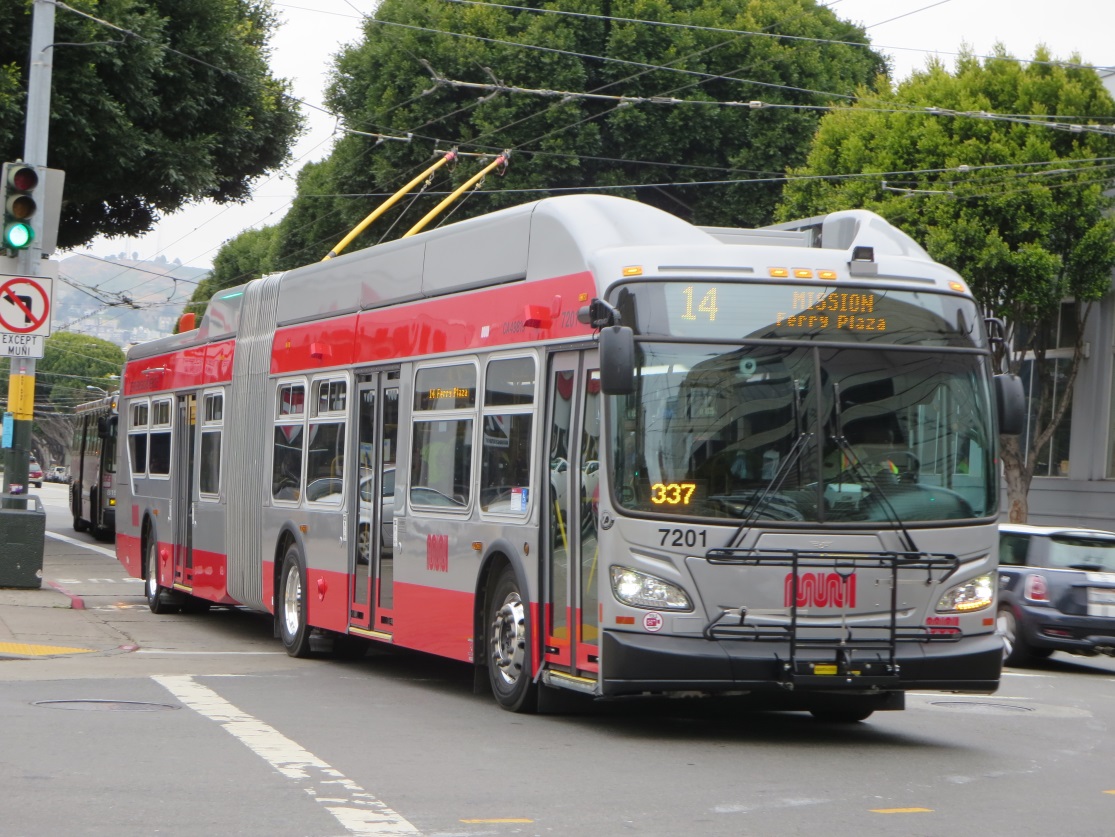
MUNI, the local transit agency for San Francisco, is both amazingly busy (for an American transit system) and amazingly incompetent. I happened to move to SF the summer they replaced their electric trolley buses. 


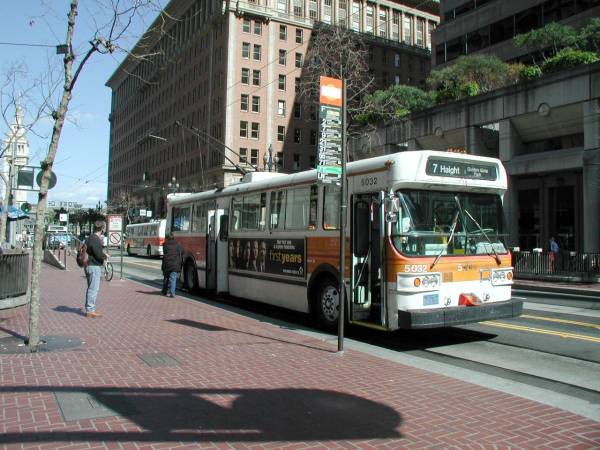
That was 40 years ago. That generation of new buses was replaced eventually and some of those replacement buses are still on the road today... 


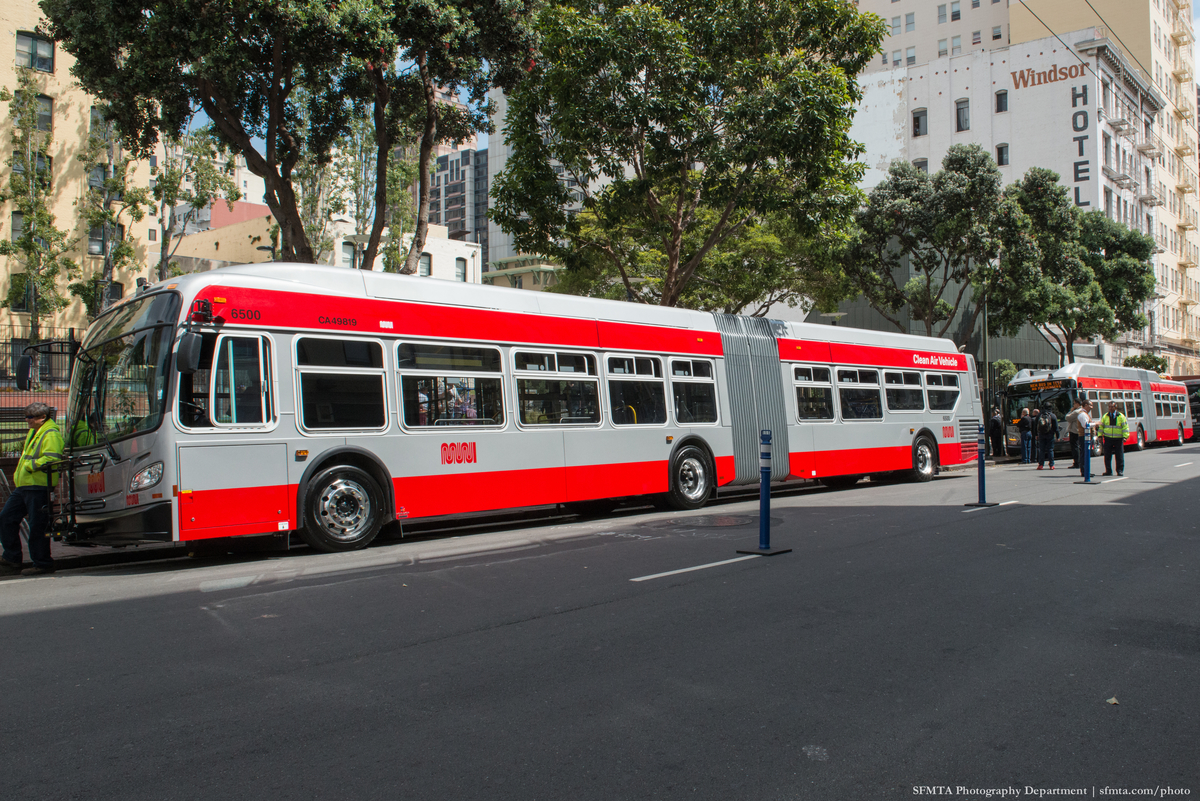
...along with an even newer generation just coming into service in the past year. 


The trolleys got quieter, than louder, and now quieter again. The system for notifying the operator you want to get off, has gotten more elaborate to better serve the disabled, elderly, short, and those standing in the center aisle. Operators gained the ability to adjust their mirrors remotely (a huge time saver when shifts change) and battery backup so they don't get stuck in intersections without power. (Though I do sometimes miss the days when riders had to get out to help push the bus out of an intersection.) They gained the ability to carry wheelchairs and scooter (and now strollers) and the most recent generation has lowered the floor to make this process easier. 

What's unique about the newest generation (which also successfully tackled the problem of the truly vile off-gassing of new plastics) is that the new trolley buses, for the first time, visually match the motor coaches. They are identical except for the poles on the roof. 


This is a purely cosmetic factor, I was about to say, except that, now I think of it, it isn't at all. I assume that, apart from the motors and engines -- drive trains, if you will -- there is probably a great deal of commonality (in parts, for example) between the electric and hybrid buses which should make maintenance simpler. I have no idea how significant this really is. 

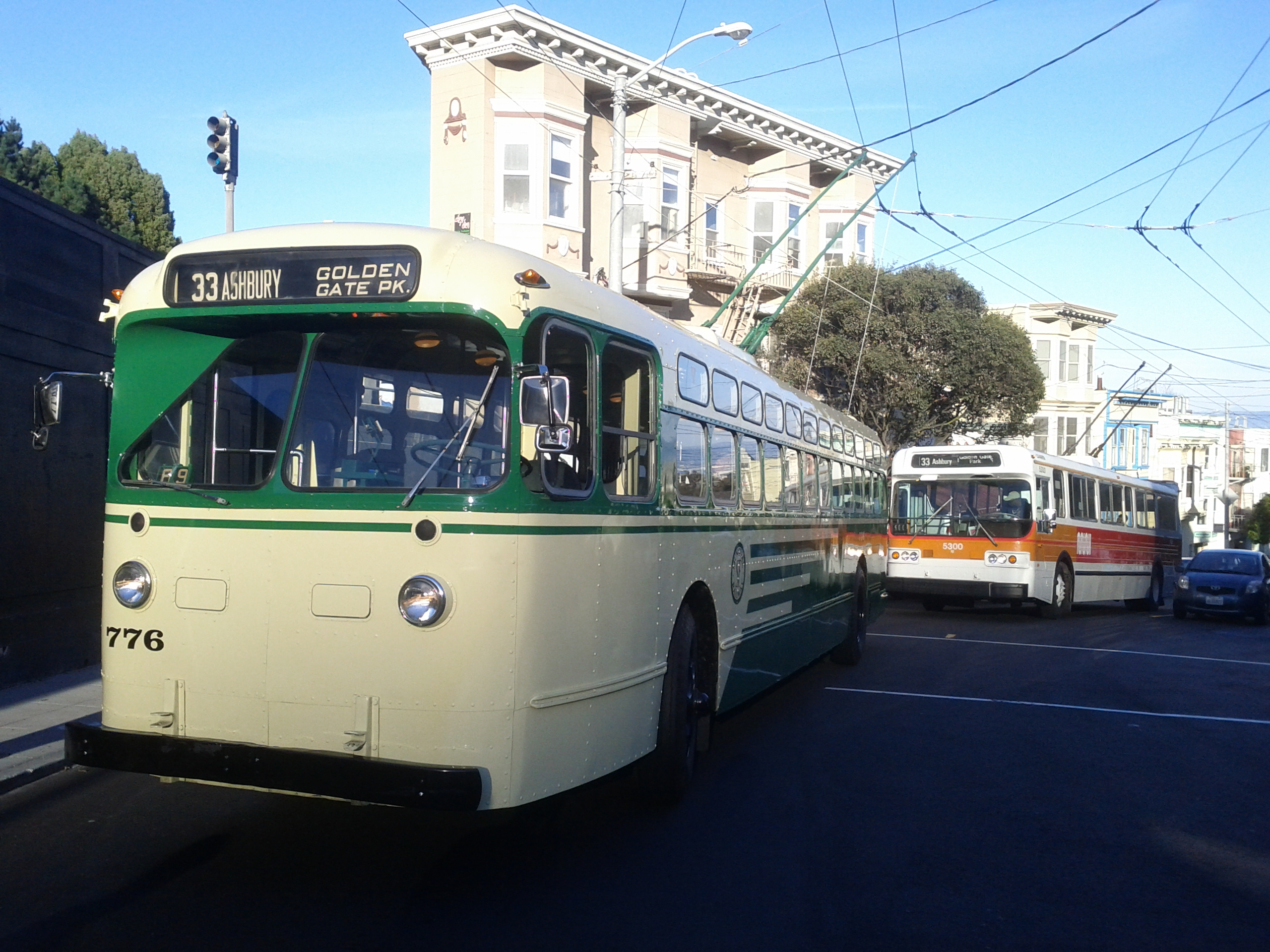
I totally lucked out in scheduling my exploratory visit to SF in May of 1976, just before the prior generation of trolley buses were replaced. I got to ride several of those old beasts. 


They looked like they were from the '30s or '40s. Their motors where amazingly loud. SF does have a great transit museum collection and they do still have at least one of these old trolleys that I see when they occasionally bring out the old equipment. 

MUNI, I've heard, is close to introducing a third generation of light-rail trains -- the first generation started service a year or more after I arrived. But BART, the only heavy rail, mass transit operator here, is still using it's original equipment from the early '70s, though they are in the process of introducing replacement trains. I assume this means that heavy rail is both more efficient by carrying many more people on their tracks (with lower labor costs -- more passengers per operator), but also by getting more years of service out of their investment in rolling stock. And yet almost all new service these days seems to be light-rail. It makes no sense to me. 


It's time...

...for a political thought experiment. Imagine if you will that the U.S. Supreme Court decides the recent Presidential election is void due to Russian interference and orders a new election to be held in June of this year. People of sanity breath a sigh of relief. Clinton already won the popular vote and it's reasonable to think that she would pick up a significant percentage of Stein supporters (I can't actually imagine Stein deferring to Clinton for this election because politicians are ego maniacs). Also some percentage of the people on the left who couldn't bring themselves to vote for Clinton (a woman) will rethink that decision now and some percentage of people who voted for Trump will be having buyer's remorse. So it's all good, right? No.

It's my understanding that more eligible voters failed to vote than voted for either major candidate. Normally these (don't give a fuck) voters aren't a factor, but in my thought experiment I think they might be. First off, I doubt many of them are Clinton supporters. Politically engaged liberals vote. Aside from the already mentioned segment that couldn't bring themselves to vote for a woman, I suspect most of these non-voters are screw-the-system types who don't vote because they assume The System is rigged against them. But not any more. Now they have a screw-the-system President. (I concede that this view explains why my prediction that Trump would win the popular vote was wrong without really being wrong.) 

So, in my June election thought experiment I think, as Trump has asserted, he would not only win the Electoral College but the popular vote as well.


Next - 121. In which Hegel fails us

Friday, February 10, 2017

117. The Dashwoods


Previous - 116. Abusing QCD & synesthesia


Food dislikes

Here's the kind of thing the internet is so handy for. In "real" life I've ran into any number of people with odd (to me) food preferences -- a dislike of mushrooms is common, also of cilantro and green bell pepper -- but someone in my online group brought up foods people can't stand and the list amazes me.

We had stumbled on avocado and raisins before, many people in the group detest both. Now we're adding olives, ham, ketchup & mustard. And today we've added cherries -- at first Maraschino and then all cherries -- and marzipan!! 

Gustatory synesthesia! (Everybody downs a drink.) I shouldn't be surprised at any of this since my mother never tasted any of the items on this list -- though that puts her dietary preferences in an entirely different (not taste-based) category. But some of the items on this list I consider to be among life's greatest small pleasures: avocado, cilantro, real cherries, marzipan. And if you told me I would have to live the rest of my life without raisins or mustard I would not be happy.

My point is that these taste based differences are as striking to me as the more conventional forms of synesthesia. They are at least more comprehensible than the emotional synesthesia I wrote about last time -- someone pushing away a bowl of guacamole is puzzling but it also means there's more for me. Someone doing a good job but not being able to acknowledge that, or feel any pride in the accomplishment, is much harder for me to get my mind around. 

An excellent example of this for me was that recent Women's March in Oakland I greened. As a "good dog" (in a previous life) I thrive on pleasing whoever is in charge. For that event there was no one else around for most of the day so I had to please myself, and I can be something of a perfectionist. I can nit pick any number of aspects of my work that day (and have done so) but I can also see that I did more than could reasonably have been expected of me, and I can feel pride in my work (while still keeping in mind a short list of things I would have done differently and will try to do differently if I'm ever in that situation again.) To not be able to correctly assesses my performance would be as scary as Oliver Sacks' list of freakish neurological conditions like being unable to recognize faces, or read words, or speak, or imagine color. 


Sense and Sensibility

I'm watching the most recent mini-series version of this again. So delightful. This time, as I watch, I've been thinking of "parade." In the first of the three parts there was one instance of parade in the usual sense -- a funeral parade in this case -- but I lost track of the instances of parade in the other sense. (And yes, I have in mind Parade's End here.) We see the Dashwoods on parade first at the head of their establishment at Norland Park and then in their reduced circumstances at the cottage and at the home of their cousin, where we also see that landed family in welcoming parade. Every social visit requires a degree of parade.

This would be hard to defend, but I rather think this degree of parade is related to the way people, within living memory, would dress up to go to town -- or go downtown. Gloves and hats. Dressing for church may be the last of this sort of parade. My (Boomer) generation was probably the death of all this, and I was never a fan of it in any case, but now one has to wonder if this was also part of the path that lead to Donald Trump. 


Jane Austen's works are spiced with memorable minor characters (Sophie Thompson has nailed two of these parts), but one that I never thought of in this way was Anne Steele, until Daisy Haggard took her in hand. There should be special prizes for running away with a part like that.

I've finished my re-watch, and I would also like to praise Dan Stevens. I don't think anyone could play Edward Ferrars better than this. That penultimate scene where he has to play through the awkwardness of the Dashwoods thinking he -- rather than his brother Robert -- had recently married Lucy Steele was brilliant. 

I would even praise Mark Gatiss. John Dashwood is one of the most thankless parts, as he is so weak and it would be so easy to turn him into a joke. Fanny knows very well what she is about, but John, I think, truly thinks himself to be a an honorable man. Mark gives us a character who is shallow and conventional, but decent in his own way. He truly believes the advice he gives Elinor.

And I'm sure I've written about this elsewhere, but I do prefer this Maryanne to the one Austen wrote. For one thing she actually grows as a character over the course of the novel, as a young woman of 17 ought to do, and as the written Maryanne (to my recollection) fails to do. Elizabeth in P&P, and Emma, and Catherine in Northanger all develop as characters. Even Anne Elliot grows a bit of a backbone. But Elinor seems to be perfect from the start. We will not speak of Fanny Price. 


Next - 118. Evola & the Alt-right

Thursday, January 26, 2017

112. I immediately regret this...


Previous - 111. Miscegenation


Trump

I have a confession to make. Since G.W. Bush, I've tried to avoid hearing Presidents speak and, to the extent possible, avoid reading about their antics. From everything I've run into about Obama, he was exemplary (though still just more of the same when it comes to trade and all that trade implies -- this relates to my hatred of David Ricardo) and yet I still mostly avoided listening to his speeches. I've really done an excellent job of avoiding listening to Trump. 

I mention this because it seems that I may have over estimated his usefulness in my anti-Ricardo scheme. This morning I woke-up to a conversation on the local CBS radio news station about how reporters were learning to be very careful about calling Trump a liar as the growing consensus -- in just his first week in office -- is that he is actually delusional. Just as Bill Clinton taught us all how to parse statements about sexual relationships, Trump is helping us to understand that it isn't "lying" if you actually believe the "alternative fact." We may already be to the Annette-Bening-nude-in-the-hallway scene of The Grifters -- the instant where the audience suddenly comprehends she's bat-shit crazy. 

Since I never watched his TV shows or his campaign speeches or the debates, I had assumed that he was at least a high-functioning whack-job. I will still take Pence over Ted Cruz, but he is not going to give me the only thing I was hoping to get out of this debacle. 

Absalom

I never pay much attention to descriptions of settings, rooms and scenery and the like, (well, rarely) but this passage at the beginning of the final chapter is so brilliant. Again we have the contrast between winter Cambridge and summer Jefferson. Shreve and Quentin are in their cold beds -- Shreve even opens the window onto the snowy, icy night. And then we get this,

p362 [Quentin] ... He could taste the dust. Even now with the chill pure weight of the snow-breathed New England air on his face, [Martha Grimes would love that] he could taste and feel the dust of the breathless (rather, furnace-breathed) Mississippi September night. He could even smell the old woman in the buggy beside him, smell the fusty camphor-reeking shawl and even the airless black cotton umbrella... He could smell the horse; he could hear the dry plaint of the light wheels in the weightless permeant dust and he seemed to feel the dust itself move sluggish and dry across the sweating flesh just as he seemed to hear the single profound suspiration of the parched earth's agony rising toward the imponderable and aloof stars....

p365 ... he led the mare from the road and tied one rein about a sapling in the weed-choked ditch...

I'm sorry, but horses in books and films are so much more accommodating than the horses I've known. If I had tied up my horse like that I would have been walking back to town cursing.

Something that suddenly struck me reading again this final chapter, which contains a good deal of dialog, I've never "heard" a Southern accent while reading this. When I read Barry Gifford's Wild at Heart, I could hear the accent. Maybe this is because I've not been around Southern accents recently. Maybe Mississippi (and in the early 20th century) had different accents. I don't know.

So Charles Bon is the one associated with the biblical Absalom? I'm afraid I don't know my Bible well enough to quite follow that. It would seem Henry would work just as well.

And that brings to a close my reading of Absalom, Absalom! 


John Green

John Green is a popular young novelist I have not read, but he's one of my favorite YouTube personalities. I've watched hours of videos by both John and his brother Hank. But what struck me again tonight is how great his novel titles are. According to Wiki, he's written four novels (plus two projects "with" another author, that I know nothing about). All four titles are excellent: Looking For Alaska, An Abundance of Katherines, Paper Towns, and The Fault in Our Stars.

Each of these titles, if I noticed them in a shop, would make me pick up the book to at least find out what it's about. I collect book titles myself -- though I have no plans to write books to go with them. My favorites (not counting the ones a friend of mine has suggested) are: I immediately regret this...A Question Yet Open to Some ControversyThe Three Musketeers (biography of Constant, Byron, and Goethe), The Streetlights of My LifePaper Bullets of the Brain (from Much Ado About Nothing), and A Failure to Thrive.

Next - 113. Books For Living

Monday, January 23, 2017

110. Tainted blood and sticky buds


Previous - 109. Oakland


Pork People

I'm back at Coffee to the People after having breakfast at the Pork Store. I'm sitting at a different table and this one, I'm delighted to find, has a concert poster for "Not In Our Name" an anti-war benefit in Berkeley from 2003 headlined by Ani Difranco, who I love. Cool. 

Absalom

p321 Shreve imagining Bon, "...It should have been me that failed; me, I, not he who stemmed from that blood which we both bear before it could have become corrupt and tainted by whatever it was in mother's that he could not brook...."  

p323 Still Shreve talking to Quentin, "...and you said North Mississippi is a little harder country than Louisiana, with dogwood and violets and the early scentless flowers but the earth and the nights still a little cold and the hard tight sticky buds like young girls' nipples on alder and Judas trees and beech and maple and even something young in the cedars like he never saw before..."  

I haven't a clue what Shreve/Faulkner means by this, or what Ivan/Dostoyevsky means by "sticky little leaves", but it would seem there's some male descriptive tradition here that I've never known about -- though I wonder if it can be traced back to either Goethe or Byron. In this day, however, "sticky buds" sounds like potent cannabis.

"besides knowing that that sherbet [Judith] is there for you to take... and him [Bon] not used to that since all the other cups [women] that had been willing and easy for him to take up hadn't contained sherbet but champagne or at least kitchen wine..." 

I must confess here that it's never occurred to me to compare women to beverages. Now I'm also wondering what beverage I would be. This is why reading is so valuable :-|

Next Shreve speculates about how incest might differ from other "fleshly encounter[s]." The idle curiosity of sister-less boys. 


Troy 2

Still reading that other book. Finished the part where he covers what is now known about the Hittites and Mycenaeans (some) and about the Trojans and "Sea Peoples" (next to nothing). For someone who has spent far too much time reading and thinking about obscure areas of history (and philosophy) I have very little interest in subjects we are unlikely to ever know much about. The best case scenario would be our discovering some historical text -- carved into clay, probably -- by a precursor of Herodotus. How would we ever be able to judge the veracity of his (or her) account? Maybe "alternative facts" go back a thousand or more years BCE -- in fact I'm sure that they do. (I really like Kellyanne's "alternative facts" coinage. This is a term the study of comparative religion has always needed.)

What's more important? What actually happened over 3000 years ago or what the Attic tragedians, and Homer and the others, were able to make of it. Just as what actually happened to the characters in Absalom, Absalom! (nothing, in fact) is less interesting than what Quentin and Shreve see in this Rorschach-like story.

You can even say that what Trump does will be less interesting (though it does look like it's going to be compelling TV) than what the rest of us do with this situation. Will this turn into America's "Finest Hour" or, as an article I read suggested, is this just a Hegelian thesis, antithesis situation waiting for a synthesis. 

My tendency to see American history as an echo of the Roman Republic is consistent with this Hegelian view, I think. Though I'd never thought of Roman History in that way. I've always viewed the swings between the popular and senatorial Roman factions as like a machine falling out of balance and finally toppling over. But I guess you can see the Empire as a kind of synthesis. And of course the core of this synthesis was that, while the Roman people continued to hold elections and the offices of the Republic remained, the real power was removed from their hands. If anyone before had doubts about why one would want to do that, they should be gone now.

Though I still think there is a chance for a synthesis that preserves the Republic. But that could change if The Opposition can't get it's shit together in the next several years. If instead we go all Italian, I'll have to reconsider the desirability of the Imperium.


Finally


Our rains are finally letting up. On the one hand I don't mind: We've got a good supply of water and snow, and I would like to start getting back to the gym regularly. On the other hand, now people are going outside to smoke again. Now we'll get to see if the air cleaner I bought for myself at Christmas actually works.


Next - 111. Miscegenation