Link to Chronology
Spring 2018
Every morning, when I look out my kitchen window, the maple tree is greener and visibly fluffier. And my allergies are just about killing me.Yesterday was our first "real" greening event of the year. (By "real" I mean it was a public event in Golden Gate Park on a beautiful day.)
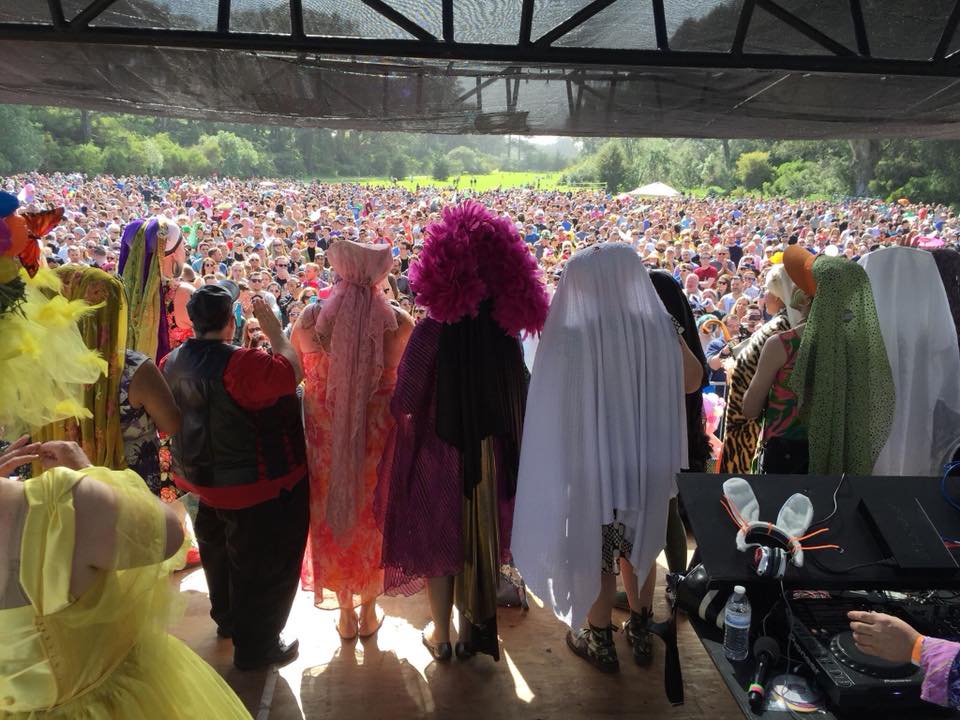
The Hunky Jesus competition went on forever.
It's nice to know that my generation can blaze the way when it comes to new manifestations of the "grumpy old man" trope. I, for example, found myself grumbling yesterday about the form of drag preferred by today's Sisters. Back when they started, they went with the traditional black nun's habit, accessorized with roller skates. Now they have to be so flamboyant it makes we want to set myself on fire. (That's an Arrested Development joke I'm pretty sure I've used before.)
My planning for the new season went pretty well. I'm in good physical shape. I shaved my beard so I can apply sunscreen better. And I have a new, sun screen flap that hangs down from the back of my hat and covers the back of my neck, since I cut my hair shorter. Though spending an afternoon with the Sisters made me wonder if I might not be even better off with a wig. Maybe next year.
Fortunately this was just a warm-up for the four day Cherry Blossom Festival in a couple weeks, because I do have something to work on. By the end of the day, and it was a short three and a half hour day for me, I was ready to kill the recycling scavengers. My assignment for this month is to chill and to avoid confrontations by not bagging up the CRV bottle and can portion of the recycling. This is tricky at picnic events like this where there's also lots of heavy glass and it helps to pull the light stuff out into bags. But there are ways to work around this, I just have to remember what they are. And chill.
I can't find any recent videos on YouTube -- which is a bit of a shock, honestly -- but here's the Hunky Jesus competition from several years back.
End of the Hundred Years' War
A History of Europe by Henri Pirenne
University Books, first published 1938 but written during the Great War
Book Eight
The European Crisis
(1300-1450)
The Avignon Papacy, the Great Schism, and the Hundred Years War
Chapter II
The Hundred Years War
2. The Burgundian Period (1432)
p436 ...The reign of Richard II [England] is memorable on account of the great rural insurrection of 1381. The fundamental cause of this rising, like that of the Jacquerie, was the poverty of the rural population... How should the political assemblies concern themselves with the troubles of the people, since they consisted only of the representatives of the privileged classes?...
...The religious movement provoked by Wycliffe let to the final catastrophe, just as in the 16th century the Lutheran propaganda led to the outbreak in Germany of the Peasant War. Of course, neither Wycliffe nor Luther urged the masses to rebel, but both reformers, by undermining the people's respect for religious authority, taught them to revolt against the social order which was the cause of their sufferings...
p437 But the peasants could not hold their own against the nobles, those steel-clad policemen. Like the Jacquerie, their rising ended in a massacre, and like the Jacquerie it was not repeated.
...
p438 [In England] The new king [Henry of Lancaster (1399-1413), chosen by Parliament] found himself in the situation which in 1689 was that of William of Orange on succeeding to James II. Parliament, to which he owed the throne, expected guarantees, which he hastened to give...
p440 ...Louis de Maele resumed possession of his County. [Flanders, following the French victory at Roosebeke.] He had just inherited from his mother Artois and the Franche Comte of Burgundy, so that on his death in 1384, Philip [the Bold] became the possessor of these territories, as well as Flanders. Combined with his Duchy of Burgundy, they gave him a power which no vassal of the Crown had ever before possessed... The result at which Charles V had aimed was achieved. Flanders was now ruled by a prince of the blood...
...
p441 ...when... [Philip the Bold] died in 1404 the influence of his dynasty was enormously increased in the Low Countries. [He married into Brabant, as well.] But these regions were so wealthy, and their political situation was so advantageous, that before long the dynasty took root there, when, forgetting its French origin, and actuated by an ambition which naturally identified itself with the interests of its northern subjects, it became naturalized among them... by the irony of history the marriage of 1369 [which had assured the Duke's possession of Flanders] was the beginning of that Burgundian power which was presently to become the cruellest enemy of France.
Already, under Jean the Fearless (1404-1419)... we see the beginning of the evolution which was to make him, the son of a pure-blooded Valois, above all things a Burgundian prince... In the interest of Flemish industry he was obliged to humor England...
Jean the Fearless has the Duke of Orleans assassinated in 1407. He supports the Paris mob against the Armagnac faction in France.
p443 ...The disaster of Agincourt (October 25th, 1415) gave Normandy to the English. The French wished to negotiate. The claims of the victors were so exorbitant that Jean the Fearless, who had merely wished to see France and England neutralize each other, made approaches to the Dauphine, round whom the Armagnacs had rallied. But men's passions were too unbridled to subordinate themselves to the national interest. On September 20th, 1419, on the occasion of their meeting at Montereau, a blow from an axe avenged the murder of the Duke of Orleans.
p444 At the very moment when the House of Burgundy was becoming reconciled to France, this crime led it to conclude an immediate alliance with the English. For sixteen years the son of Jean the Fearless, Philip the Good (1419-1467), strove to overthrow the kingdom, with an energy inspired by the spirit of vengeance and directed by political interest...
While I see what Pirenne means when he talks about the power the Third Estate is gaining -- both in France and in England -- when it comes to financing government, I can't help also noticing how the behavior of the princes is just as bloody-minded as it was in Carolingian times. This conflict between the branches of the House of Valois is a wonderful example of this. That Jean the Good is finally killed with an axe only emphasizes the brutality of the grands seigneurs.
I'm not going to go into detail about the steps that lead to Joan of Arc but I will include this,
p444 ...The exalted, simple, pure and ingenious conception of the king entertained by Joan was possible only in a child of the people. Joan of Arc was no more than the sublime expression of the national sentiment of the French peasants, a sentiment which was blended with their religious faith, and which their memories of the good king Saint Louis had indissolubly associated with the monarchy.
p445 ...when the war... was resumed in 1445, it was one series of victories. [For France.] In 1449 Rouen was recaptured. In 1450 the victory of Formigny gave the French the whole of Normandy; Bordeaux and Bayonne were theirs in 1451, and finally, in 1453, after the battle of Chatillon, [Castillon] the enemy evacuated the last positions which he still occupied in the south of the kingdom. Of all the English conquests, Calais alone was left, and the empty title of King of France, which figured on the English currency even in the 19th century. The only lasting result of the Hundred Years' War was the creation, on the northern frontier of the kingdom, of a powerful Burgundian State. Philip the Good, in assisting the English, was really working for himself... He purchased the County of Namur in 1421. In 1428 he was acknowledged... as the heir to Hainaut, Holland and Zeeland; in 1430 he succeeded his cousin... as Duke of Brabant and of Limburg; and when he concluded the Peace of Arras it was only in return for the cession of the King of Artois and the towns of the Somme. The following years brought him the possession of Luxembourg, and the protectorate over the ecclesiastical principalities of Liege and Utrecht.
So the Duke of Burgundy becomes the new Duke of Normandy.
p447 ...It was only to be expected that once France recovered from the terrible crisis by which Philip the Good had profited so greatly, she would never cease endeavoring to recover the preponderance which she had lost in the basins of the Meuse and the Scheldt. Her enemies just as obstinately disputed this preponderance, so that the creation of the Burgundian State created that problem of the Low Countries which, until the 19th century, when it was finally solved, was to give rise to so many European crises that it served... as a pressure-gauge in the international relations of the great powers.
This would be more impressive, as an explanation for why this region is so crowded with famous battlefields, if there were not already a bunch of them. More than any particular political sequence of events -- from the Treaty of Verdun to the rise of Burgundy -- I still think the "problem of the low countries" has more to do with geography.
I'm going to take another break here as I read and build up more material for future posts. There's still quite a long way to go. After all, the great German breakthrough and advance of one hundred years ago is only just getting started. Hardly any Americans have seen the elephant to this point.
This is your lucky day! I'm deleting my paean to John Browning, the Thomas Edison of American automatic weapons -- yes, this is my coinage.

