Showing posts with label England. Show all posts

Tuesday, June 19, 2018

286. Calvinism part 1 (Anglicanism?)


Link to Chronology


Not so much Calvinism as the history of the Church of England


A History of Europe by Henri Pirenne
University Books, first published 1938 but written during the Great War


Book Nine
The Renaissance and the Reformation

Chapter II
The Reformation

2. The Spread of the Reformation. Calvinism [But we will start with England]

p571 ...It was because the times had changed that the dispute with regard to indulgences almost immediately assumed the form of a religious revolution. Fifty years earlier the same man, [Luther] with the same conviction, the same fire, the same eloquence, would have interested, at the very most, a few theologians in his own province, and history would have passed over him in silence... [so the Reformation was a side effect of technology and media. Without the press, it could not have occurred. ] And further, it may readily be shown that the fundamental ideas of Lutheranism itself were not really individual to Luther. In the Low Countries Wessel Gansfort, who died ignored in 1489, and whose works were not published until 1522, has already formulated the majority of these ideas; and we find them again in France among the members of the little circle that gathered, about 1515, round Lefevre of Etaples... 

p572 ...Closely subjected to the secular power, the Landeskirchen lacked the liberty of procedure and the independence which would have been necessary for an effective external propaganda. They were too completely adapted to the political environment of Germany... Their nationalism, so to speak, made it impossible beforehand that they should exercise a universal influence. The only conquest of Lutheranism was that of the Scandinavian countries, and it was victorious there because the kings declared for it...


p573 ...Promulgated by authority and accepted in obedience, it progressed... by annexation. Conversion came afterwards, and slowly, just as a conquered people is slowly assimilated to the conquering nation.

...

It is only too evident that in those countries whose princes remained faithful to Rome the Church had nothing to fear from the Lutherans... It was soon realized that they were not very dangerous, and even in the Low Countries the Inquisition of Charles V, so ferocious in its treatment of the Anabaptists, prosecuted the Lutherans with a certain laxity.


...Henry VIII, who prided himself on his theology, regarded Luther as a mere heretic, and attacked him in his Assertio septem sacramentorum, which earned him the title of "Defender of the Faith," conferred upon him by Leo X. He persecuted Tyndale, and placed an interdict on his translation of the Bible. The motives of his opposition to Rome, and of the constitution of the Anglican Church, were entirely external to the domain of faith. Neither Henry nor -- above all -- the English people felt the least inclination to reject the traditional beliefs of Catholicism... The Pope's opposition to the King's divorce from Catherine of Aragon certainly induced him to have himself proclaimed by the assembly of the clergy "the chief protector of the church and clergy of England" (1531), in order that he might obtain the dissolution of his marriage (1533). But there matters might have stopped... The elevation of Thomas More to the post of Chancellor, after the condemnation of Cardinal Wolsey (1530), proves that the government had no thought of turning away from Catholicism. Parliament, which supported the King's cause... wished to profit by the situation and establish a national Church. But no one was dreaming of a schism, much less of a heresy. On accepting the post of Chancellor, More no doubt intended to lead the English Church... toward those moderate reforms of which the humanists had dreamed. Like Erasmus, he wished to preserve the traditional faith while purifying it... But the government was then in the hands of a man who was devoting all his energies and his genius to making England an absolute monarchy. Formed in the school of the Italian politicians, Thomas Cromwell's only conception of the State was one in which the Crown was omnipotent. [I strongly recommend reading that Wiki entry on T. Cromwell. What a life. And during a time when politics was played for keeps. It seems there are a number of films and mini-series dealing with the later stages of his life, but I would love to see something about his younger days wandering around Europe.] For him, as for Machiavelli, the Church was merely a factor of politics, but whose importance was proportionate to its influence over men's minds. To place it at the service of the prince was therefore to invest him with a power and ascendancy which he derived from its sacred character. In 1534, profiting by the obedience of Parliament and its hostility to the court of Rome, he caused it to pass the "act of Supremacy," acknowledging the king as the sole and supreme earthly head of the Church of England... In the following year the king appointed Cromwell his vicar-general in ecclesiastical affairs... This was schism, but it was not yet heresy...


p575 ...all the monasteries were subject to a "visit," the result of which was a foregone conclusion. The all-powerful minister had resolved to confiscate their property, partly for the benefit of the Crown, and partly for that of the nobles, in order that the lords and gentlemen of the country might henceforth be unanimous in favor of maintaining the new ecclesiastical constitution, just as the purchasers of national properties in the France of the Revolution were in favor of the maintenance of the Revolutionary regime... The "Articles of Religion" which the assembly of the clergy accepted without protest in 1536 cut the last tie which, by community of faith, still bound the English Church to the Catholic Church. As the bases [basis?] of dogma they accepted only the Bible and the three first Oecumenical Councils ("the Bible and the Three Creeds"), retaining as sacraments only Baptism, Penitence and the Eucharist. No modification was introduced either in the ritual or in the organization of the hierarchy. A position was adopted which was half-way between Protestantism and Catholicism, and apparently very like that toward which the humanists had wished insensibly to lead the Papacy.


p576 Yet the best and most celebrated of these humanists, Thomas More, had resigned his position as Chancellor as early as 1532, and two years later his head had fallen on the scaffold. The most pious and enlightened spirits among those who aspired to reform the Church were revolted by the violence which was imposed upon it. The government appeared to them, and actually was, a moral despotism imposed by terror. Cromwell's police carried on a veritable inquisition; and victims, chosen for the sake of example among the most illustrious men in the country, were pitilessly sacrificed to the end envisaged by the terrible minister...


...After 1536... [Henry VIII] sought to return to tradition, and the six Articles which were submitted for the approval of the clergy in 1539 marked a fairly definite revulsion in the direction of the Catholic faith. The sensational fall and death of Cromwell in 1540 were explained in part by his attempts to draw England into an alliance with the Lutherans of Germany...


p577 After... [the death of Henry VIII] there was chaos. The minority of Edward VI (1547-1553) enabled the "Protectors" -- the Duke of Somerset, followed by the Earl of Warwick -- openly to favor Protestantism. The Mass was suppressed, images were removed from the churches, the celibacy of the priests was abolished, and a Prayer Book was adopted, together with new articles of religion, constituting the doctrine to which the Anglican Church has remained faithful to this day. All these things were imposed by violence, in the midst of veritable religious anarchy. While the exasperated Catholics were inciting to revolt on every side, a new party had lately made its appearance. Calvinism had entered upon the stage.
 

I will tell you what you can't tell, because you don't have the book in your hand. We are very close to the end. While this entire work is supposed to be a first draft, this section seems to be especially rough. For instance, this section really should be two sections. Here we shift from the history of the Anglican Church to Calvinism from one paragraph to the next. Since I can't do the best thing and create a new section, I will simply break here and resume next time with Calvin.

This break is all the more important as the Lutheran and Anglican sections share an indifference to the beliefs of the actual faithful. So far we've been talking about a new faith imposed by princes and kings. That this -- seemingly arbitrary, though profitable to men of importance -- change continued to split English society into the 20th century is pretty amazing. Especially when you consider what a degraded institution the Catholic Church was at this time. And I love (holding Burke's proxy here) how even the realization of the reform ideas of the "humanists" took the form of a "terror" with random victims. 

Perhaps next time we will actually get into matters of faith, because so far this all seems to be much ado about nothing.

To be continued...


The Great War

I believe we are now ahead of the events one hundred years ago in Europe. The tide on the Western Front is yet to turn, yet Pirenne is wrapping up. He seems eager to pack his bags and return home, leaving me frustrated at missing the next phase of European history. 


The Entente Powers were planning a big offensive for 1919 including improved tanks and many more American divisions. If only this had been allowed to happen Pirenne might have made it up to the European centuries I'm more familiar with. Suddenly I find myself sympathizing with the Tietjens boys... though I still don't understand what they would have preferred to have happened in 1918. I just don't want Pirenne released from his confinement.

I haven't mentioned The Great War for some time. This year, and last, has not been encouraging for any optimists in the audience. The stupidity of man, or at least of military men, has been repeatedly confirmed. Ludendorff (for the sake of simplicity) came up with a clever system of defenses in depth on the Western Front for 1917 that allowed the Germans to hold their front, by not defending every square mile of it, with a modest force that made German divisions available for the more vulnerable Eastern Front. This all went well for the Germans as both Russia and Romania were forced out of the war. 

The French and English figured out what Ludendorff was doing in the West, and the English, of all people, came up with clever tactics for taking advantage of the defense in depth. They would take just as much as the Germans were willing to risk, and then stop. Brilliant... though Haig was unable to control himself and went back to trying to "break through" with the usual results. 

This year, 1918, the Germans threw divisions freed up by the collapse of the Eastern Front against the West in an attempt to defeat the Entente before the Americans had time to arrive in strength. The French had also learned the lessons of defense in depth and, officially, adopted that idea... only many of the army commanders refused to agree to something so practical and un-glorious. But here's the funny part: When the Germans were able to break through the too-thin French lines, they quickly ran into the usual logistical problems of not being able to reinforce and supply their attacks as quickly as the defenders could bring help up by rail. It was the American Civil War in Virginia all over again. The idiocy of the French generals lost them more men, but actually succeeded in ruining the German offensives through too quick a success.

And now the first American units are catching a first sight of the elephant at places like Belleau Wood. The German window of opportunity is closing.

Friday, May 25, 2018

279. Proletarians and serfs


Link to Chronology


Capitalism transforms society again


A History of Europe by Henri Pirenne
University Books, first published 1938 but written during the Great War


Book Nine
The Renaissance and the Reformation

Chapter I
The Transformation of Social Life From the Middle of the Fifteenth Century

2. The Renaissance in the Rest of Europe

Continued...

p525 The great wars of the beginning of the 16th century gave a fresh impetus to the spirit of capitalism. Charles V especially... was an extraordinary client for the financiers. Without the development of capitalism it may be said that his reign, which set so many armies on the march and launched so many fleets, would have been impossible... the profits of the bankers were fully comparable to the services which they rendered him. The prosperity of the Low Countries was largely responsible for maintaining the Emperor's credit, enabling him to reimburse his creditors, despite the fact he had to pay from 12 to 50 per cent interest. The Fuggers owed a great part of their fortune to the advances which they made to him... The bankruptcies of Philip II in 1575 and 1596 put an end to the alliance of private capitalism and monarchical policy. 

p526 At this moment, however, another source of gain offered itself to the insatiable financiers. About 1550 the silver mines of Peru and Mexico began to furnish Spain with ingots which presently found their way all over Europe in the form of silver coins. This inundation of precious metals reduced the purchasing power of the currency, the result being a general rise of prices. Trade, and especially industry, received a powerful stimulus, and had yet one more motive for enfranchising themselves from the insupportable control of the guilds and corporations. Manufacture -- that is, the form of production in which the artisan worked under his own roof, and was paid and given orders by a contractor -- became, from the middle of the 16th century, the typical form of industrial organization; and so it remained until the appearance of the modern factory, of which... some precocious examples might already be found here and there.


Remarkable as the development of capitalism may have been, we must not exaggerate its scope. It was superimposed on the old economic organization of the privileged cities, but it did not abolish this organization. The petite bourgeoisie continued to live in the shelter of the trade corporations and to supply the local market. Bakers, butchers, cabinetmakers, shoemakers, etc., remained faithful, until the end of the ancien regime, to the protectionism which reserved for them the exploitation of the municipal clientele. In no case did the governments think it wise or prudent to make them amenable to the common law... their fear of democracy persuaded them to tolerate these defects as the best means of keeping the "compagnons" in a docile mood... they... [did begin] to abolish the political privileges of the guilds, and to keep a tight hand, or at least of close watch, over the urban administrations... The cities could have retained their political and economic autonomy intact only be retaining their military strength. But what could their guilds and corporations do against regular armies, and what could their ancient walls avail against artillery? Only where the State was powerless, as in Germany, did they hold their own... The few attempts at resistance, such as that of the Liegois [people of Liege? I believe so.] against the Dukes of Burgundy, the people of Gand against Charles V and the people of La Rochelle against Francis I, showed that their claims were inspired only by a past which was indeed the past. The democratic policy which the petite bourgeoise had so ardently supported in the 14th century was henceforth a lost cause. Just as capitalism was supreme in the domain of wholesale trade, so the State was supreme in the domain of politics.


p527 Under the influence of the new conditions which were transforming social life the conception of the bourgeoisie was transformed in its turn. The political and juridical characteristics which had given it its special position in the society of the Middle Ages, beside the clergy and the noblesse, were gradually becoming less marked. From the beginning of the 16th century the bourgeoisie had become essentially a class of men living by exploitation or by the revenues of their wealth. The mere manual worker, according to current ideas, had ceased to belong to the bourgeoisie. It now rejected the artisans in whom its strength had formerly resided. It began to affect definitely plutocratic manners, which distinguished it from the petite bourgoisie and brought it nearer the noblesse. In each country... it developed its special features... It is enough to say that henceforth wealth was everywhere [the Low Countries, France, England] the sign par excellence of the bourgeoisie. The bourgoisie of the Middle Ages was privileged by law; the modern bourgeois is privileged by virtue of his economic situation... In the Middle Ages the bourgeois depended on his city for his livelihood, and existed for his city; the commune of which he was a member was the indispensable guarantee of his person and his interests; his mode of life and his ideas alike were dominated by the municipal group to which he belonged. But after the Middle Ages these conditions disappeared. For the modern bourgeois the city is merely a place of residence and a business center; it is no longer the center of his affections, his ideas and his interests. The sources of his wealth are widely dispersed... If he is a manufacturer his factories may be in the country; if he is a merchant his correspondents and his merchandise are distributed over distant ports and markets; if he lives on his dividends his money may be invested in distant countries, in loans, or in commercial or industrial enterprises of every kind. His livelihood is now... implicated in the existence of the nation as a whole, and its relations to foreign nations. He has to know what is happening in all parts of the world. Hence the development of the post, and presently, of the Press, whose object, in the beginning, was merely to bring within reach of all the news which until then had been translated only by private correspondence.
 

I can't help thinking of Voltaire here. He not only abandoned the city, he was all but indistinguishable from a nobleman -- though Proust's Baron would not have agreed, I'm sure. But this is a trend Pirenne has already mentioned a number of times.

p528 Economic liberty... immediately imposed its consequences upon the world of workers... The regulations of the guilds determined the worker's rights, safeguarded his wages, and guaranteed him against too glaring abuses; they often granted him aid in case of sickness or old age... But there was no trace of all this in the new system of manufacture. Here, in conformity with the "common law," the employer and employee entered into contracts directly... The one sold his labor, the other bought it, and the price depended on their "free will."... Completely unorganized... the workers in the new industries had to submit to the law of the capitalist... from the beginning of the 16th century there is abundant evidence of the wretchedness of... [the worker's] conditions, and of their discontent. The rise of prices in the middle of the century exasperated them still further, and contributed largely to the success of the semi-social, semi-religions propaganda of the Anabaptists. As for the government, it did nothing for them, ignoring them as long as they did not trouble the public peace.

p529 Here again we have striking evidence of the degree in which social changes had weakened the influence of the Church... as the ascetic spirit declined, the halo of sanctity which surrounded the mendicant faded. People began to regard him as a vagabond, dangerous to the public peace, a professional loafer... [various factors] so multiplied the numbers of wandering men who had no other resources than alms, that towards the beginning of the 15th century they had become a veritable social plague. The authorities therefore began to persecute them mercilessly, in the hope of compelling at least the able-bodied among them to work. The first administrative regulations directed against mendicity authorized it only in the case of children, the aged, and the infirm, and sought to prevent the others from begging by the threat of corporal punishment... It was well understood, from the beginning of the 16th century, that it would be necessary to attack the root of the evil and abolish mendicity by removing its cause... the reforms introduced at Ypres in 1525, under the influence of Vives... by concentrating the resources of all the charitable establishments of the city, appointing visitors to the poor, and sending children in receipt of charity to school, or apprenticing them to a trade, sought to abolish pauperism by enabling the poor man to earn a living... It is interesting to note that... [these attempts] were especially numerous and effective where the development of capitalism and manufactures enabled the charitable societies to find situations for their charges. The example of Holland, and above all of England, is particularly significant in this respect. The English laws of 1551 and 1562 relating to the employment of the poor were the precursors of the famous Act for the relief of the poor of 1601, which was so admirably adopted to the needs of modern industry that in its essential features it has survived to this day.
 

I have to say, this section could not be more relevant today. The main differences being that the problem now is the reduction in the number of jobs for the unskilled (or even the skilled) and possibly the degree to which mental illness or diminished mental capacity is involved.

p530 ...Society contented itself with compelling the poor man to work; it did not attempt, as the cities of the Middle Ages would have done, to regulate the work itself. Until the 19th century it subjected labor to no restrictions, and this fact is eloquent of the capitalistic character which was henceforth the essential feature of the economic world. 

It would be interesting to know how, back then, the successful capitalist justified to himself the exploitation of the workers. Was this perhaps where Calvinism played a role? Or were attitudes the same among Catholics?

p531 It is... not surprising that from the second half of the 15th century, contemporaneously with free industry, and increasing with its expansion, a proletariat made its appearance whose history has yet to be written. It is true that there existed, in the Middle Ages... a class of wage-earners whose condition was very nearly that of the proletariat.... the modern proletarian was completely at the mercy of his employer... Moreover, they were too wretched and too uneducated to organize themselves... during the three centuries that began about 1450... manufacture, even in those countries in which it was most advanced, still played only a limited part in the activities of the nation... It was far less important than commerce, and above all, than agriculture, which everywhere remained the essential branch of production.

God, this is a long, but interesting, chapter.

p532 ... Here too [in agriculture] the advance of capitalism was profoundly felt. In some counties it had the effect of enfranchising the peasant, while in others it forced him back into a state of servitude far completer, and... much harsher than that of the Middle Ages... In those counties which were economically the most advanced, like Italy and the Low Countries, the landowners... were inclined systematically to favor free labor.

...as early as the beginning of the 15th century we see that in Italy what was left of the ancient servitude was replaced by personal liberty. As early as 1415 a Florentine statute decreed the obligatory suppression of serfdom... In the Low Counties, from 1515 onwards, the prince issued a number of edicts whose purpose was to enfranchise both the man and the soil... The enfranchisement of the peasants was in reality the enfranchisement of the landowner, who, having henceforth to deal only with free men who were not attached to his land, could dispose of the latter by means of simple revocable contracts... 


p533 Further, as serfdom disappeared... the technical methods of agriculture were improved and modernized. In the 15th century the cultivation of rice was introduced in the Lombard plain; the rearing of silkworms became general in the Midi in the reign of Louis XI. In Flanders... Fallow land was sown with clover, so that it no longer lay idle... Spain and England sacrificed the cultivation of cereals to sheep-farming... It was the flocks of sheep that gradually made Castile the stony, treeless desert which it has become, and it was owing to sheep-farming that pastures began to cover a larger and larger area of the English soil, where the sheep replaced the peasant and his plough. From the reign of Henry VI onwards Parliament was continually passing Enclosure Acts, which authorized the conversion of arable soil into pasturage, driving evicted tenants into the ranks of the proletariat, from which the manufacturers recruited their workers.
 

I guess the Highland Clearances are later in time, though the same idea. Actually they run together. The Clearances start in the first decades of the 18th century and are mostly complete by the middle of the 19th century while the first Inclosure Act is 1773 and the last not until near the end of the 19th century. Wiki says "Between 1604 and 1914" for the Inclosure Acts. Which is a century after Henry VII (1457-1509). This may be where Pirenne's inability to consult his books lead him a bit astray. At least in Britain, this effect of capitalism and modern methods seems to have occurred a century or more later than the period he's discussing.

p534 While in Western Europe the evolution of capitalism tended to make the peasant a farmer or a worker for wages, in Germany it created a new form of serfdom. The essential cause of this phenomenon... must be sought in the omnipotence and brutality of the nobles, whom the territorial princes did not dare to oppose... the nobles took advantage of the distress caused by the excess of population in order to oppress the rural class. If agriculture had been further advanced, or if industry had been more extensively developed, the peasant might have discovered new resources on the spot. But the feeble economic development of Germany delivered him, defenseless, into the hands of his seigneurs... beyond the... [Elbe], in Brandenburg, Prussia, Silesia, Austria, Bohemia, and Hungary, the most merciless advantage was taken of... [the situation.] The descendants of the free colonists of the 13th century were systematically deprived of their land and reduced to the condition of personal serfs (Leibeigene). The wholesale exploitation of estates absorbed their holdings and reduced them to a servile condition which so closely approximated to that of slavery that it was permissible to sell the person of the serf independent of the soil. From the middle of the 16th century the whole of the region to the east of the Elbe and the Sudenten mountains became covered with   Ritterguter  exploited by Junkers, who may be compared, as regards the degree of humanity displayed in their treatment of their white slaves, with the planters of the West Indies. The negro in the New World, and the German peasant in the Old World, were the most typical victims of modern capitalism, and they both had to wait until the 19th century for their enfranchisement. [The Junkers represent "modern capitalism"?]... There were still periods of dearth, but there were no more famines... [Check the climate data.] there may have been something like forty inhabitants per square kilometer in the two regions that were then most densely populated: Italy and the Low Countries. France, about 1550, seems to have had a population of something like 18,000,000. At the same date the commercial metropolis of the West, Antwerp... did not contain more than 100,000 inhabitants.

p535 ...The total amount of wealth had increased, but this increase was distributed in a very unequal manner. Practically no one profited by it excepting the great landowners, the nobles, the Church, the wholesale merchants, and the manufacturers. That middle class which was composed of small independent producers, which was so widely distributed in the 13th century... was visibly declining... If the noblesse of the modern era seems in many respects to have been even prouder and more arrogant that [than?] that of the Middle Ages, that is because it felt the need of maintaining the social distinction, in respect of the "nouveaux riches," which the similarity of fortune, education, and interests might easily have led the latter to overlook. However, nothing could have been easier than for the new men to obtain letters patent which would enable them to enter the ranks of the noblesse, and share in the prestige which it owed to tradition, but which was maintained by its wealth. Aristocracy and plutocracy -- these, in the last resort, are perhaps the two words which best characterize the social transformation which was accomplished at the time of the Renaissance.
 

Haven't we seen the same thing going back to the Carolingian period? How is this any different? I appreciate the importance of the upper class always being permeable to new people of wealth, but if you are going to keep talking about it you either have to make clear how this differs from period to period or how it is identical.

I'm now caught up again, and I'm reading a new book club book. There will be another break before I return to Pirenne.

Monday, April 2, 2018

269. Rise of Burgundy


Link to Chronology


Spring 2018

Every morning, when I look out my kitchen window, the maple tree is greener and visibly fluffier. And my allergies are just about killing me. 

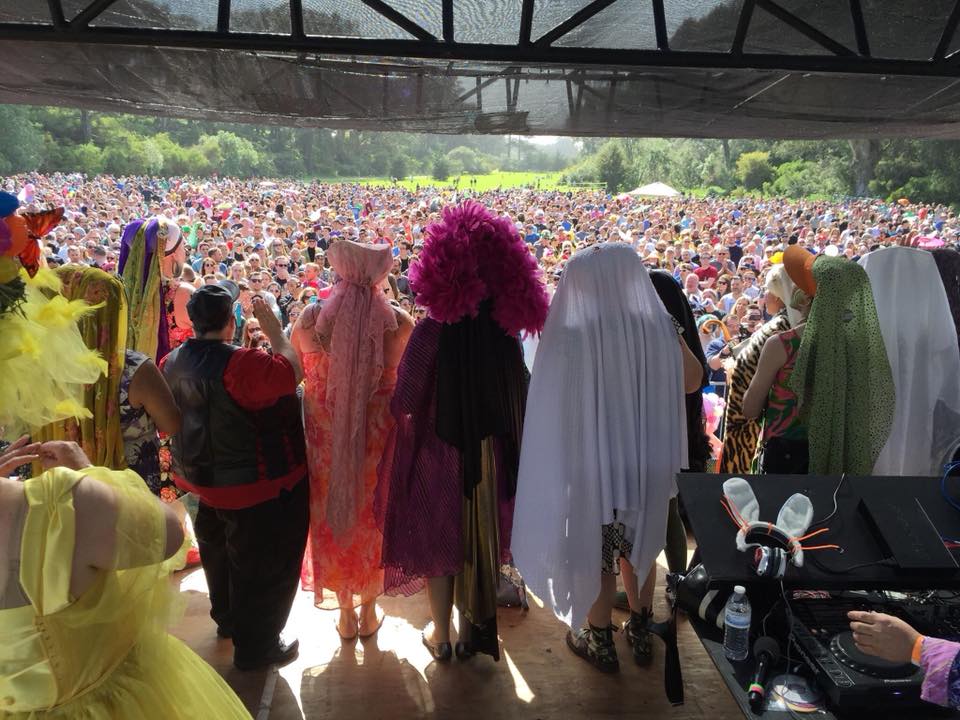
Yesterday was our first "real" greening event of the year. (By "real" I mean it was a public event in Golden Gate Park on a beautiful day.) 


Some of the Sisters of Perpetual Indulgence on stage.

The Hunky Jesus competition went on forever

It's nice to know that my generation can blaze the way when it comes to new manifestations of the "grumpy old man" trope. I, for example, found myself grumbling yesterday about the form of drag preferred by today's Sisters. Back when they started, they went with the traditional black nun's habit, accessorized with roller skates. Now they have to be so flamboyant it makes we want to set myself on fire. (That's an Arrested Development joke I'm pretty sure I've used before.)

My planning for the new season went pretty well. I'm in good physical shape. I shaved my beard so I can apply sunscreen better. And I have a new, sun screen flap that hangs down from the back of my hat and covers the back of my neck, since I cut my hair shorter. Though spending an afternoon with the Sisters made me wonder if I might not be even better off with a wig. Maybe next year.

Fortunately this was just a warm-up for the four day Cherry Blossom Festival in a couple weeks, because I do have something to work on. By the end of the day, and it was a short three and a half hour day for me, I was ready to kill the recycling scavengers. My assignment for this month is to chill and to avoid confrontations by not bagging up the CRV bottle and can portion of the recycling. This is tricky at picnic events like this where there's also lots of heavy glass and it helps to pull the light stuff out into bags. But there are ways to work around this, I just have to remember what they are. And chill.


I can't find any recent videos on YouTube -- which is a bit of a shock, honestly -- but here's the Hunky Jesus competition from several years back.


End of the Hundred Years' War


A History of Europe by Henri Pirenne
University Books, first published 1938 but written during the Great War

Book Eight
The European Crisis
(1300-1450)

The Avignon Papacy, the Great Schism, and the Hundred Years War
  
Chapter II
The Hundred Years War

2. The Burgundian Period (1432)

p436 ...The reign of Richard II [England] is memorable on account of the great rural insurrection of 1381. The fundamental cause of this rising, like that of the Jacquerie, was the poverty of the rural population... How should the political assemblies concern themselves with the troubles of the people, since they consisted only of the representatives of the privileged classes?... 

...The religious movement provoked by Wycliffe let to the final catastrophe, just as in the 16th century the Lutheran propaganda led to the outbreak in Germany of the Peasant War. Of course, neither Wycliffe nor Luther urged the masses to rebel, but both reformers, by undermining the people's respect for religious authority, taught them to revolt against the social order which was the cause of their sufferings... 

p437 But the peasants could not hold their own against the nobles, those steel-clad policemen. Like the Jacquerie, their rising ended in a massacre, and like the Jacquerie it was not repeated.

...

p438 [In England] The new king [Henry of Lancaster (1399-1413), chosen by Parliament] found himself in the situation which in 1689 was that of William of Orange on succeeding to James II. Parliament, to which he owed the throne, expected guarantees, which he hastened to give...


p440 ...Louis de Maele resumed possession of his County. [Flanders, following the French victory at Roosebeke.] He had just inherited from his mother Artois and the Franche Comte of Burgundy, so that on his death in 1384, Philip [the Bold] became the possessor of these territories, as well as Flanders. Combined with his Duchy of Burgundy, they gave him a power which no vassal of the Crown had ever before possessed... The result at which Charles V had aimed was achieved. Flanders was now ruled by a prince of the blood...

...

p441 ...when... [Philip the Bold] died in 1404 the influence of his dynasty was enormously increased in the Low Countries. [He married into Brabant, as well.] But these regions were so wealthy, and their political situation was so advantageous, that before long the dynasty took root there, when, forgetting its French origin, and actuated by an ambition which naturally identified itself with the interests of its northern subjects, it became naturalized among them... by the irony of history the marriage of 1369 [which had assured the Duke's possession of Flanders] was the beginning of that Burgundian power which was presently to become the cruellest enemy of France.


Already, under Jean the Fearless (1404-1419)... we see the beginning of the evolution which was to make him, the son of a pure-blooded Valois, above all things a Burgundian prince... In the interest of Flemish industry he was obliged to humor England...
 

Jean the Fearless has the Duke of Orleans assassinated in 1407. He supports the Paris mob against the Armagnac faction in France.

p443 ...The disaster of Agincourt (October 25th, 1415) gave Normandy to the English. The French wished to negotiate. The claims of the victors were so exorbitant that Jean the Fearless, who had merely wished to see France and England neutralize each other, made approaches to the Dauphine, round whom the Armagnacs had rallied. But men's passions were too unbridled to subordinate themselves to the national interest. On September 20th, 1419, on the occasion of their meeting at Montereau, a blow from an axe avenged the murder of the Duke of Orleans.

p444 At the very moment when the House of Burgundy was becoming reconciled to France, this crime led it to conclude an immediate alliance with the English. For sixteen years the son of Jean the Fearless, Philip the Good (1419-1467), strove to overthrow the kingdom, with an energy inspired by the spirit of vengeance and directed by political interest...


While I see what Pirenne means when he talks about the power the Third Estate is gaining -- both in France and in England -- when it comes to financing government, I can't help also noticing how the behavior of the princes is just as bloody-minded as it was in Carolingian times. This conflict between the branches of the House of Valois is a wonderful example of this. That Jean the Good is finally killed with an axe only emphasizes the brutality of the grands seigneurs. 

I'm not going to go into detail about the steps that lead to Joan of Arc but I will include this,

p444 ...The exalted, simple, pure and ingenious conception of the king entertained by Joan was possible only in a child of the people. Joan of Arc was no more than the sublime expression of the national sentiment of the French peasants, a sentiment which was blended with their religious faith, and which their memories of the good king Saint Louis had indissolubly associated with the monarchy.

p445 ...when the war... was resumed in 1445, it was one series of victories. [For France.] In 1449 Rouen was recaptured. In 1450 the victory of Formigny gave the French the whole of Normandy; Bordeaux and Bayonne were theirs in 1451, and finally, in 1453, after the battle of Chatillon, [Castillon] the enemy evacuated the last positions which he still occupied in the south of the kingdom. Of all the English conquests, Calais alone was left, and the empty title of King of France, which figured on the English currency even in the 19th century. The only lasting result of the Hundred Years' War was the creation, on the northern frontier of the kingdom, of a powerful Burgundian State. Philip the Good, in assisting the English, was really working for himself... He purchased the County of Namur in 1421. In 1428 he was acknowledged... as the heir to Hainaut, Holland and Zeeland; in 1430 he succeeded his cousin... as Duke of Brabant and of Limburg; and when he concluded the Peace of Arras it was only in return for the cession of the King of Artois and the towns of the Somme. The following years brought him the possession of Luxembourg, and the protectorate over the ecclesiastical principalities of Liege and Utrecht.

So the Duke of Burgundy becomes the new Duke of Normandy.

p447 ...It was only to be expected that once France recovered from the terrible crisis by which Philip the Good had profited so greatly, she would never cease endeavoring to recover the preponderance which she had lost in the basins of the Meuse and the Scheldt. Her enemies just as obstinately disputed this preponderance, so that the creation of the Burgundian State created that problem of the Low Countries which, until the 19th century, when it was finally solved, was to give rise to so many European crises that it served... as a pressure-gauge in the international relations of the great powers.

This would be more impressive, as an explanation for why this region is so crowded with famous battlefields, if there were not already a bunch of them. More than any particular political sequence of events -- from the Treaty of Verdun to the rise of Burgundy -- I still think the "problem of the low countries" has more to do with geography.

I'm going to take another break here as I read and build up more material for future posts. There's still quite a long way to go. After all, the great German breakthrough and advance of one hundred years ago is only just getting started. Hardly any Americans have seen the elephant to this point. 

This is your lucky day! I'm deleting my paean to John Browning, the Thomas Edison of American automatic weapons -- yes, this is my coinage.

Monday, February 5, 2018

252. England & France


Origin of States


A History of Europe by Henri Pirenne
University Books, first published 1938 but written during the Great War

Book Six
The Beginnings of the Western States

Chapter 1
England

1. Before the Conquest

England was unique in Europe in that the Angle-Saxon kingdoms remained Germanic with no Roman influence. (The surviving Celts had withdrawn to Wales, Cornwall and Brittany.) 

p245 It was at the end of the 11th century -- that is, at the epoch when the appearance of the bourgeoisies was completing the social constitution of Europe -- that royalty [on the Continent] began to lay the foundations of the first States worthy of the name...
...

p248 ...Bruges and Rouen, from the end of the 10th century, maintained an increasingly active navigation with England. With the return of a more advanced civilization the order of things which had so long been interrupted by the Barbarian invasions once more followed its natural course.


The Norman conquest was merely the consequence and final consecration of what may be called the Europeanization of England... 


p249 The ducal house of Normandy was closely related to that of Edward the Confessor, [who died without issue 1066] whose mother, Bertha, was a Norman princess... 


...On the Continent the powerful feudal aristocracy had diminished the status of the king only to increase its own... In England... no one had any real power... The feudal system and the order of chivalry were unknown. The Anglo-Saxon earls and thanes, armed with battle-axe and sword, fought on foot.

...

p250 ...The Anglo-Saxons, who had so long struggled against the Scandinavian invasion, submitted at once to the Norman invasion.


2. The Invasion

p252 ...Since he [William, Duke of Normandy] held his kingdom [England] only by the sword, since he ruled his new subjects only by force... The indispensable condition of success was to subject everything to the royal power, to make it so strong that nothing could shake it. The constitution had to be... essentially monarchical. It was reserved for a great vassal of the King of France to create the most vigorous monarchy in Europe.

...All the Continental kings were elected by their great vassals, but the great vassals themselves were hereditary. William was the hereditary Duke of Normandy, and he remained a hereditary prince as King of England, so that while the other kings were given their crowns... he was from the first the true possessor of his own crown... The entire territory of England was his property; he exercised over it a right analogous to that which the seigneur of a great domain exercises over his estate; in their relation to him, all the private occupiers of land were merely his tenants... He took care to ensure that no one should become, in his kingdom, what he himself was in the kingdom of France, and neither under him, nor at any other time, was the English feudality more than what may be called a purely feudal feudality. It had lands, but no principalities; it had tenants, but no subjects.


3. The Great Charter

p254 ...

The first kings of England had had no Continental possessions beyond their Duchy of Normandy. Henry Plantagenet [1154-1189] added to this the Duchy of Anjou... and the Duchy of Guyenne... Thus all the coast of France, with the exception of wild Brittany, belonged to the King of England... [?? Does he not know where Anjou was? And it wasn't a duchy until 1360.] But to his reign also must be referred the origin of that conflict with France which, from then until the beginning of the 19th century, recurred... throughout the history of Europe...
...

p257 Magna Carta might be called the first Declaration of Rights of the English nation... The barons who imposed it on the king did not forget their allies; they made stipulations not only for themselves, but also for the clergy and the bourgeoisie. At first sight, nothing would appear more incoherent than this charter, which proclaims, without order, entirely at random, the confirmation of feudal usages, clerical franchises, and urban liberties... by wrestling pell-mell from the king so many different rights, and by confounding, in a single text, the claims of all the classes, it established between them a solidarity which would endure... The common danger, and the common oppression, had here allied and united a solid complex of interests... Elsewhere the kings had been confounded by different "estates,"... In England, the Crown had to deal directly with the nation...


p258 ...The principle that taxes should be voted by the nation constituted the essential basis of the Great Charter, and for this reason it was the basis of the first free government that Europe had known...


Chapter II
France

1. The King and the Great Vasals
...

p265 From the reign of Louis VII to that of Philip Augustus the royal power made such progress as cannot be explained merely by the genius of the king. It was due very largely to the economic and social transformations occasioned by the development of the bourgeoisies. During the second half of the 12th century all the cities of Northern France had constituted themselves as sworn communes. Almost everywhere, in the episcopal cities -- at Arras, Noyon, Senlis, Loan, Reims, etc. -- they had to struggle against the resistance or the ill-will of their bishops, imploring the king to support them, a request he hastened to grant. In this way an understanding was established between the Crown and the bourgeoisies which assured the royal policy of the co-operation of the youngest, most active, and wealthiest class of society.

p266 ...The royal treasury, hitherto merged in the total private fortune of the king, became a special branch of the administration. The oldest treasury accounts that we possess date from the reign of Philip Augustus. Not only was the king henceforth able to hire bands of mercenaries in time of war, but he was able... to attach to his service men who were true functionaries: that is to say, paid agents who could at need be dismissed... Capable henceforth of paying his servitors, the royal prince was no longer obliged to entrust their offices to hereditary incumbents whom he could not dismiss if he chose. The replacement of the old agricultural economy by a monetary economy removed the obstacle which, since the Frankish epoch, had invincibly hindered the development of the State.

...

p267 Philip Augustus may therefore be regarded as the veritable creator of monarchical power, not only in France, but on the Continent... [Footnote: Except in Sicily, where the foundations of the State were Byzantine.]

...

p268 The Counts of Flanders, who under Louis VI had fought beside the monarchy against England, under Philip Augustus sided with England against the monarchy. It was very natural that being threatened by the increasing power of their suzerain they should seek support in the great island whose next-door neighbor they were, and on which the industrial cities of their country were dependent for their wool. The cities, which in France supported the Crown, took the side of their prince in Flanders... simply on account of their economic interests... The policy of the Flemish princes thus assumed, from the beginning of the 13th century, an amplitude which no longer permits us to regard it as a mere policy of feudal resistance... it inaugurated an alliance with England, which being based on mutual interest, was perpetuated through the centuries, finally becoming one of the most important factors of the future independence of the Low Countries... on the other hand, by relying on the support of the bourgeoisies it assumed the appearance of a national policy, which identified the cause of the bourgeoisies with that of the dynasties.

...

p270 ...the conflict between France and England [1212] divided the whole of Europe into two camps, and its issue was to decide the fate of the West. The enemies of Philip Augustus resolved, in 1214, upon a decisive effort. While John [Lackland, King of England] was to attack him through Guyenne, Otto of Brunswick marched upon Paris through the Low Countries, rallying... the troops of Ferrand of Portugal... The clash took place at Bouvines, near Tournai, on July 27th, [1214] and the result was a brilliant triumph for Philip Augustus. This was the first of the great European battles, and if we except Waterloo, where six hundred years later the same adversaries were to confront one another, no other battle had such vast and immediate consequences. In Germany, Otto of Brunswick was replaced by Frederick II. In England John Lackland, humiliated, saw the barons rise against him and enforce his acceptance of the Great Charter. In France the territorial conquests were assured (Treaty of Chinon); the feudality was vanquished in the person of Ferrand of Portugal; and the royal power... was invested in the eyes of the people with a national prestige that endowed it with twofold vigor.


It is interesting that the Duchy of Brunswick became part of the Kingdom of Hanover (I think) by Napoleonic times, but it's a bit of a stretch to say "the same adversaries" were involved in both battles. But it was England, "Germany," and the Low Countries vs France.

Of all the great battles that have taken place in and around Flanders, Bouvines is the one I'm least familiar with. Pirenne doesn't spell this out, but after the battle Philip secured the parts of France -- like the Duchy of Normandy -- that had previously belonged to the King of England. Bad King John, indeed.

And then, everything being finally settled, they all lived happily ever after. Ha!