Showing posts with label Jane Jacobs. Show all posts

Thursday, August 3, 2017

182. Of this and that


Previous - 181. Flower Piano


Money


I believe I've already written about my curiosity as to where money for something like a government military acquisition -- like a ship -- goes. In the same vein I wonder what the wealth of the average billionaire is actually doing. When people talk against the One Percent the assumption seems to be that their wealth is in gold and jewels stashed under their beds. In reality, I imagine their wealth -- when it isn't tied down in the stock of a company they are associated with, or in land -- is actively doing the kinds of things one expects capital to do. Perhaps we would want to redirect it to different sectors of the economy, or to different charities, or to different politicians, but that capital is still out there actively creating jobs of one sort or another. (Now I'm pretty sure I have written about this before.) Even the money they spend on themselves goes from pocket to pocket.


People really should be protesting me. Aside from supporting (in a very modest way) a number of modest cafes and restaurants, I spend almost nothing in ways that put dollars in the pockets of clerks or plant workers or artisans or even repair-people.


As I imagine Ford Madox Ford's good Tory landowner, one of his primary roles is to be the chief consumer of his neighborhood. Consuming the fruits of his tenants labor (or labour). Of course this is a role that Christian Tiejens shirked. Voltaire may have been much better in this regard. Also Vronsky. And do we want to be dependent on the occasional good seigneur? Especially when we know that the average landlord will see the benefit of clearing the land or in-closing the commons -- just as the average Clinton and Obama supporting landlord in SF sees the benefit of asking for the maximum rent the market will bear.


It just occurred to me that Sir Walter Eliot in Jane Austen's Persuasion could be the poster child for the economic quality I'm talking about. His inability to "retrench" would have been greatly beneficial to the common people around Kellynch Hall. We see him as vain and uncaring of others -- even when he is played by Tony Head (BtVS's Rupert Giles) -- but I imagine that, when they left for Bath, his purse was more missed in the neighborhood than was Anne's wisdom and good sense.

And now I'm wondering if any of the Annales School historians has studied the economic effect of the concentration of nobility in Versailles under Louis XIV? I'm guessing it was a sad time for the rest of France.


"Ballet of the good city sidewalk," with coughing 

This morning I had a very early doctor's appointment downtown -- so equal distance between my gym and the Bank Cafe (where I'm writing this. I even got one of the nice chairs in the window I'm so early). I woke an hour early and was walking to my appointment at the time when I usually wake up. My point being that I was seeing Bush Street at an unusual hour. 

This is the stretch of Bush I've written about before because it has so many French connections and because it is the haunt of the smoking gnome. I was only two hours earlier than normal, but the street felt so different I was reminded of Jane Jacobs's "ballet of the good city sidewalk" from The Death and Life of Great American Cities.

If I gave that woman a copy of the book, do you think I could get her to write her own description of the changes on Bush over the course of a day? No. But I love the idea. As perfect as Jacobs's Greenwich Village street was, this stretch of Bush may be even better. There are a number of small hotels and restaurants catering to tourists. There's the Tunnel Top bar and that nest of commerce by the Stockton tunnel that I've already written about -- including The Green Door Massage parlor

But there are also apartment buildings, the big parking garage, the church, the consulate, and the Goethe Institute. And of course the ebb and flow of commuter foot traffic that I've also written about before. 

Walking here to the Bank Cafe from the doctor's was like swimming against a salmon migration as I neared Market and the swarm of commuters exiting the train station there around 9am. And while 7am is early for me now, I know from my taxi days that the Financial District (and now the downtown part of SOMA as well) wakes up at 4:30am. Somewhere in there I'm sure there's a shift change with commuters (coffee cups in hand) starting to trickle in by car, bike, bus, train, and ferry while the "homeless" start to breakdown (some) of their camps and move into their begging positions.

YouTube


One of my favorite YouTube science presenters (?) is in the midst of a wonderful series of videos about Quantum Field Theory. (Here and Here and here and here .) I was promised a second video focused on Richard Feynman but there has been an annoying delay. (Here.)

My favorite Medium writer about science just did a wonderful piece on what's been learned about the universe (astrophysics, here) in the past hundred years. But it's almost like they are teasing me because what I want from both of these sources is more about Quantum Chromodynamics. 

It would seem to be the logical next step for the YouTube person, and perhaps the third step ahead for the Medium person. But I don't know if they see it the same way.

New book


Our latest book club title is My Name Is Lucy Barton. A novel by Elizabeth Strout. I'm enjoying it but there's nothing to write about so far. It's a refreshing change of pace, to be honest.

So, having said that I read a few more sections... The book, at least so far, is about how we are shaped by our childhoods; by how our parents managed their parental duties along with everything else in their lives. 

It's easiest to see this when the parents did an obviously bad job, leaving their kids with emotional injuries they often never recover from. But it's always worth being reminded that the parents who did a better job are also responsible for how their children turned out. At least to some extent. 

I'd say my parents did a great job up until I was about eight, and that may be the most character forming period. My mother always said I was born "this way" -- calm and reserved, I guess. Self-sufficient. Yet would I have stayed this way if I hadn't been so supported in those early years? No way to know.

Now, I remember the way my parents argued constantly, from the time I was eight or nine until I left home after high school, the way I remember that I had swine or avian flu several times in the 1950s and 1960s (that I hope will continue to give me some immunity in the future). I recall it but I don't dwell on it or remember the day to day anxiety unless I really think about it (like now.) The immunity I got from that experience has also stayed with me and shaped me in social ways. It's the main reason I can check off the "Single, never been married" option on some forms.

One of my online friends has had a life, but especially a childhood, that no one would believe if you recorded it in the form of a novel. She's more damaged but also more resilient than I am. 

Next - 183. Seeing the end

Friday, November 4, 2016

69. When Cities Work


Previous - 68. You will + Game 7


Finally a shot of the refused left flank of that new building going up on Bush. This facet of the building preserves natural light (and views) for both the neighboring Russ building and the new structure.


The Green Door building

I'm going to go out on a limb and guess that no one else, writing about city planning and the urban experience, would ever choose this building as an example of the city at its best, but all those straw-men would be wrong, wrong, wrong.

The chief virtue of this building is everything it has going against it. On the Bush street level,


My building of interest is the small structure housing the market. Note that it is dwarfed by both the residential building on the right and the parking garage on the left. 


In this view you can see that, in addition to the market, there is also a small restaurant and a fairly famous bar named The Tunnel Top.


...it lies a block too far down a recently gentrifying street and a block too far up a hill from one of the City's highlight intersections -- where the Union Square shopping district meets Chinatown's tourist extension at the Chinatown Gate. (There's an odd, but ingenious, three block Chinatown finger or limb or root that taps into the Ghost world right at the heart of the French Quarter, across from Cafe de la Press. The real Chinatown starts at Sacramento and extends north but also east and west. Grant street south of Sacramento is Chinese only in the buildings facing Grant itself.) But back to my building of interest...

On the Stockton street level,


This is the view looking down on the lower level of Stockton from Bush. Note the Green Door Massage sign to the right.


This is the view looking back down lower Stockton toward Bush. Here you can see the Stockton tunnel that runs under Nob Hill, below both Bush street and upper Stockton, to the real Chinatown.


...it faces a huge parking garage and anchors one end of a block of opportunistic businesses that thrive (I hope) in old buildings in a zero status location on the edge of a good neighborhood.


The south section of the block: (I'm ignoring what will be a CVS pharmacy if they ever finish work on the place) The red awning belongs to an upscale hotel and bar.


Boba Guys is a popular new addition. There's always a line.


Mana is a pretty decent taqueria.


This story has to start with The Green Door itself. Trying to find some background I found THIS, even better, instead. I think I would like Katy St. Clair. With that as an appetizer, here's my understanding of the layout of the building, but first a little about the unique geographic character of the structure. 

Even in San Francisco it's unique to have a building with street access to one street on the third floor and street access to another street on the ground floor. And then there's the civic stairs next to the tunnel that connects the Bush and Stockton sidewalks. As near as I can tell (without bothering to get a massage), the third floor is divided between the bar, restaurant, and market. The ground floor is divided between the salon, photography store, shoe repair place, and the massage parlor. I assume most of the massage parlor is on the second floor.


This is probably the best view of the building. The small arch on the right leads to the pedestrian walkway through the tunnel and also to the stairs that lead up to Bush. A year ago I would have said the stairs/urinal, but this is one of the places they've used this special paint that caused urine to bounce back onto you if you releave yourself against the wall. To my surprise, it has been effective... though not perfect.


The shoe repair place (decent for simple jobs) shares an entrance with the massage parlor. A friend of mine took all her new paintings to the photography business in the center to have professional images made for submitting to gallery competitions. While waiting for the photographer to finish with the painting so I could put them back in the van, I noticed the interior of the salon on the right which is stylishly white and clean, as you would expect.


So seven business operating in this one little, old building in a questionable location. While I said the location is off the beaten path, there is still decent foot traffic especially down on Stockton where three busy bus lines stop. Still, I think the main advantage for business in this block is reasonable rents due to the age and condition of the buildings, and that no business with options would opt to settle here. These are the kind of buildings Jane Jacobs had in mind when she claimed shiny new developments are not supportive to city life.

But remember I'm also the guy who always wants to find a way to sneak around Jane Jacobs' rules. That so much can be packed into this single block (ignoring the Bush street addendum for the moment) suggests that really tiny zones of below market rate commercial rents could make a big difference in a city. A city, or a non-profit, could conceivably organize and sponsor something like this. The less desirable the location, the lower the rents would have to be. The more businesses the better. Call it a commercial incubator if necessary, though it would be better if successful businesses could persist at the same location for an extended period. 


Postscript

It turns out the name Green Door, and even the porno Behind the Green Door, are probably a reference to a song from the mid 1950s. Here's "Green Door."


Next - 70. A new book

Thursday, September 22, 2016

44. Jacobs & George


Previous -  43. 94 F


This and that

It's been a busy week. I've completed almost all the HOA errands and tasks I can do before the professional painting. And one day another owner was in residence so that helped with some tasks that I just can't quite do by myself -- which also led to socializing and too much wine in the evening.

Anyway, the laundry room is done, including the improvised door to block off the alcove, and I even hung a motion sensing light on the wall in there. I caulked and painted the improvised kick-plate with sweep on the back door and it looks pretty amazing, for our $6 investment. Tonight the last of the junk goes out for our free Bulk pick-up. 

It's too windy at the moment to touch-up the front iron work with black spray paint, but that's a small job I should be able to do tomorrow. I've finally been able to schedule a contractor to come by, just after Hardly Strictly Bluegrass, to take a look at the back yard. I think we have a decent shot at getting the yard and then the painting done before the end of October. I'm rambling.


Hardly Strictly Bluegrass


And speaking of HSB, we are just over a week away now. I was notified about a pre-event meeting to be held in the park a week from today. I've been sending out emails about this since last October so I really don't have anything more to add (and it's a long way to go just to see things I know too well and eat some pizza) but, I've been specifically invited so I guess I'm going to have to make the trek out there four days in a row rather than the three days I was expecting. 

It had better be decent pizza. (Hmmm... there's a cafe near there with very good fountain service. I could indulge in a pre-event milk shake before the ordeal begins.)


Jane Jacobs

In what I like to think of as "continuing education," one of my college professors sent me a link to a very interesting article about Jane Jacobs she knew I would want to see. I don't disagree with anything in the article -- though I'm tempted to launch a defense of Jacobs on a couple points -- but I think the piece is fair. I've commented on the dark side of citizen activism myself. 

Today there is a column in the San Francisco Chronicle about a development which is still in the early planning stages in Brisbane (an oddly charming small town on the Bay, just over our southern border). I'd link it but it's still behind a pay-wall -- maybe in a few days it will make it to SFGate

I say it's in the early planning stages but I've made extensive plans for that area for decades. The site was a rail yard along the tracks Caltrain uses when leaving or entering SF from the Peninsula. I watched them rip up the rails and tear down most of the structures back in the 1990s. I've envisioned a dense and diverse new neighborhood that incorporates most of Jacobs' rules while attempting to sneak around her view that big, starting-from-scratch plans like this never work. For example, a certain number of the small blocks, especially on the periphery, would not be fully developed at first. Some would be occupied by construction related businesses like lumber yards and specialty electrical and plumbing businesses, so that workers don't have to leave the site to get most of what they need. There would also be low rent spaces for cafe's or food trucks feeding those workers. Once the bulk of the project is built, these blocks would be filled in as a 2nd phase. 

But some blocks would be low-rise, high-concept mini-developments (tents and shipping containers and the like) with lower rental rates to spur economic activity as the site slowly fills in. These blocks, too, would probably be built up at a later date -- though perhaps not. 

At any rate, I imagined tens of thousands of new residents (if not tens of thousands of new residential units) with easy access to Caltrain and the Muni Metro T line. Brisbane has a very different idea.

Their idea, since they are very happy with the current small town feeling of the place, is that it will be a place for people to work or possibly shop but not live. They don't want any new housing. 

Now Jacobs was a big advocate of mixed use, so she wouldn't approve of this plan. But she is most famous for showing that the people, not big shots, should decide what is best for a neighborhood. Again, this is the dark side of that particular "Force." 

And you don't have to go to Brisbane to find that dark side in action. The New Yorker piece kept referring to the "San Francisco problem" (which I would rather call the "Aspen problem") meaning the destructive effect of high rents due to the unreasonable popularity of a place. This too is a result of "the people" taking charge of planning and limiting growth, of them saying, "We like it the way it is right now." 

It's always dangerous to make statements about something you know nothing about, but I would be very much surprised if there weren't a large number of people who came to regret the tattoos they were so eager to get while in their teens. I'm too cheap and pain-averse to ever even consider getting a tattoo, but if that weren't true, I could imagine myself in my late teens borrowing a nice image from William Blake, for example. I don't hate William Blake now, but I also don't recall the last time I owned anything that included images of his work. 

Cities are stuck with the zoning and other planning restrictions they've tattooed onto themselves by popular vote. And because people's identities are based on which side they were on for those battles, it's as hard to change those rules as it is to remove tattoos on skin. Harder really since in the case of a tattoo the owner just has to come to the decision that he's seen about all of that Blake image that they can stand and then come up with the cash to undo the deed. 

The other thing Gopnik didn't get into in The New Yorker piece is the Henry George/monopoly-on-land aspect of the "San Francisco problem." And he really should have since Henry George wrote Progress and Poverty with SF -- after a major recession -- in mind. (And Henry George is something else that New York and San Francisco have in common.)

Greed is where Henry George's economics and the dark side of Jane Jacobs' citizen activism overlap. The people of Brisbane don't want thousands of new people trying to park on their streets. And anyone who owns property in SF wants to maximize the rent they receive even if they aren't required to do so by a new mortgage and high property taxes. 

Henry George's property tax scheme would limit the increases in rents. (To a point. Building for greater density is always more expensive than building for lower density, so the resulting capital costs would still be passed along in the form of higher rents, but you would lose the speculative value of land and the personal greed portion of rents.)

Here we have yet another topic where I find myself imagining P.G. Wodehouse's Monty Bodkin alluding to "wheels within wheels." And now I want to re-read, not Jacobs or George but, "The Crime Wave at Blandings." Clearly there's a down side to having had an education that balanced philosophy with history and literature, with a bit of architecture thrown in. 


...and the Great Books

And this is a problem for any "Great Books" curriculum, because how can you include all these authors? Whenever I've sat down to assemble my personal essential books list, it quickly becomes absurd. I can limit Jane Jacobs to two titles and Henry George to one, but where do you stop with P.G. Wodehouse? 

While I want to also add a couple Barbara Tuchman titles and some Germaine Greer, I don't want to remove any Classics. And Proust is a waste of time unless you commit to reading him twice. (In my opinion.) And then there are the writers of the Annales School -- what would King George III (or Henry, Duke of Gloucester) have said about them? "Another damned fat book...? Scribble, scribble, scribble, eh Mr. Braudel?"


Next - 45. HOA & Greening

Monday, September 19, 2016

43. 94 F


Previous - 42. Apocalyse


Saturday

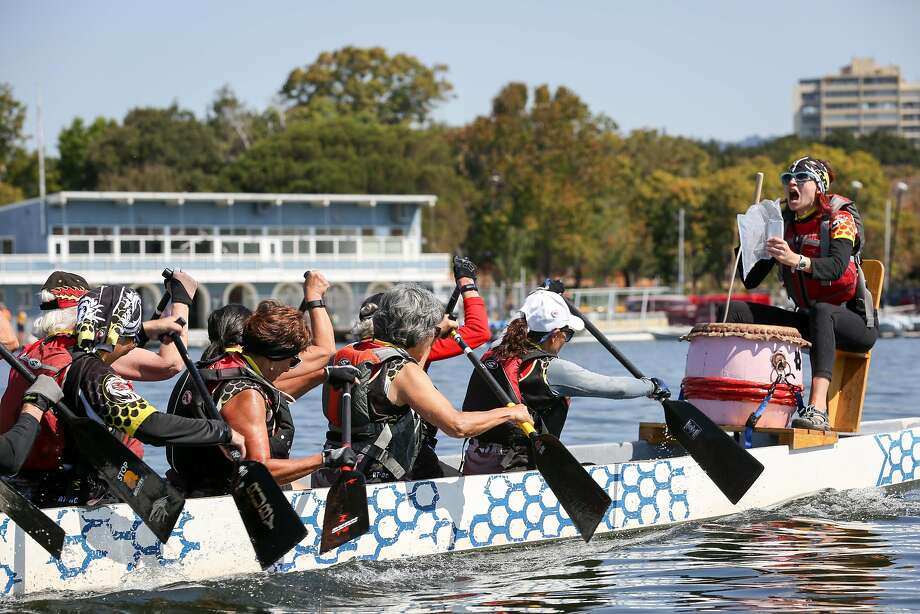
The first day of the Dragon Boat Races went pretty well. I was foolish to think it would be dramatically easier than in past years. Instead of the crews being in one paved area they were in two separate grassy areas divided by a road. One of the grassy areas had more trees than the other -- which would turn out to be important for the shade. But I'll get more into that when I talk about Sunday. Lake Merritt is a lovely place for boat races and this park is much nicer (and bigger) than I knew. Something else I've learned thanks to my Greening work. 

Cities and Burke & Jacobs

I was standing on the sidewalk in downtown Oakland -- in front of the new offices of the Oakland Tribune --- waiting for the shuttle to take me to the Dragon Boat Races, when I make a connection I don't recall ever making before. 


This is the old Oakland Tribune building.

Some of Oakland's finest surviving buildings were across the nearly dead street from me. Downtown Oakland, like many other traditional American downtowns, has never recovered from the economic devastation caused by the auto-age. These cities are like the failed states produced by the "Arab Spring" in that the consequences of making changes had dramatic unintended consequences. People, like Robert Moses or Le Corbusier or Mary Shelley's parents, think you can make extensive changes to complex systems -- even start over from scratch -- without considering Edmund Burke's conservatism and the need to make small changes while keeping an eye out for signs of system failure. 

Jane Jacobs was arguing for the same kind of conservatism for cities that Burke was for political states. Cities are actually trickier than states in that they are inherently dynamic and strict conservation -- preventing any change -- would be as bad as too much change. The same is true of nations of course, but cities need to change even faster if they are to thrive. 


Sunday

Day two of the Dragon Boat Races was an entirely different experience. For one thing, my sock/shoe insert strategy for working multiple days in a row failed miserably: It felt like I was getting a blister on the bottom of my left heel at the start of the day. (I have two weeks to work this out before the three days of HSB.) And then it was hotter than it had been on Saturday.

As I think I've said, San Francisco has not had a summer this year. We've had one day when it hit 80 F and for virtually all August it was below 70. On Saturday in Oakland -- always warmer than SF -- it was in the low 80s. When it felt hotter on Sunday I wrote it up to my working harder and the natural tendencies of San Franciscans to whine when it's over 80 or under 40. I worked to stay hydrated because I sweat profusely, but I didn't really think much about it aside from pausing, during a mid-afternoon hydration break, to realize I was really beat and still had four more hours (the hardest four hours) to go. Something about all this -- the heat and the park setting -- was reminding me of something but I couldn't put my finger on what it was.

My crew chief suggested I get a cold beverage at the volunteer food area and I enthusiastically took her up on this brilliant idea. (On Treasure Island the volunteer food/break area had been in a hot tent with views of nothing. Here it was on the second floor of the boat house with the best views of the event. There was even an outdoor, but under shade, terrace. It was really nice.) I grabbed my ice cold water and went to sit outside in the shade. 


This is a dragon boat on Lake Merritt but not from the festival. That is the boathouse in the background with the outdoor deck on the left. I was working in the trees to the left of what is shown here. Our dumpsters were awkwardly located near the building on the far right, which is much better than what was shown on the map we were given. Either my Chicken Little impression of the consequences of having the dumpsters so far away made them rethink their plans or the map was created by people not good with maps. I would lean toward the not-good-with-maps option.

As I said, I was working two crew areas (with bus traffic in between) and James had one of his people assigned to each area to keep things clean and to haul my sorted bags out to the road where they could be picked up (by James, usually). I had been wondering what had happened to the guy in one of these areas as my bags had started to pile up noticeably.  I found him listening to the Oakland Raiders football game up there in the shade. Smart... though not helpful. 

As a response to some boneheaded play by a Raider, he said something like, "That's the kind of thing you learn not to do in Pop Warner." And that's when the penny dropped and I realized what this day had been reminding me of. 

"Pop Warner" football is a program for pre-high school age kids. I played three years of Pop Warner football while living in the San Fernando Valley in the mid-1960s. The worst... worst part of the season was our training camp in mid-summer before the season really started. It was the equivalent of boot-camp but held in a lovely park in Encino. (This was the only occasion I had any reason to be in Encino, which was on the other end of the Valley. Why we trained there rather than at our usual facility in White Oak I don't know, but speculate it was so we didn't come to hate our regular practice field.) This was always at the hottest part of the summer with vile, mid-60's air quality. All I remember are hellish episodes of exercise and endless running with maybe a few blissful minutes collapsed in the shade under the trees.

Both Saturday and Sunday were "Spare the Air" days, and perhaps the program works because I didn't notice the smell of ozone, something I'm finely attuned to thanks to those years in the Valley. But the heat and lack of wind and the constant work (and sweating) were certainly reminiscent of those days almost 50 years ago. And then, when I got home, while drinking close to a liter of electrolyte water to keep the foot and leg cramps at bay, I learn that I hadn't been working in 80 degree heat but in an Oakland record (for the day) 94 F. That explains so much.

Our crew was one person short of what it should have been, and, because the worst trash doesn't come in until the vendors (and in this case the crew teams) breakdown at the end of the day (and the crews tend to party which delays things even more), I would have needed another half hour to get my sections shut down to my satisfaction. Some bags went directly into the landfill that I "could" have diverted. But for the most case, if I do say so myself, I totally rocked it, while also training one of James's people who sometimes also works for us. In part this went well because the crews didn't leave behind some of the most difficult trash I recall from previous DBRs, and in part because I was grabbing stuff from them throughout the day -- my plan for the year. 

In any event, when my shift was over I walked away (limped away, and I still had to walk quite a few blocks to catch a train home) not really caring about those final bags. I was at the open end of the landfill dumpster and was, I admit, tempted to look at the most recent bags to see if they were ones I had marked as sorted, but it was getting dark and I just wanted to go home, take a shower, and dig into that bottle of electrolyte water.

I almost forgot the highlight of the day. Cans and bottles of some beverages come in cardboard containers wrapped in plastic,


 The problem with this packaging for us is that the plastic goes in the landfill stream while the cardboard goes in either the recycling or compost. I've joked in the past that we should teach seminars in the occult science of removing the cardboard from the plastic (flattening cardboard boxes is the other skill vendors seem unaware of). Yesterday a high school aged rowing crew member came up to a station where I was working with one of these empty boxes and asked if it went in the recycling. I said yes, once you remove the plastic, which, and I give him credit here, he preceded to do. Only it was so pathetic. At one point I thought he was going to start crying. I even offered to finish it for him but he was determined. Though I did still have to flatten the cardboard.

I say it was the highlight of my day, because it made me laugh, but really it was sad. We are never going to win this battle to get people to properly sort their own trash.

And there was something else that made me laugh. The PA directed all the teams to their marshaling points by name. One crew was going by the team name "Boaty McBoatface."

Caption.


It's no secret I have an interest in military history and weapon systems. This leads to my viewing any number of YouTube videos and even commenting on them. Which then means I get a long stream of notifications of responses or other comments. Currently, we are more than a few days into a debate about the relative value of Sherman and Panther tanks during WW2. I'm using the popular names though most of the weirdos in these debates use the official designations -- though they may disagree even on that, and they aren't even as specific as I would like. It quickly gets very complicated. 

And the reason I'm bringing this up is because of an image I just saw of a B-24 bomber from the same period. You could argue (well, I could argue) that the B-24 and the M4, excuse me, Sherman tank have something in common. While no one would ever say they were the best bomber or tank of the period, they each played an essential role in wining the war. 

The B-24 is the ugly stablemate of the more beloved B-17. Most crews come to praise their aircraft, even if it wasn't what they would have chosen (I'm thinking of the P-47 here), but I don't recall hearing anyone say they loved the B-24. And yet it was, arguably, more important to winning the war than the B-17. It carried a heavier bomb load, but that isn't what made it so valuable in all theaters of the war. It was it's longer range that made it possible for the US and the UK to close the gap in the mid-Atlantic where German U-boats had previously been safe. And in the Pacific it could hit remote targets like Truk. 

It wasn't until almost the end of the war in Europe that the U.S. Army fielded a tank that was the equivalent (face to face) of the best German and Soviet Tanks, but the Sherman was operationally superior to everything else in almost every situation. You don't need to defeat Panthers and Tigers one-on-one to win a war. 

Just as the Japanese wasted precious resources on building super battleships they didn't really need, the Germans wasted their resources on building tanks that were a poor value for their army. I've heard that there is a Russian proverb, "Better is the enemy of good enough." The Sherman and the B-24 are perfect examples of "good enough." 

And, since we've come this far, it's worth noting that by the end of the war, the Sherman had been improved to M4A3 status which included a version with what was essentially a 105mm assault gun (in a regular turret) and the M4A3e8 (Easy Eight) version that mounted a decent anti-tank gun. The M4A3 family of vehicles may not have looked as cool as their German or Soviet equivalents, but they got the job done. 

Next - 44. Jacobs & George

Friday, September 2, 2016

31. Grids & Grahams


Previous -  30. Less chatty


Surprises where street grids meet

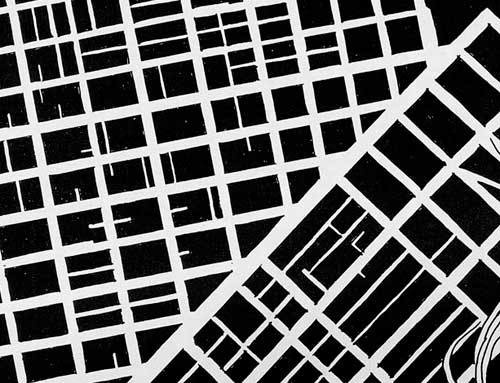
San Francisco has a typical American street grid, though not quite properly oriented north-south as you would expect. But then a diagonal street, Market, was tossed in with a completely different grid to the south (in SOMA). Besides creating a whole series of devilishly complicated intersections, this merging of grids does a couple interesting things.


This is a fun image. This shows Market separating the SOMA grid at the lower right from the Union Square/Financial District grid at the top left. You can use Maiden Lane and Commercial street to orient yourself if you know SF. Claude Place is missing along with my alley and at least one other mid-block street.

First, as Jane Jacobs pointed out, it creates perspectives ending in architecture on almost every street downtown -- at least when looking in one direction. The lack of streets that seem to run on forever is a key factor in making SF look compact and "different" for an American city.

The second, and I'm sure unintended, consequence of the  grid collision, is that it's hard to anticipate where something in the other grid is going to appear from the perspective of the grid you are in. And that -- long lead in -- is what I want to talk about.

The new Salesforce Tower is rising over where the old Transbay Terminal was, and when completed will be the tallest building in SF. Most of the tall buildings in town lie between there and where I live, so I assumed it would not affect the skyline for me. Wrong, as it turns out.

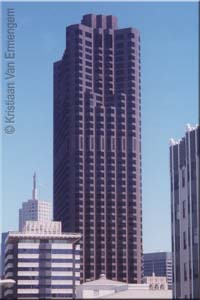
Recently it has reached a height where I can see it, still rising, in a gap between two nearer towers as I walk on Bush street just below where I live. (Where I took those "French" photographs.) A block above (literally) on Pine, the skyline is dominated by what was the BofA Building -- a massive, dark presence only a few blocks from me. 


But down on Bush you can hardly (if at all? You can see it from one sidewalk but not from the other.) see that structure due to the hill and other buildings, and now Salesforce is getting ready to take it's place as orientation point for SOMA and downtown. 

And I'm serious about the "orientation" aspect. Once it gets its decorative tower cap it will become a visual guide to where the Transbay Transit Center and that whole "new" area of town is and, consequently, where you are in relation to it. It will serve to end, at least in part, the disorientation of the grids. At least I think it will. There's a tiny chance that what I'm seeing is a lesser building also going up in the same area. If it is that building instead (which I really doubt) then Salesforce Tower is blocked and the effect I want wont come to fruition. Time will tell.

Belle Ruin

Yes, I'm still reading this as slowly as I can. Getting close to the end now and there's only one more book. 

Martha Grimes published Double Double: A Dual Memoir of Alcoholism which I have not read. I'm interested, but I have the feeling I have everything I need to understand her in the Emma Graham novels. I don't really want to know if she is less like Emma than I think. But what got me thinking about this was a passage in Belle Ruin with a bit more detail than usual about Emma's mother.

While every cab driver and diner patron in this fictional world develops more and more of a character, Emma's mother does not. She stays a mystery outside of her cooking. As readers, we have to encourage Emma's independence and isolation -- we don't want her mother suddenly acting parental -- but it is odd and totally unexplained. She's like a cloaked character at the center of the book. In a sense everything revolves around her either as cook or mother or hotel co-owner, yet we can hardly see her. We know more about the cat.

I'm guessing if I read Double Double I would probably get some insight into this, but do I want to know too much? Now I'm sounding like Emma, with her round-about method of gaining information and not asking questions of the most obvious people.


Next - 32. Mann + retrofit