"Voltaire and Candide" by I.O. Wade 1959 ... p151 Candide is thus in its substance not wholly optimistic, or pessimistic, or skeptical, or cynical: it is all of these things at the same time. Since every created thing resembles its creator and the moment of its creation, it is precisely what Voltaire and his time were: optimistic, pessimistic, skeptical, and cynical, a veritable "moment de la crise" {moment of crisis}. Facts had produced ideas, it is true, but ideas had not yet produced ideals, and no one knew what to do. ... ...The world had become a paradox and Voltaire responded with a revolt. p152 It is imperative to understand the nature of this revolt, since the whole eighteenth century and subsequent centuries have derived from it. Voltaire's response was born of both anger and despair. He was "fâché" {angry with kings}... with earthquakes... with God... Voltaire's attitude toward Providence must be considered very carefully if we are to grasp the meaning of Candide... If to be specific, Voltaire felt that Pope's arguments no longer "justified the ways of God to man," and Leibniz's were equally deficient, did he thing that he had better ones, or that he could find better ones elsewhere? In other words, was his quarrel with the optimists whose arguments could not justify Gods ways or with God whose way could not be rationally justified? ... It is undoubtedly true that his act was not a critique but a revolt, a titanic revolt [that's nice as it is a revolt against the Gods] brought about by a breakdown in the power of critique... he could only attack the irrationality, the ambiguity of the universe by annihilating rationally all rationality. In that respect his wit is a spiritual, not a rational, instrument for assailing the ambiguity, the clandestinity of a universe which refuses to make itself known. This would make him de Sade's precursor. p153 This state of things explains why one never knows in reading Candide whether to laugh with Voltaire or at him, whether to laugh with the philosophers or at them, whether indeed to laugh with or at Providence... Vertigo Dr. K Takes the Waters at Riva I assumed this was Kafka, but it's hard to find anything about him being in Italy through an online search. I did find this interesting (to anyone obsessed with The Magic Mountain) quote in Wiki, Around 1915 Kafka received his draft notice for military service in World WarI, but his employers at the insurance institute arranged for a deferment because his work was considered essential government service. Later he attempted to join the military but was prevented from doing so by medical problems associated withtuberculosis,[54]with which he was diagnosed in 1917.[55] In 1918 the Worker's Accident Insurance Institute put Kafka on a pension due to his illness, for which there was no cure at the time, and he spent most of the rest of his life insanatoriums.[5] One can almost imagine a novel in which Hans Castorp's place at the Berghof is taken by Kafka when Hans rushes off to the war. On the cover of my copy of this book is the following quote, "Think of W.G. Sebald as memory's Einstein." -Richard Eder, The New York Times". Yes, I'm procrastinating getting back into this book, but what can he mean by that. What would a General Theory of the Relativity of Memory be? What is "space" to "time" here? The Proust chapter in Proust Was a Neuroscientist, did establish the relativity of memory in that what we recall is not absolute or unchanging. Perhaps it's "time" and "memory" that combine, at least in Lehrer's view. But Sebald -- at least some of the time -- is imagining the memories of other people. And, to reference the chapters in that book on music and painting, what engages me about this book is that, as with Stravinsky's music or a canvas by Cezanne, I struggle to make sense of what the author is doing and it's that struggle that attracts me. Perhaps I should have my head looked at, I now see that Part II, All'estero is the account of the author gathering the material for Part III, Dr. K Takes the Waters at Riva. This is amusing as Part III is so much shorter than either Part II or Part IV. The author travels (twice) through central Europe and northern Italy to research an extremely un-dramatic episode in the life of Kafka, and then pads his tale with a much longer account of his own un-dramatic travels, and only slightly more dramatic childhood.
Almost Easter so time for a resurrection of my blog
I'm going to keep this one short as the next will be quite long.
I need to get the rest of the book up before my book club meeting tomorrow, so I'm publishing a bunch of posts at the same time. Sorry. This should be on top, but below you will find posts on Gertrude Stein and Igor Stravinsky. I don't know when I will resume but I will return to Vertigo and Candide.
Virginia Woolf - From Proust...
p169 ...Woolf's revelation was that we [as selves] emerge from our own fleeting interpretations of the world. Whenever we sense something, we naturally invent a subject for our sensation, a perceiver for our perception. The self is simply this subject; it is the story we tell ourselves about our experiences... "We are the words; we are the music; we are the thing itself." ["In the beginning was the Word, and the Word was with God, and the Word was God." John 1:1] ... p170 ...she also acknowledged the strange utility of her [mental] illness. Her incurable madness -- this "whirring of wings in the brain" -- was, in some ways, strangely transcendental: "Not that I haven't picked up something from insanities and all the rest. Indeed, I suspect they've done instead of religion." ... p171 ...After each depressive episode, she typically experienced a burst of creativity as she filled her journal with fresh insights into the workings of her own "difficult nervous system."... [Sounds like Adrian in Doctor Faustus.] p172 What Woolf learned about the mind from her illness -- its quicksilverness, its plurality, its "queer conglomeration of incongruous things" -- she transformed into a literary technique... Although the self seems certain, Woolf's writing exposes the fact that we are actually composed of ever-changing impressions that are held together by the thin veneer of identity... ... p175 ...The self emerges from the chaos of consciousness, a 'kind of whole made of shivering fragments." ... ... p176 Woolf's writing never lets us forget the precariousness of our being. "What does one mean by 'the unity of the mind.' " Woolf wonders in A Room of One's Own, "it {the mind} seems to have no single state of being."... Although the self seems everlasting -- "as solid as forever" -- it lasts only for a moment. We pass "like a cloud on the waves." ... He [T.S. Eliot] believed that the modern poet had to give up the idea of expressing the "unified soul" simply because we didn't have one... p177 ...Experiment after experiment has shown that any given experience can endure for about ten seconds in short term memory. After that, the brain exhausts its capacity for the present tense, and its consciousness must begin anew, with a new stream. As the modernists anticipated, the permanent-seeming self is actually an endless procession of disjointed moments. ... Those interesting corpus callosum splitting experiments where there are actually two competing "selves" in our head, are mentioned here. Emergence p180 ...If we know nothing else, it is that we are here, experiencing this. Time passes and sensations come and go. But we remain. [Descartes's I think therefore I am] ... ...The secret, Woolf realized, was that the self emerges from its source. Emerge is the crucial word here. While her characters begin as a bundle of random sensations... they instantly swell into something else... The impersonal sensation is always ripening into a subjective experience, and that experience is always flowing into the next one. And yet, from this incessant change, the character emerges... In her fiction, the self is neither imposed nor disowned. Rather, it simply arises, a vision stolen from the flux. ... p181 Woolf realized that the self emerges via the act of attention. We bind together our sensory parts by experiencing them from a particular point of view. During this process, some sensations are ignored, while others are highlighted. The outside world gets thoroughly interpreted... ... p182 But how do we endure? How does the self transcend the separateness of its attentive moments? How does a process become us? For Woolf, the answer was simple: the self is an illusion. This was her final view of the self... The self is simply our work of art, a fiction created by the brain in order to make sense of its own disunity. In a world made of fragments, the self is our sole "theme, recurring, half remembered, half foreseen." If it didn't exist, then nothing would exist. We would be a brain full of characters, hopelessly searching for an author. ... p183 Lesions in the V1 only cause conscious blindness, a phenomenon [Lawrence] Weiskrantz named "blindsight." Although these patients think they are blind, they can actually see, at least unconsciously. What they are missing is awareness... blindsight patients are unable to consciously access what their brains know. As a result, all they see is darkness.
p184 ...On various visual tasks they perform with an aptitude impossible for the totally blind... While they have no explicit awareness of the light, they can still respond to it, albeit without knowing what they are responding to... ...their consciousness has been divorced from their sensations. Although the brain continues to "see," the mind can't pay attention to these visual inputs... Blindsight patients are sad evidence that we have to transform our sensations -- by way of the moment of attention, which is modulated by the self -- before we can sense it.A sensation separated from the self isn't a sensation at all. I disagree with what is in bold in that paragraph. They are true statements for the "conscious self" or the "mind" but not for the totality of the being-in-our head. That may sound like a meaningless distinction, but unless you are willing to subtract all the unconscious aspects of our selves -- like how we can fall in love at first sight -- then I will stand by it. These experiments, on the contrary, seem to prove the opposite: The brain (or under-mind) is aware of more than the self is aware of. Not only do these sensations remain, they are processed up to the point of their being made available to the self-consciousness. As strange as blindsight is, is the process of the brain passing information to the mind without the mind knowing where it's coming from really that different from other things we seem to "know" without understanding how -- like we can, apparently, know when a woman is ovulating or that the person across the dance floor would make a perfect life partner. If anything, the blindsight experiments prove that there is a more profound level of intelligence below the level of our conscious selves. Here's a BBC piece that makes a similar point. ... Your head contains a hundred million electrical cells, but not one of them is you or knows you or cares about you. In fact, you don't even exist. The brain is nothing but an infinite regress of matter, reducible to the callous laws of physics. ... ...and biology. I have in mind evolution. "You" may be a ghost riding a biological machine, but the cells of that machine follow the rules of evolution. I was thinking about all this at the gym this morning and it occurred to me that multiple personality disorders, schizophrenia, amnesia and the like, should be collectively termed diseases of the self. "I think therefore I am" is the fundamental statement of the philosophy of the self, and this is true even if you have to add a MPD amendment like, "We think therefore we are." But this tells us nothing about reality in general, despite what Descartes intended. The statement is just as true if the self is no more than a helpful creation of the brain. The usual problems people have suggested for our being mentally unable to understand the mind of God, could equally well apply to our understanding the logic of the brain that creates "us." Lily p185 The most mysterious thing about the human brain is that the more we know about it, the deeper our own mystery becomes. The self is no single thing, and yet it controls the singularity of our attention... ... Coda ... p196 We now know enough to know that we will never know everything. This is why we need art: it teaches us how to live with mystery...
A little more about this book and this author. The book was published in 2007 -- so Lehrer hasn't been following my blogs and answering most of my questions about things like dissonance. And the dust jacket has this to say about Jonah Lehrer, "is editor at large of Seed magazine. A graduate of Columbia University and a Rhodes scholar, Lehrer has worked in the lab of Nobel Prize-winning neuroscientist Eric Kandel and in the kitchen of Le Cirque 2000 and Le Bernardin. He has written for the Boston Globe, Nature, NPR, and NOVA ScienceNow, and writes a highly regarded blog, The Frontal Cortex."
Real estate sales in this Brave New World
When I consider a space to live in I try to imagine what I would do with it given my stuff and my abilities. I moved into my present (tiny) place largely because it was an interesting challenge. In over 20 years the place has had a number of different looks, as I accumulated family furniture. (Now I kind of wish I had followed young Marcel's example in In Search of Lost Time and found a nice brothel to give the furniture to.) But (in so many different ways) I am not normal, and the thing to do now if you want top dollar in a hot market is to pay people to "stage" the space. I just toured the newly staged lower level unit in our building and it looks amazing. There's no doubt in my mind that it has never looked better -- and probably will never look this good in the future. There are some obvious (and some less obvious) shortcomings of the space, but what you see now is how bright and perfect everything looks. The staging acts as a distraction, you see the staging instead of the space. If I was considering buying the unit I would have to mentally remove all the staging to try to get an idea of what I was really dealing with. Most people won't go to that trouble so they will judge the place by how great it looks now... which is not what they will be buying. None the less, at the price it's listed at, they will be getting a good deal, given the location, as long as they don't need a car. And just to give you an idea of how crazy the housing market is here, this, problematic, 450-480 sq ft space (a variety of number are floating around) is listed for a half million dollars. Though the regular association dues are very reasonable for Nob Hill. If I were the realtor, that's what I would plaster on all the signs.
p144 Before Gertrude Stein was an avant-garde artist, she was a scientist. Her first published piece of writing was in the May 1898 edition of the Psychological Review. The article summarized her research in the Harvard psychology lab of William James, where Stein was exploring automatic writing... Stein wanted to write down whatever words first entered her mind. The result was predictably ridiculous... Stein concluded that... [her writings] didn't mean anything. Her experiment hadn't worked... p145 But Stein's experimental failure got her thinking. Even when she wrote about absolutely nothing... her nothingness remained grammatical. The sentences were all meaningless, and yet they still obeyed the standard rules of syntax... "There is no good nonsense without sense," Stein concluded, "and so there cannot be automatic writing."... what she ended up discovering was the constraint that can't be escaped. Our language has a structure, and that structure is built into the brain. Well, hold on a second. Unless this means that the brain is trained by schooling and thus "built" I don't see that this is true since not everyone, even when they are trying, can follow the standard rules of syntax. It would be another decade before Stein converted her experimental conclusions into a new form of literature... The sentences she wrote in the laboratory inspired her lifelong obsession with words and rules, with how language works and why it's so essential to the human mind... Tender Buttons, written in 1912... is divided into three arbitrary sections, "Objects," "Food," and "Rooms." "Objects" and "Food" are composed of short, epigrammatic pieces with titles like "Mutton" and "An Umbrella." But these objects are not Stein's subject. Her subject is language itself. The purpose of her prose poems, she said, was "to work on grammar and eliminate sound and sense." Instead of a plot, she gave us a lesson in linguistics. p146 Stein, as usual advertised her audacity. The very first page of Tender Buttons serves as a warning: this is not a nineteenth-century novel. In place of the customary scene setting, or some telling glimpse of the main character, the book begins with an awkward metaphor. A CARAFE THAT IS A BLIND GLASS A kind in glass and a cousin, a spectacle and nothing strange a single hurt color and an arrangement in a system to pointing. All this and not ordinary, not unordered in not resembling. This tricky paragraph is about the trickiness of language. Although we pretend our words are transparent -- like a layer of glass through which we see the world -- they are actually opaque. (The glass is "blind.") Stein is trying to remind us that our nouns, adjectives, and verbs are not real. They are just ordinary signifiers, random conglomerations of syllables and sound. A rose, after all, is not really a rose. Its letters don't have thorns or perfumed petals. Why then, do we invest words with so much meaning? Why do we never notice their phoniness? Stein's revelation... was that everything we say is enclosed by "an arrangement in a system." This linguistic system, although invisible, keeps words from being "not unordered in not resembling." Because we instinctively "arrange" language, it seems like "nothing strange." Stein wanted us to acknowledge these hidden grammars, for it is their structure that makes language so meaningful and useful. But if Stein wanted to talk about grammar, then why didn't she just talk about grammar? Why did she have to make everything so difficult? ... It's like he read my mind. Maybe because she had seen what a mindfuck reading Saussure was? p147 Reading Tender Buttons, with its "grammar trips" and "incongruous vocabularies," is often an experiment in frustration. [These are terms William James used to describe an experiment "...whereby a mind can be made aware of the structure underneath our words..."] She wants us to feel the strictures of the sentence, to question our own mental habits. If nothing else, she wants to rid us of our "drowsy assent," to show us that language is not as simple as it seems. And so she fills her sentences with long sequences of non sequiturs. She repeats herself, and then she repeats her repetitions. She writes sentences in which her subjects have no verb, and sentences in which her verbs have no subject. But the secret of Stein's difficulty is that it doesn't drive us away. Rather, it brings us in. Her words demand a closeness: to steal sense from them, we have to climb into them... When suffering through her sentences, we become aware, she says, of "the way sentences diagram themselves," of the instinctive nature of syntax... Stein wrote, "but to me undoubtedly when I was at school the really exciting thing was diagramming sentences." In her writing, Stein wanted to share the thrill. ... in 1956, a shy linguist named Noam Chomsky announced that Stein was right; our words are bound by an invisible grammar, which is embedded in the brain. These deep structures are the secret sources of our sentences; their abstract rules order everything we say... Picasso's Portrait [At medical school] ...Instead of studying organic chemistry or memorizing her anatomy lessons, Stein stayed up late reading Henry James. She was inspired by the first murmurings of modernism... In 1903... Stein moved to Paris. She settled in with her brother Leo... Leo had just purchased his first Cézanne painting... p149 Her early work was influenced by the artists who lingered around the apartment. Three Lives was inspired by a Cézanne portrait. Her next book, The Making of Americans, emerged from her relationship with Matisse. But Stein was closest to Pablo Picasso. As she wrote in her essay Picasso (1938), "I was alone at this time in understanding him because I was expressing the same thing in literature." Their relationship began in the spring of 1905, just as Picasso was becoming bored with his blue period. Gertrude Stein asked him to paint her portrait. The painter couldn't say no; not only had Stein's Saturday-night salons become a magnet for the Parisian avant-garde (Matisse, Braque, and Gris were normally there), but Gertrude and her brother Leo were some of his earliest benefactors. Their walls were lined with his experiments. I'm reminded of the bright young things Henry Ryecroft (Gissing?) so detested perhaps a decade earlier. Picasso struggled with Stein's portrait... Day after day, Stein returned to Picasso's apartment... They talked while Picasso carefully reworked the paint on the canvas. They discussed art and philosophy, William James's psychology, Einstein's physics, and the gossip of the avant-garde... p151 ... When... [Picasso] returned to Paris, [after a trip to Spain] he immediately began to rework Stein's portrait... and the painting became even more similar to Cézanne's painting of his wife, which Picasso had seen in Stein's apartment. When someone commented that Stein did not look like her portrait, Picasso replied, "She will." Picasso was right. After he painted Stein's face, [makes it sound like face painting] she began writing in an increasingly abstract style. Just as Picasso had experimented with painting -- his art was now about the eloquence of incoherence -- Stein wanted to separate language from the yoke of "having to say something." Modern literature, she announced, must admit its limits. Nothing can ever really be described. Words, like paint, are not a mirror. ...If "Egg ear nuts" is interesting, it is only because we have stopped understanding it one word at a time. An egg is no longer an egg. For Stein's writing to succeed, the sentence must become more than the sum of its separate definitions. There must be something else there, some mysterious structure that transcends her individual words... [How is Stein translated?] The James Brothers p152 ...Before Gertrude Stein converted cubism into a literary form, Henry James, William's younger brother, made a career out of writing famously verbose and ambiguous fiction. Nothing in James's later novels is described straight or directly. Instead, his prose constantly questions its own meaning. Everything is circumscribed by words, words, and more words, until the original object vanishes in a vapor of adjectives, modifiers, and subclauses. The world is swallowed by style. p153 ..."You see." Stein once said of Henry James, "he made it sort of like an atmosphere, and it was not the realism of the characters but the realism of the composition which was the important thing." ... "Henry James was the first person in literature to find the way to the literary method of the twentieth century." She called him "the precursor." ...he was the first writer to deprive the reader of the illusion that language directly reflects reality. In his novels, words are vague symbols that require careful interpretation... A perfect truth or final reading always eludes our grasp, for reality, Henry wrote, "has not one window but a million . . . At each of them stands a figure with a pair of eyes." ...In... The Principles of Psychology, William [James] declared that "language works against our perception of the truth." Words make reality seem as if it is composed of discrete parts -- like adjectives, nouns, and verbs -- when in actual experience, all these different parts run together. William liked to remind his readers that the world is a "big blooming buzzing confusion," and that the neat concepts and categories we impose on our sensations are imaginary... "it is, in short, the reinstatement of the vague to its proper place in our mental life which I am so anxious to press the attention."...
Stravinsky the Hipster p134 ...the terrible beauty of the "Augers" chord ["the awful sound that started the riot"] is not really dissonant. The sound is actually composed of classic tonal chords set against each other, in dissonant conjunction. Stravinsky melts together two separate harmonic poles, which has a short-circuiting effect. The ear hears shards of harmony (E, E-flat, C), but the brain can't fit the shards together... Because the sound is new, Stravinsky electrified the familiar... The brain is befuddled, its cells baffled. We have no idea what this sound is, or where it might go, or what note will come next. We feel the tension, but we can't imagine the release. This is the shock of the new. ... p136 This is the method of The Rite. First Stravinsky throws a wrench into our pattern-making process, deliberately and loudly subverting everything we think we know... Then... Stravinsky forces us to generate patterns from the music itself, and not from our preconceived notions of what the music should be like. By abandoning the conventions of the past, he leaves us with no pattern but that which we find inside his own ballet music... Even when we can recognize Stravinsky's notes, their arrangement confuses us, for Stravinsky fragments everything. His imagination was a blender. p137 All of this novelty leaves us bitterly disoriented. To find the echo of order in The Rite, we have to pay exquisite attention. If we fail to listen carefully, if we tune out its engineered undulations, then the whole orchestra becomes nothing more than a mutiny of noise. The music disappears. This is what Stravinsky wanted. "To listen is an effort," he once said, "and just to hear is no merit. A duck hears also." [Sounds like a Russian proverb.] ... ...His symphonic music denies us a consonant climax. It mocks our expectations of a happy ending. In fact, it mocks all our expectations. ...Stravinsky decides to kill his virgin with some big timpani drums. He forces her to dance the impossible dance, giving her a different beat in every musical bar. The rhythmic patters fly by in a schizophrenic babble: 9/8 becomes 5/8, which becomes 3/8, which abruptly shifts into 2/4-7/4-3/4, and so on. Our cells can sense the chaos here; we know that this particular wall of sound is irresolvable. All we can do is wait. This too must end. Plato's Mistake p138 What is music?... Stravinsky... believed... that noise became music "only by being organized, and that such an organization presupposes a conscious human act."... This was a radical new definition of music. Ever since Plato, music had been seen as a metaphor for the innate order of nature. We don't make music, Plato said, we find it. While reality appears noisy, hidden in the noise is an essential harmony, "a gift of the Muses."... Plato... insisted that music... be strictly censored inside his imaginary republic... Plato believed that only consonant musical pitches -- since they vibrated in neat geometrical ratios -- were conducive to rational thinking... Unfortunately, this meant systematically silencing all dissonant notes and patterns, since dissonance unsettles the soul. Feelings were dangerous ... But Plato... misunderstood what music actually is. Music is only feeling. It always upsets our soul. If we censored every song that filled people with irrational emotions, then we would have no songs left to play... music really begins when... order collapses. We make art out of the uncertainty. Thanks to having read The Birth of Tragedy, we have another perspective on this and on what Plato was afraid of with non-consonant music... the music of Dionysus. Though it isn't clear to me that Stravinsky's music is Dionysian. p139 ...the myth Stravinsky took the most pleasure in shattering was the parable of progress... While Plato believed that music would one day perfectly mirror the harmony of the cosmos -- and thus inspire our souls with the pure sound of reason -- Stravinsky's symphonies were monuments to the meaninglessness of progress... music is simply a syntax of violated patterns. It doesn't become better over time, it just becomes different. ...within a few years of its premiere, The Rite was being performed to standing ovations... The same symphony that once caused a violent riot became the cliched example of modern music. Audiences were able to hear its delicate patterns... By 1940, Walt Disney used The Rite in the sound track of Fantasia. The "Augurs" chord was fit for a cartoon. p140 ... The auditory cortex... is deeply plastic. Neuroscience, stealing vocabulary from music, has named these malleable cells the corticofugal network, after the fugal form Bach made famous. These contrapuntal neurons feed back to the very substrate of hearing, altering the specific frequencies, amplitudes, and timing patterns that sensory cells actually respond to. The brain tunes its own sense of sound, just as violinists tune the strings of their instruments. ... ...the brainstem contains a network of neurons that respond only to surprising sounds. When the musical pattern we know is violated, these cells begin the neural process that ends with the release of dopamine... (Dopamine is also the chemical source of our most intense emotions, which helps to explain the strange emotional power of music, especially when it confronts us with newness and dissonance.)... Okay, now we have a possible link with the Dionysian. Also, I would bet that dopamine was what was inhibited when Temple Grandin sheep-dipped herself. And why I get a near-religious response to Thelonious Monk, Bill Evans, and the guitar gods. p141 But dopamine has a dark side. When the dopamine system is imbalanced, the result is schizophrenia. [Footnote: "While schizophrenia cannot be reduced to any single anatomical cause, the dopaminergic hypothesis is neurosciences' most tenable explanation. According to this theory, many of the symptoms of schizophrenia are caused by an excess of certain dopamine receptor subtypes, especially in the mesolimbic-mesocortial dopamine system." Well that's interesting. Now we can toss "hearing voices" and "voice hearing" and the extremes of religious experience into this dopamine pot. Not only do you "hear" the voice of God but you have an intense emotional response to that experience.] If dopamine neurons can't correlate their firing with outside events, the brain is unable to make cogent associations. Schizophrenics have elaborate auditory hallucinations precisely because their sensations do not match their mental predictions. As a result, they invent patterns where there are none and can't see the patterns that actually do exist. The premiere of The Rite, with its methodical dismantling of the audience's musical expectations, literally simulated madness. By subverting the listener's dopamine neurons, it also subverted their sanity... the corticofugal system... takes a dissonant sound, a pattern we can't comprehend, and makes it comprehensible. As a result, the pain of The Rite becomes bearable. And then it becomes beautiful. p142 The corticofugal system has one very interesting side effect... Over time... we become better able to hear those sounds that we have heard before. This only encourages us to listen to the golden oldies we already know... and to ignore the difficult songs we don't know (since they sound harsh and noisy, and release unpleasant amounts of dopamine). We are built to abhor the uncertainty of newness. [But is that true for schizophrenics?] ...The artist is engaged in a perpetual struggle against the positive-feedback loop of the brain, desperate to create an experience that no one has ever had before... If the art feels difficult, it is only because our neurons are stretching to understand it. The pain flows from the growth... [No pain, no gain?] ...Works like The Rite jolt us our of complacency. They keep us literally open-minded... p143 ... The Rite of Spring was... the sound of art changing the brain. Once again, far more here than I was expecting, with connections to so much more than the obvious Doctor Faustus and The Birth of Tragedy. This book definitely going to be a keeper, and I didn't buy it -- my library branch had a copy -- so now it looks like I will have to find a copy. And still two chapters to go.
p123 ...While the crowd at the premier [of The Rite of Spring] assumed that beauty was immutable -- some chords were just more pleasing than others -- Stravinsky knew better. An instinctive modernist, he realized that our sense of prettiness is malleable, and that the harmonies we worship and the tonic chords we trust are not sacred. Nothing is sacred. Nature is noise. Music is nothing but a sliver of sound that we have learned how to hear. With The Rite, Stravinsky announced that it was time to learn something new. [If this doesn't lead to jazz and my guitar gods, I will be surprised.] His faith in our mind's plasticity -- our ability to adapt to new kinds of music -- was Stravinsky's enduring insight. When he was first composing The Rite, in Switzerland, testing out its dissonant chords on his piano, a young neighborhood boy got into the habit of yelling, "That's wrong!" at his window. Stravinsky... knew the brain would eventually right his wrongness. The audience would adapt to his difficult notes and discover the beauty licked inside his art. As neuroscience nowknows, our sense of sound is a work in progress. Neurons in the auditory cortex are constantly being altered by the songs and symphonies we listen to. Nothing is difficult forever. The Birth of Dissonance ... Where has this book been all my life?
p125 [Stravinsky studying under Nikolai Rimsky-Korsakov] ...The problem facing modern music, Korsakov said, was simple: orchestral music had become boring. Wagner's vaunted ambition had been largely replaced by cheerful pastiche, most of it written for the ballet... The modern composer was trapped by the past. For this reason, the revolution in sound would have to begin with an act of deconstruction... p126 The modernist coup d'etat occurred in 1908, when Arnold Schoenberg decided to abandon the structure of classical music... Before Schoenberg, every symphony followed a few simple rules. First, the composer introduced the tonic triad, a chord of three notes. This chord was the invisible center of the music, the gravitational force that ordered its unfolding. Next the composer carefully wandered away from the tonic triad, but never too far away. (The greater the acoustic distance from the tonic, the greater the dissonance, and too much dissonance was considered impolite.) The music always concluded with the tonic's triumphant return, the happy sound of a harmonic ending. Schoenberg... began daydreaming of "the day when dissonance will be emancipated," when the symphony will be set free from the easy cliches of the eight-note scale... ... p127 In the program that night, ["Schoenberg's String Quartet no. 2 in F-sharp Minor, written in 1908"] Schoenberg tried to explain the logic behind his "pandemonium." He needed freedom from form because musical form had ceased to mean anything. "The overwhelming multitude of dissonances" could no longer be suppressed or censored... Waves of Noise ... p129 ...while every sound starts as a temporary pattern of hair cells, that's only the beginning of listening. In the time it takes to play a sixteenth note, the sensory rumors heard by the ear are rehearsed again and again inside the brain. Eventually, the sound reaches the primary auditory cortex, where neurons are designed to detect specific pitches... the auditory cortex focuses on finding the note amid the noise. We tune out the cacophony we can't understand... When these selective neurons in the auditory cortex become excited, the vague shudders of air finally become a musical note. p130 ...Music is the pleasurable overflow of information... the mind... stops trying to understand the individual notes and seeks instead to understand the relationships between the notes. The human auditory cortex pulls off this feat by using its short-term memory for sound... to uncover patterns at the larger level of the phrase, motif, and movement. This new approximation lets us extract order from all the notes... It is this psychological instinct -- this desperate neuronal search for a pattern... that is the source of music... We continually abstract on our own inputs, inventing patterns in order to keep pace with the onrush of noise. And once the brain finds a pattern, it immediately starts to make predictions, imagining what notes will come next. It projects imaginary order into the future, transposing the melody we have just heard into the melody we expect... The Tension of Emotion ... Tonal music... begins by establishing of melodic pattern by way of the tonic triad. This pattern establishes the key [which sense of key?] that will form the song... A key or theme is stated in a mnemonic pattern, and then it is avoided, and then it returns, in a moment of consonant repose. p131 But before a pattern can be desired by the brain, that pattern must play hard to get. Music only excites us when it makes the auditory cortex struggle to uncover its order. If the music is too obvious, if its patterns are always present, it is annoyingly boring... The longer we are denied the pattern we expect, the greater the emotional release when the pattern returns, safe and sound. The auditory cortex rejoices... This sounds like a love affair from In Search of Lost Time. This is the pattern of the recurring love theme starting with Swann & Odette, and then repeated with Gilbert and finally Albertine. Can that be a coincidence? A work structured like a piece of music that shares the pattern of denied fulfillment?.
...the musicologist Leonard Meyer, in his classic book Emotion and Meaning in Music (1956), analyzed the fifth movement of Beethoven's String Quartet in C-sharp Minor, opus 131. Meyer wanted to show how music is defined by its flirtation with -- but not submission to -- expectations of order... If E major is the tonic, Beethoven plays incomplete versions of the E major chord, always careful to avoid its straight expression. He preserves an element of uncertainty in his music, making our brains beg for the one chord he refuses to give us. Beethoven saves that chord for the end. p132 ...Music is only interesting when it confronts us with tension, and the source of tension is conflict. Stravinsky's insight was that what the audience really wanted was to be denied what it wanted. [In The Rite]... Dissonance never submits to consonance. Order does not defeat disorder. There is an obscene amount of tension, but it never gets resolved. Everything only gets worse. And then it ends. ... [In The Rite]...We do not know what notes will come next. And this makes us angry. ... Why is music capable of inflicting such pain? Because it works on our feelings directly. No ideas interfere with its emotions. This is why "all art aspires to the condition of music."... When we listen to music, we are moved by an abstraction. We feel, but we don't know why. Here is a performance of The Rite of Spring,
The Blank Canvas p116 When Cézanne began his studies in the blank canvas, science had no way of explaining why the paintings appeared less vacant than they actually were. The very existence of Cézanne's nonfinito style, the fact that the brain could find meaning in nothing, seemed to disprove any theory of mind that reduced our vision to pixels of light. The Gestalt psychologists of the early twentieth century were the first scientists to confront the illusions of form that Cézanne so eloquently manipulated. Gestalt literally means "form," and that's what interested Gestalt psychologists. Founded by Carl Stumpf, Kurt Koffka, Wolfgang Kohler, and Max Wertheimer... the German Gestalt movement began as a rejection of the reductionist psychology of its time, which was still enthralled with the theories of Wilhelm Wundt and his fellow psychologists. Wund had argued that visual perception is ultimately reducible to its elemental sensations. The mind, like a mirror, reflected light. But the mind is not a mirror. The Gestaltists set out to prove that the process of seeing alters the world we observe. Like Immanuel Kant, their philosophical precursor, they argued that much of what was thought of as being out there -- in our sensations of the outside world -- actually came from in here, from inside the mind. ("The imagination," Kant wrote, "is a necessary ingredient of perception itself.")... According to the Gestaltists... everyday illusions [like vase/silhouette] were proof that everything we saw was an illusion. Form is dictated from the top down... the Gestaltists began with reality as we actually experienced it. [Like Kant, they are, I believe, saying that we aren't in a position to say anything about the thing-in-itself.] p117 Modern neuroscientific studies of the visual cortex have confirmed the intuitions of Cézanne and the Gestaltists: visual experience transcends visual sensations... If the mind didn't impose itself on the eye, then our vision would be full of voids... we each have a literal blind spot in the center of the visual field. But we are blind to our own blind spot: our brain unfailingly registers a seamless world. ... p119 The shocking fact is that sight is like art. ["surrounded by artifice"] What we see is not real. It has been bent to fit our canvas, which is the brain. When we open our eyes we enter an illusory world, a scene broken apart by the retina and re-created by the cortex... ...[The visual experience] is art, and not science, that is the means by which we express what we see on the inside. The painting, in this respect, is closer to reality. It is what gets us nearest to experience. When we stare at Cézanne's apples, we are inside his head. By trying to represent his own mental representations, Cézanne showed art how to transcend the myth of realism. As Rainer Maria Rilke wrote, "Cézanne made the fruit so real that it ceased to be edible altogether, that's how thinglike and real they became, how simply indestructible in their stubborn thereness." The apples have become what they have always been: a painting created by the mind, a vision so abstract it seems real.
Postscript
We were celebrating the completion of work on our building last night, so I didn't get around to posting this. I'll post two sections today.
There's a nice summary of impressionism on pages 100-101, but I'm not going to copy it. p103 ...Cézanne had stopped worshiping light. He found the impressionist project -- the description of light's dance upon the eye -- too insubstantial. ("Monet is only an eye," Cézanne once said, with more than a little condescension.)... He had stopped arguing with the camera. Instead, in his postimpressionist paintings he wanted to reveal how the moment is more than its light. If the impressionists reflected the eye, Cézanne's art was a mirror held up to the mind. p104 ... Cézanne discovered that visual forms... are mental inventions that we unconsciously impose onto our sensations... No matter how hard he tried, Cézanne couldn't escape the sly interpretations of his brain. In his abstract paintings, Cézanne wanted to reveal this psychological process, to make us aware of the particular way the mind creates reality. His art shows us what we cannot see, which is how we see. This is related to Annie Dillard's "tree with the lights in it" from Pilgrim At Tinker Creek. The limits of Light ...Particles of light alter the delicate molecular structure of the receptors in the retina. This cellular shudder triggers a chain reaction that ends with a flash of voltage. The photon's energy has become information. [Footnote: "...the photons cause the sodium ion channels inside our photoreceptors to close, which causes the cell to become hyperpolarized..."] ...in our evolved system, the eyeball's map of light is transformed again and again until, milliseconds later, the canvas's description enters our consciousness. Amid the swirl of color we see the apple. ... [I'm not going to copy the scientific quest for how we see.] p106 ...Hubel and Weisel became the first scientists to describe reality as it appears to the early layers of the visual cortex. This is what the world looks like before it has been seen, when the mind is still creating the sense of sight. Not sure about the use of "mind" here. Maybe the under-mind -- that Operating System level I've talked about before.
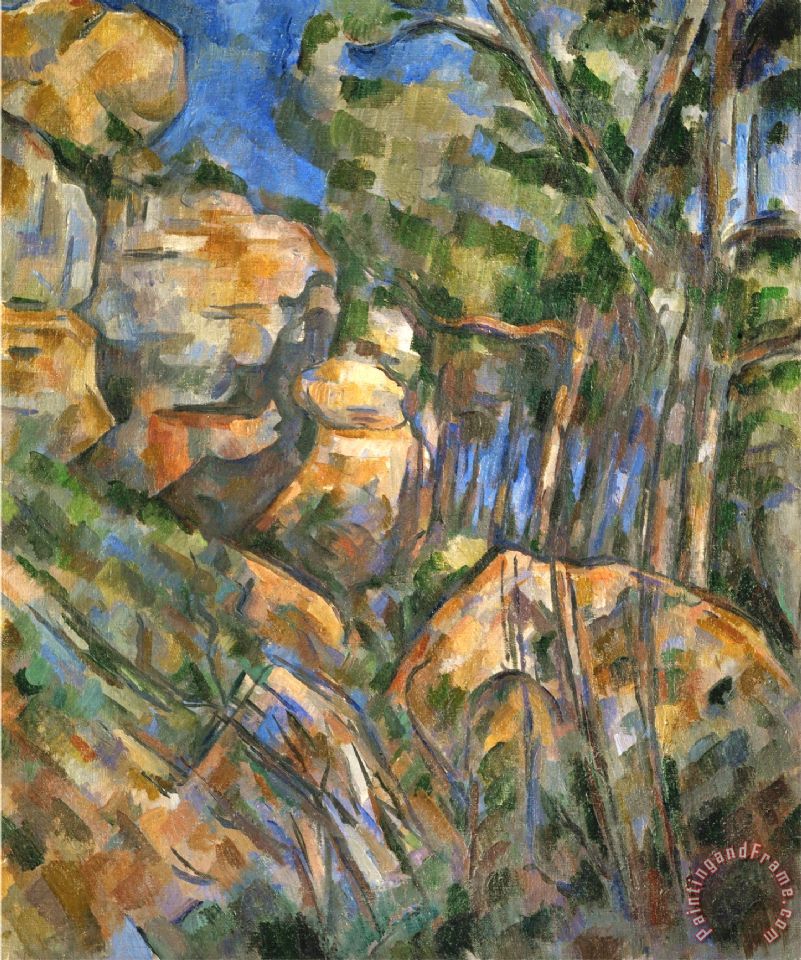
The Rocks Above the Caves at Chateau Noir. It's as if [Cézanne] broke the brain apart and saw how seeing occurs... Cézanne's painting [above] is not about the sky or the rocks or the trees. He has broken each of these elements into their sensory parts, deconstructing the scene in order to show us how the mind reconstructs it. ...Cézanne... [creates] the entire picture out of patches and strokes... His impasto paint calls attention to itself, forcing us to see the canvas as a constructive process and not a fixed image... Instead of giving us a scene of fully realized forms, Cézanne supplies us with layers of suggestive edges, out of which forms slowly unfurl... p107 This is the abstract reality represented by the neurons of the V1... The cells of the visual cortex, flooded by rumors of light, see lines extending in every possible direction. Angles intersect, brushstrokes disagree, and surfaces are hopelessly blurred together. The world is still formless, nothing but a collage of chromatic blocks... Before we can make sense of Cézanne's abstract landscape, the mind must intervene. ...From the earliest levels of visual processing in the brain up to the final polished image, coherence and contrast are stressed, often at the expense of accuracy. ... [Here we get more about how the brain processes visual data into what we see, leading to a review of Oliver Sacks's Dr. P, the man who mistook his wife for a hat.] p109 ...when Dr. P was given a rose, he described his conscious thought process to Sacks: "it looks about six inches in length. A convoluted red form with a linear green attachment." But these accurate details never triggered the idea of a rose. Dr. P had to smell the flower before he could identify its form. As Sacks put it, "Dr. P saw nothing as familiar. Visually, he was lost in a world of lifeless abstractions." To look at a Cézanne painting is to become acutely aware of what Dr. P is missing. Staring at his postimpressionist art, we feel our top-down process at work. It is because Cézanne knew that the impression was not enough -- that the mind must complete the impression -- that he created a style both more abstract and more truthful than the impressionists... In the section on impressionism, the author mentions the visual problems many of them had. I wonder if Cézanne had anything in common with Dr. P? p110 ...While [Cézanne] deconstructed his paintings until they were on the verge of unraveling, his paintings don't unravel, and that is their secret. [Like Thelonious Monk?] Instead they tremble on the edge of existence... Until Cézanne sold a canvas -- and he rarely sold anything -- he continued to edit his brushstrokes, trying to edge closer to the delicate reality he wanted to describe. [A recurring theme, here.] His work would become thick with paint, with layer after layer of carefully applied color... ...he wanted to give the brain just enough to decipher, and not a brushstroke more. If his representations were too accurate or too abstract, everything fell apart. The mind would not be forced to enter the work of art. His lines would have no meaning. [Cézanne and Zola were pals back in Aix-en-Provence before heading off for Paris.] p112 ... [Zola] was the proud founder of naturalism, a new school of literature that aspired to write "the scientific novel." The novelist, Zola declared, must literally become a scientist, "employing the experimental method in their study of man." ...Zola based his fiction [L'Oeuvre (The Masterpiece)] on a story stolen straight from real life. The life he stole this time was the life of his best friend. After the novel was published, in the spring of 1886, Cézanne and Zola never spoke... ... But the real insult came when Zola [in the novel] described Claude's (Cézanne's) art. His abstract paintings, Zola wrote, were nothing but "wild mental activity . . . the terrible drama of a mind devouring itself." Sondoz's (Zola's) novels, on the other hand, "describe man as he really is." They are a new literature for the coming century of science." ...If Cézanne's paintings made our subjectivity their subject, Zola's novels were determined to turn man into just another object. The artist, Zola said, must "disappear, and simply show what he has seen. The tender intervention of the writer weakens a novel, and introduces a strange element into the facts which destroys their scientific value." To be continued...