Sunday, January 20, 2019

314. Martians in Mill Valley part 1


Link to Table of Contents


Something entirely different

I have now completed (for now) the Table of Contents for this blog. Eventually I will re-read everything and possibly change the labeling in the TOC to be more useful. But for now, you can jump to all the books I’ve blogged here.

And now for something completely new. While looking for something else (that I’m still searching for) I discovered one of my SciFi stories from the late ‘70s. To my surprise, this story, after skimming through it a bit, seems as funny as I had remembered. And since it only exists as a typed manuscript (the work of my little Smith Corona) I am going to transpose it here. So, for the first time, I will be blogging my own fiction. 

I generally think fiction should stand on its own, but there is some background to this. When I moved to SF in 1976 I didn’t have a car, or a TV, or even a telephone, but I did have a radio and I learned about the Bay Area largely by listening to the news radio station in the mornings. At the time, they had people up in planes giving reports on the traffic in the Greater Bay Area. From Gilroy to the south to Santa Rosa to the north and east to the Central Valley. At first the place and street names meant nothing to me, but gradually they became familiar and over the years I would visit most of the cities and streets. Radio let’s your imagination fill in the gaps -- especially when you fall back asleep while listening and the traffic reports mix with your dreams. Anyway, it was while I was listening to the radio every morning that I wrote this. I was also studying Roman history at the time which contributed something to Atlantian naming conventions. Here goes...


Martians in Mill Valley


Harry! Harry! Come quick, it’s the Martians!

“Good Lord, guess a man can’t take a nap on a Sunday afternoon without...”

God have mercy, Harry come quick!”

Harry Johnson, a newly retired appliance dealer, walked into the living room where his wife was running from window to window shouting hysterically.

“Mabel, have you lost your mind?”

“We’re all dead, Harry! Look, Martians in the yard!”

“Did you take your pill this morning like the doctor said?”

Look out there! She ran to the window again, “Lord, save us! Here they come!”

Out on the lawn, three silver suited Martians were climbing down from what looked like a large Airstream trailer. One dug a divot out of the Johnson’s yard with a small silver shovel. A second stuck a small flag pole in the ground and unfurled the flag. The third captured the action with some sort of camera as the others saluted the black and gold flag. All three then walked toward the Johnson’s brand new 1958 Cadillac.

“Harry! They’re coming after the Cady! Don’t let them hurt the Cady! Get your shotgun and do something!” Harry stood watching the Martians take pictures of the car; he couldn’t see that they were hurting anything. “Harry Johnson those monsters are going to steal the Cady and kill us all if you don’t do something.” It was no use arguing with Mabel. He went for the gun.

The Martians stopped examining the car when Spot, the Johnson’s three month old mongrel, barked at them. Spot raced to the Martians growling and yapping, then darted away. After several passes, he came to rest about six feet away: his front legs stretched out, his belly on the ground, his rump in the air, and his tail still wagging. The Martians looked at each other, shrugged their shoulders, went back to work. One reached inside the car and pulled out a magazine and a newspaper; he placed these artifacts in a pocket of his suit.

“Hey there!” Harry had come out on the front steps, “Listen, why don’t you fellows go back to your ship, there, and leave the car alone?” He held the shotgun awkwardly, “No offence.”

One of the Martians pointed a small device at Harry and he crumpled slowly to the ground, smiling.

Harry!” Mabel ran out onto the porch. “They’ve killed Harry! We’re all gonna die! Help! Martians! Lord, save me!” She ran along the porch yelling for help. There wasn’t another house for hundreds of wooded yards.

The Martians ignored her and continued with the car. The one with the camera fumbled a cartridge while reloading and Spot raced in, scooped it up as it hit the grass, and ran. The Martians chased after him in their awkward suits. With difficulty, they corralled him and pried the cartridge from between his teeth. He rolled on his back and pawed the air. The Martian with the magazine scratched Spot’s belly with a silver glove.

Back at the car, they finished working, pulled their flag from the lawn, and returned to the ship. They raised the steps and closed the door. More surprised then relieved, Mabel watched whimpering. She was being spared. Then, the door opened again and the steps came down again. They were coming after her for sure this time. She fell to her knees begging God, in a hoarse voice, to save her. A Martian carried Spot down the steps. The Martian found a stick and threw it toward the porch, causing Mabel to hug the ground in terror, then he hurried back aboard and closed the door before Spot returned.

When the first police car arrived, Spot had already revived Harry. He sat on the steps with what would one day be called a “spaced-out” expression. The only signs of alien invasion were four patches of crushed grass, a large divot, and a pole hole. Harry remained groggy the rest of the day. Mabel was placed under sedation by her doctor. Reporters and police at the scene wondered aloud what the Johnsons had been drinking and where they could get some. Spot chewed through a newsman’s microphone cord terminating a live report.

By the time the silver ship arrived at New Atlantis, four years later, everyone on Earth had forgotten about the alien invasion of Mill Valley except the Johnsons -- and they weren’t talking about it anymore.

Wednesday, January 9, 2019

313. About The Elegance of the Hedgehog


Link to Table of Contents


Table of Contents progress

This is taking forever but I've now made it to 210. I'm not mentioning much but books, but at least it's something.


Sort of a cold?

I seem to be in between sick and well. (All better now.) Not quite one or the other. It’s finally getting cold -- which for us means below 60F -- so I’ve spent the last two mornings under the covers in my nice warm bed. I did want to get out of the house and I remembered the mezzanine at Another Cafe. It’s always warmer up there and also less crowded (since it isn’t clear if I’m really sick, I don’t know if I’m contagious). I did recall that the reason I stopped going to that cafe is that it’s often too crowded to get a seat, and so it was today. So I dropped down a block to the Beanstalk, which used to be tiny but has expanded and is now merely small -- a fraction of the size of Another Cafe, but there are plenty of seats free here. The reason I never come here is that it is so close to my house I don’t even get any exercise. It’s less than two blocks from my door. 

I haven’t been here since they expanded into the small space next door. It’s very nice, and they have an interesting menu. I really should come here for lunch.

The cafe is almost directly across Bush from the now defunct Nob Hill Theatre. It still says “Touch Our Junk” on the marque. The female equivalent of the Nob Hill Theatre, down on Market, is now a building of condos. On their marque it always said, “Touch the Magic” which I really think they should have named the new building, or at least the HOA. A Touch the Magic HOA would be so cool. I don’t know what is planned for the Nob Hill Theatre, but if it’s going the same route, I hope they save “Touch Our Junk.” I admit that would be a bit less likely.

The theatre was operating there when I moved here in 1993 and only shut down this year, so it has a long history. I tended to forget it was even there, only to be reminded by tourists pointing or taking photos. I don’t ever recall seeing anyone entering the place. No idea what their hours of operation were.


Emmanuel Kant airport

I just read on the BBC site that Kaliningrad is thinking about naming their airport after Emmanuel Kant. What an odd idea. Though he was known for being very punctual. Apparently you could set your watch by his appearance at the same point on his daily walk. And the airport could then specialize in impenetrable explanations for why flights were delayed or cancelled. The true nature of the “flight-in-itself” would be ultimately unknowable.


NYC rents

YouTube has been offering me videos on touring NYC apartments and I’ve been watching them. What is interesting is how similar they all are -- new buildings with largely the same amenities and high rents -- and also how similar it is to here. So I’ve been thinking about why this is the case. 

It would be better if I had some basic information like, the cost to build and the profit margin they are getting. My guess is that, the cost of building just a basic apartment in these buildings is so high that adding the laundry or slightly better bath and kitchen details, doesn’t make much of a difference. But, more importantly, they are competing with other similar buildings so they can’t not offer the same experience unless they want to knock down the price, which there’s no justification for doing. 

Following this same logic, there is really no obvious way to build new, moderately priced housing unless you are coming from a non-profit position with non-market based criteria for choosing tenants. Which, incidentally, would increase your cost of doing business and make your management job harder, rather than easier. 


The Elegance of the Hedgehog, yet again

I am to the restaurant scene. They are sampling sushi and this is where I, too, nibble at the book, afraid to read too much at a time because I know there’s so little left. 

We just had the scene where two of the women residents fail to recognize Renne as she leaves with with M. Ozu, and Renne speculates about vision. Isn’t this just a continuation or translation of what was said before about Phenomenology? What we “see” is what our brains decide to show us based on what they already know and other criteria we can only guess at. As M.Ozu says, they have never seen her so of course they don’t recognize her.

And we are getting foreshadowing. Renne has now taken over Paloma’s position, “I feel weary, to be honest, weary of all these rich people, all these poor people, weary of the whole farce...

“Something must come to and end; something must begin.”


Both “story” and music can touch us emotionally in a way few things can. And by “story” I mean both things like the plots of Anna Karenina or Elegance (especially the ending of the latter) but also story in the sense of the adventurous creation of fiction and Devi. This is why we read novels and listen to Beethoven’s 9th. It’s an aspect of life and art that most paternalistic religions are hostile to. That they wish to transcend. We don’t want Renne to die at the end of Elegance, but we would miss the catharsis if she didn’t. The emotional payoff of the novel would be much less. It’s kind of sick. It’s why the Dionysian tragic hero also must die. And to tie this in to another very diverse book, this is a point made very well in The Ship Who Sang with the aliens who are willing to trade technology for Shakespeare plays. It’s the emotions of Romeo and Juliet that we crave. This is what life is for, but what meditative religion is against. Art and philosophy are natural enemies in this regard. Is this why Socrates and Euripides favored the deus ex machina to save the day and avoid the full emotional payoff of tragedy.


Tuesday, January 8, 2019

312. Not tanks, not panzers


Link to Table of Contents


Bank Cafe

There are finally renderings of what they plan to do with this space. They gave up the idea of extending the mezzanine... not surprised. Most of the changes are actually downstairs and look to be improvements. I’m assuming (hoping) the colors in the renderings are arbitrary as they’ve turned the white ceilings black -- among other random changes. This would be a lot of work for no real gain. And I say that as someone who loves black ceilings, like the ones in the Nike Store. I’m hoping this was done just to make the rendering look better. It is actually pretty bland looking otherwise.


Not quite tanks

I’ve been trying to avoid this but another chapter in my book about armored warfare really wants to be written. Here goes:

Leading up to WW2 the armored warfare doctrine of Germany and America were quite similar. Both envisioned independent armored forces breaking through the enemy front and rampaging in the enemies rear. (There's no good way to say that.) This was the traditional role of cavalry. The Germans saw anti-tank action as a central part of this kind of action -- as heavy cavalry was often opposed by enemy heavy cavalry. The Americans (possibly because the US Army had only employed light cavalry?) saw the tanks more as a light raiding force that could take on enemy infantry (they thought) and artillery and lines of communication. 

Apparently Guderian gets too much credit for developing this doctrine, though he did write an influential book on the subject. Von Rundstedt realized that, with the panzers all consigned to their own divisions, the infantry could use some armored support and suggested the StuG. 


The StuG was a modest vehicle with no expensive turret, a low velocity 75mm assault gun, a very low profile and with a comparatively low cost. With the StuG German infantry forces could take on enemy pillboxes and bunkers, artillery, and in a pinch they could fight off enemy tanks as few tanks at the start of the war were armored enough to resist even a low velocity 75mm  gun. 

Tanks and StuGs seemed to be all the German army really needed... until the invasion of the USSR. The sheer volume of Soviet tanks became a problem for the Germans as only their Panzer III was configured as a tank killer. (The Panzer IV has the same gun as the StuG.) And then when they started running into the Soviet’s newest tanks, the KV1 and T-34, the 50mm gun on the Panzer III came up short. They had an excellent towed 75mm anti-tank gun, but they needed to make it more mobile. At this point they started improvising.

Both the Panzer IV and the StuG were up-gunned to the long barrelled 75mm. 


And they started producing two classes of tank hunters/chasers that were similar to the StuG, but different. The Panzerjager had an anti-tank gun slapped onto the top of a tank chassis. 


There was very little protective armor for the crew, but it got the gun into the battle quickly. The Jagdpanzers were low and well armored, like the StuG.


Over time they became ever more heavily armored and mounted the best anti-tank guns the Germans had at the time. Both the Panzerjager and Jagdpanzer were still less expensive to make than a regular tank and they could be turned out quicker. The StuG remained its own little category, but as the war progressed it’s role overlapped more and more that of the Jagdpanzer. In the end, there was no more important AFV in the German army than the StuG. And no AFV was produced in greater numbers through to the very end of the war.


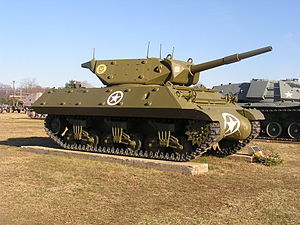
Because the US Army did not anticipate their tanks fighting other tanks, they did anticipate the need for a Panzerjager like vehicle, which they called the Tank Destroyer. The story of the development of the TD is long and fraught, but they eventually ended up with their “best” anti-tank gun, a 76mm, atop a Sherman chassis. 


The good news was that they were able to place the gun in a turret, so they didn’t have to point the vehicle at the target. The bad news was the turret lacked a roof; neither the turret nor the hull were well armored; the profile was as high as the Sherman; and, for some reason, the US Army 76mm gun lacked a good HE (high explosive) shell so it was not as good as the Sherman in an assault/infantry support role. It also wasn't as good as the German 75mm against armor.

That lack of a good HE round shouldn’t have been a problem for the M10 TD as it’s role was supposed to be simply countering tanks. In fact, German tanks were not that common in the West most of the time (they were too busy in the East) so divisions had TDs sitting around with unused guns so they often used them in infantry support (StuG) roles. After the US Army started running into Tigers and Panthers, they realized they needed a better anti-tank gun so they developed a new turret for the M10 mounting the 90mm gun and renamed it the M36. 

Personally, I would still rather have been in a StuG than an M36, but at least with the 90mm they had a chance of stopping the heavier German tanks if they could get a shot on target before they were destroyed. The US Army finally got the TD they had actually wanted all along in the M18. 


This was armed with the same old 76mm, but was on a new chassis that was much faster. It was able to use it’s quickness to outflank the heavier German tanks and get a shot into their less protected sides and rear. In some ways, this was the best implementation of the Panzerjager concept.

As for the StuG role, while the StuG seems to have been fine for the Germans, the most common variety of the M4 tank, with the low velocity 75mm gun, performed this task at least as well for the US Army. And there was also a 105mm howitzer armed version of the M4 that was probably even better. In retrospect, it might have been a good idea for the US to produce its own version of the Jagdpanzer. Something like the Priest but with a 90mm gun and considerable front armor could have given the Americans an AFV that was still mobile (and transportable) while being able to stand up to the German 88mm guns. Maybe. Only, as I said before, there weren’t that many German tanks on the Western Front anyway.

The German doctrine worked well enough until Germany ran short of fuel. As early as 1942 the Germans were adding more horses for transport because they lacked fuel, even if they had the trucks and AFVs.

The American doctrine also worked well enough. If the Germans could have supported large numbers of King Tigers things might have gotten tricky, but they couldn’t. And as it was, in the last months of the war the US Army finally fielded a heavy tank, the Pershing, that could finally have a chance facing Tigers and Panthers.


Saturday, January 5, 2019

311. Genji + Buddhism


Link to Table of Contents


Buddhism & Mann

For the past week, due to a friend’s traveling around India with a group of chanting Theravadic Buddhist monks and my resuming my reading of The Tale of Genji (now post Genji, see below) I’ve been thinking about Buddhism. And for me that means doing some reading and also conducting a series of thought experiments -- Buddhism didn’t do well, though no worse than other paternalistic religions. One thing I keep coming back to is a consideration of what makes a “great” person. The Buddhist I’m most familiar with is probably the Dalai Lama, so he would be an obvious candidate. And I do consider him to be a good man, but not really great. The names I kept coming back to were Richard Feynman and Michael, a friend who died several years ago now. It wasn’t until today that it occurred to me that my thinking here echoes The Magic Mountain. Feynman and Michael, in this context, have somewhat the same virtues as Pieter Peeperkorn. Whether my thinking has been shaped by Mann, or if my fondness for TMM is based on this similarity between us, I don’t know at this point.

While Peeperkorn, in TMM, mostly represents Dionysus or Bacchus, he also represents love for this world. For the simple pleasures, as the character might have said. Buddhism is not a friend of this world. Which means, drifting back to a previous train of thought, that neither Western Philosophy nor Eastern Religion is particularly interested in what is the best way to live in this world. Any value system based on (can’t find the term for things based on salvation that I keep running into lately) can only be accidentally useful in this world.

In Genji, besides all the praying, the only indication I see of a Buddhist mindset is the desire expressed by almost all of the characters at some point to retreat from life and devote themselves to religion. While many characters do this, and while Genji is talking about it for most of the book, he never does -- in the chapters we have -- and for good reasons, like needing to take care of all his ladies and their children. Buddhism, in Genji seems to be exclusively concerned with Eschatology. Which, in some ways, I have no problem with. This seems to me the thing religion should focus on even if it is just a placebo. But this leaves us with no guide for the best way to live our actual lives. And with unsatisfying “models” in the form of religious people like the Buddha.

Of course this is tricky, as establishing a value system independent of religion is as silly as establishing a physics independent of any meta-physics. You either have to come up with a religion that affirms this world, or you need to preface your value system with a declaration that religions are nothing but people telling each other nice stories. And good luck with that.


Genji

The Shining Genji is dead. We don’t know how or when, exactly. His death is simply announced at the start of a chapter, following the chapter that was all about his mourning for Murasaki. So what is this new chapter about, why the careers of the next generation: Niou (the son of Genji’s daughter by the Akashi lady) and Kaoru (Genji’s son who is actually Kashiwagi’s son.) 

Kaoru somehow outdoes even the Shining Genji in one way, his person seems to interact with scents to make them stronger. This affects anything, like flowers, he passes and has the women reeling. 

I’m not clear on the significance of perfume and scents in Japanese culture at this time. One of Genji’s chief charms was the perfumes he wore, but in the case of Kaoru, he seems to be a sort of perfume all by himself. I wonder if anyone has written a dissertation on this subject, and if it’s been translated into English? “The Importance of Scent in the Tale of Genji.”

Just as the ex-Emperor came to discover that Genji was his real father, Kaoru suspects there’s something about his paternity he doesn’t know. There are at least two women who could explain this to him -- his mother being the most obvious -- but that seems not to be an option. His half-”brother” Yugiri also has suspicions about this, but I’m not clear how this has come to be widely known. 


Free Falling

I was just listening to the Sid & Susie cover of Tom Petty’s Free Falling and started thinking how my life would have been different if we had stayed in the San Fernando Valley... or Boulder, or Louisville. I wasn’t a big fan of any of my family’s moves aside from the one to Boulder -- and if I had known the consequences of that I probably wouldn’t have liked that one either. Still, I can’t imagine myself minus the experiences I associate with the three places we moved to. Even Scottsdale.


Yet it’s still curious to think who those other mes would have been. I envy the me who spent the rest of his childhood in Boulder. I pity the me stuck in the Valley smog for four to eight more years. The Louisville me is the hardest to imagine.


Thursday, January 3, 2019

310. Aging in place plus


Link to Table of Contents


Aging in place

One of my (older) cousins is having health problems and so they are considering moving into an "independent living" complex. They have a website, of course, so I checked the place out. It's nice enough... if I could redecorate everything and move it to an urban location.

But it got me thinking about the best way to handle housing for people who are not getting any younger. Most people would prefer to "age in place." But our built environment was not constructed with Universal Design in mind (designing spaces to work for the frail elderly and disabled as well as people who can dance up stairs.) The best workaround for that is for people some time after they are 55, to move into independent living complexes that are designed with these future limitations in mind. Both my mother and my aunt lived in one of these places, so I'm quite familiar with them. They are very similar to a regular apartment complex with a few extra features and a few drawbacks. But they usually work well until people get into their eighties and start needing even more "assistance." That's why these complexes usually also have an "assisted living" section. This tends to be a fairly posh nursing home.

Also, around fifteen years ago when both my parents were making their exits in hospitals, it occurred to me that for many people, a good hotel would be a better (and often cheaper) alternative to a loud and chaotic hospital. Hospitals are designed for the convenience of doctors, not patients. 

So combining these two trains of thought, it occurred to me today that something very like our Four Seasons Hotel and Residences could be an ideal solution to many of these problems. The Four Seasons Hotel has retail at ground level (on Market Street) that I would replace with an Urgent Care operation. Above is a large fitness center, that I would keep, along with the usual ballrooms and the like. Above that are many floors of hotel rooms, and above those are many floors of condos. I'm pretty sure you can get room service in the condos.

In my vision, the Building would negotiate with hotel operators to get a tenant that would operate the hotel while providing some services to the residents above at reasonable rates: room service, discount dining, discount rooms for guests. There would be similar negotiation with the fitness center and Urgent Care tenants.

Optionally, the high-rise residential section would follow my "Medieval Urban Sky-street" model so it isn't just stacked, double-loaded corridors. (In which case the residential area would be below and the hotel section above.) 

You would move in some time after turning 55 when you were still working (in the Medieval Urban Sky-street case you might even move your business into the building with you.) As you aged, you might take advantage of additional "aging-in-place" services or you might move into a smaller unit or even sub-let your business space. You would probably make more use of room service and Urgent Care (a quick elevator ride away.) Your actual world might shrink, over time, to mostly just the building, but the building would offer most of the services you needed. If you eventually became house-bound, necessary services would be available to bring what you needed to your unit.

Devolution

Just when I think the tenants in my building can't get any dumber when it comes to disposing of their trash I'm proved wrong. I now accept that they can't distinguish between the three color coded toters, but now someone -- I'm assuming the most recent addition -- is putting their trash into the small can we have next to the dryer for the disposal of lint and other odds and ends. 

Today I finally gave up and pulled that can off the floor and replaced it with a tiny container. If she just puts her bag of trash on top of that, I may snap. This would make for interesting jury selection at the trial as prosecution and defense quiz the jury pool on their feelings about recycling and proper trash disposal. 


Education

Speculation - what is the best way to develop character for either the average person or the troubled person?

I'm not a huge fan of Plato (or you could say Socrates, though I'm not entirely confident with Plato's account of Socrates), but I do have my Republic moments when I think how I would order things if it were up to me. I've always seen the ideal educational system evaluating individuals to see in what way (if any) they excel, and then helping them develop those skills. This would include addressing weaknesses -- in much the same way the US Navy helped its young officers develop -- but I don't usually see the role of education as turning people into something they aren't by nature. Admittedly, this reflects my personal preference for following the route of least resistance.

But even I acknowledge that there is no such thing as a route of no resistance. Learning to deal with various kinds of resistance is also necessary. I know the least steep routes to most everywhere in SF, but when you live near the top of a hill, you eventually have to climb. 

To return to the great books again, I would not pick difficult books, like Fernand Braudel's, to tempt students into a field of study, but once they had discovered an interest, I would then encourage books like this. To change subjects, I might recommend The Elegance of the Hedgehog to lure people into both the Russian novels and the philosophy of the 19th and 20th centuries. Rather than having them start with The Brothers Karamazov or The Birth of Tragedy or (God forbid) something by Kant. 


Tuesday, January 1, 2019

309. 2018 ends and 2019 begins


Getting ready for a new year

It's time to get back into the habit of posting this blog. I have tons of content, just haven't been in the mood to post. I'm also determined to finally add a Table of Contents. When I started this blog I didn't really know what I was going to do with it, so I skipped the Table of Contents work -- mistake. Now it's the longest of my blogs and it's impossible to find anything. I'm going to start at the beginning and reference anything of importance.

Between that and finally posting my backlog of content, I should be able to keep a regular schedule again for at least a while. Unfortunately, I think there will be a lot of random content for a while. But then again, that's kind of why this is called "Bloggity" rather than something more meaningful.


Going the extra mile

Have I mentioned the guy who I frequently see out on the sidewalk on Pine Street during afternoon rush hour? I assume he's a drug dealer even though I've never seen him approach a car. I mention this because I haven't seen him for a while. I'm guessing he's my age or older. I like to think he lives in the somewhat interesting newer building I see him in front of, though it would make more sense that he lived elsewhere and only came here to take advantage of Pine street becoming a virtual expressway for the evening commute. 

Ignoring logic, walking past there today I was imagining him felled by some kind of age related affliction. One of his neighbors -- somewhat like me -- is called upon to help him out by... well, taking his place on the sidewalk. It's not like the SFPD are going to bust someone for selling a little something these days. How far would an officer of an HOA -- I imagine him as an officer, of course -- go these days to assist a fellow owner? 


Cities From Scratch

I was just ranting to someone about how poorly "Planned" cities are planned. How they more often resemble suburban office parks than successful cities. So how would I plan a city? 

For starters I would start with residential units -- and I mean inside the unit. I'll start with what I personally would want, but you would need to do this for as many different resident groups as possible. And that's a lot of groups.

I would want a studio apartment -- no surprise there -- but with low cost access to a guest room and an on-site storage area. Exercise and laundry facilities would be very convenient -- laundry on the same floor; exercise in the building. The kitchen would be flexible, mine would be basic but someone more into cooking could easily upgrade. The bathroom would include a recycling shower so you could have endless showers that would only use a couple gallons of water, and very little energy for heating. The toilet would be flushed with recycled grey-water. The laundry area could also be a gathering place. If the building was big enough, there might be retail establishments (dry-cleaners, markets, day-care centers, hardware stores) mixed in with the residential units, or more conventionally clustered at the base. There should be a supermarket or two within six blocks, along with most of the other businesses a person frequently needs. That means there should be a good commercial street with a variety of cafes and shops.

Another topological option would be buildings built around elevators large enough to lift a contractor's van. These would bring the resident's cars to a garage adjacent to their unit, so bringing in the groceries would be similar to doing that in suburbia. There would also be an outside terrace area of some size and with a fair degree of privacy. 

There should also be some kind of park within that (six block) range and access to substantial public transit hopefully a little closer, like four blocks. There should also be transit access to neighborhoods of light industry and loud entertainment. Most blocks should combine high and low end residential with offices and schools. 

An at least 10% tax on rent would insure that both commercial and residential space is almost always occupied. (The landlord would have to continue paying the tax even if the unit was empty.) The retail options on a commercial street should be carefully curated to provide activity all day and well into the night.  

Street grids are boring, but they do have their advantages. I would have a grid with every other street having truck traffic under the street level (like in downtown Chicago) with loading docks for all the buildings in the blocks on either side. The other streets might have express auto lanes underneath and regular traffic above. At grade there would just be buses, taxis, bikes, and pedestrians above the trucks. (This doesn't mean all the streets would be excavated. The sidewalk level might be twenty or more feet above the ground.)

The minimum building density would be like Haussmann's Paris but with allowance for a couple towers in each block but set back from the street. A typical block would be intersected by open laneways or covered shopping areas with residential above. Retail/commercial would be encouraged at ground level and one flight up and down.

Smaller (in footprint) buildings would also be encouraged, though allowances would also be made for larger buildings that included multi-floor vertical streets (like a 2-4 story Medieval block but sandwiched between other, similar vertical streets in a building, and accessed by large elevators that only stop at "street" levels.)

Friday, December 28, 2018

308. Little Fires Everywhere


Link to Table of Contents


Little Fires Everywhere

By Celeste Ng Penguin Press 2017


This is our next book club book. Quite a change from The Magic Mountain. I’m only three chapters in but I’m enjoying the ordinariness of it. So far, (I'm putting notes over a period of weeks into one long post) there’s really nothing to think about, but it’s nice seeing what the author has chosen to show us. Just ordinary life, but two versions of ordinary life coming into contact. Nothing flashy. The prose is efficient but not magical. 

There was just an odd “mistake” about photography developing. I’m guessing the author hasn’t actually done this? She seems to think it’s the developer, instead of the fixer, that leaves the characteristic smell in a darkroom. Or maybe developer has a smell I never noticed? 

The juxtaposition of an Ur-suburban American family with an Ur-artist, and her stub of a family, seems ripe for complications. This is supposed to be set in the 1990s, but feels, so far, like it could be the ‘60s or ‘70s. Were teen boys still reading the "Beats" in the ‘90s? In that respect is seems more familiar than I was hoping for.

P89 We’ve finally met Izzy. The way Ng adds layers to her story is really inspired. Every time you think, this is the story we’ll be dealing with, she adds another unexpected and complicating layer. And they all seem to lead to obvious complications and problems. 

And is anything ever going to be said about the names of the Richardson children? These are not ordinary names -- perhaps they are all nicknames. [Yes. Izzy is actually Isabelle Marie] Izzy, Moody, Trip, and Lexie [Alexandra Grace]. Pearl is perhaps dated but at least a normal name. And Celeste gave the only East Asian girl the name Serena, which is pretty ordinary for an Asian American name. Has anyone studied how child naming changes generation by generation in the Asian American community. I would find this fascinating. 

And of course the title has more than one meaning as well. Yes, it’s the various fires started in the Richardson’s house, but Ng has started little fires throughout the ‘verse of her novel. The one at the home of the adopting parents. The one that Mrs Richardson is now trying to start in Mia’s home. I guess you could add the infant’s mother’s world to this, but she’s hardly even a character. So far.

P186 I’ve been sucked into the who-done-it and what-will-they-do-next aspect of these still layering stories, but now, suddenly, I’m hoping for something more... for the characters to learn and grow based on what they do and discover about each other. Not at all sure that’s where Ng is heading, but I do hope so.

P188 A whole other layer of story, and another set of characters. Young Mia and her brother Wren. I’m thinking of Martha Grimes, but all these characters are central to the story. Ng is good at characterization, but, so far, there are no accidental characters sneaking into the story.

The Brownie Starflex camera is a perfect starter camera for someone like Mia. The twin-lens aspect is great for composition. It would have been better if Ng had mentioned that she had not been impressed with other cameras. It reads like this was the first camera she ever noticed. Again, I’m wondering if Ng knows much about photography herself. (The second time she talks about the smell of developer it’s clear she’s talking about film developer, not print developer. I don’t recall that smell. The process I used was quite contained and you would only have smelled it at the start and end. Still, the smell I do remember was fixer.)

I’m still in the middle of the story of Mia in college, but I’m wondering how Ng is going to sort something out. The story we are getting is not the story Mrs R is getting. We’re getting Mia’s point of view. Mrs R is getting whatever Mia’s parents learned and remember. How will we know what this amounts to? (She does, briefly, cover this.)

P217 We are learning Mia’s story. We’ve had Mrs R’s story (and her mother’s and grandmother’s). We get Pearl and Lexie and Izzy. Then there was Mrs M and Bebe. We started with Moody, but that ended quickly and was a long time ago now. We did get Mia’s photographer neighbor for a bit, but that was just part of Mia’s story. The same is true for Mia’s parents.

At this point, I would say this novel is about the three mothers: Mrs M, Mrs R, and Mia.

We did, just at the end of that last chapter, get an incidental character (Grimes style). Martin the doorman has a wiener dog and is a Met’s fan living in Queens. Let’s see if Ng does anything with him. (No) And speaking of Grimes, have there been any animals? I recall something about a series of cat? names, but nothing really about the animals.

I’m starting to think that the description of Mia playing cat’s cradle on page 24 is the key to the composition of this novel.

What is so clever here is that the main conflict at this point has to do with custody of a baby. One woman is the birth mother who gave her up in a desperate moment, while the other is the woman who adopted her and has raised her so far. Mia’s position is curiously in between. She carried and gave birth to Pearl but I think she’s supposed to not be her “biological” parent in terms of genes. [I searched online and still can’t tell if Mia is supposed to be Pearl’s biological mother or not. No, I was wrong. The egg was Mia’s . This is why it was important that she resembled Mrs Ryan. SO, Mia is completely the biological mother. She only violated the terms of her agreement with the Ryans.]

P285 It’s a pity Vonnegut already used “Cat’s Cradle” as a title. Normally I’m not that fond of carefully planned out novels, but this is artfully done. It does mean you can’t stray from the plan. So, thinking about this aspect, the careful planning, so far this is like Mrs R, even though it was Mia with the actual cat’s cradle. Can you change this at the end, be more un-planned like Mia? Less deterministic. 

Finished book. Still processing ending. Will need to re-read the first and last chapters again. I suppose you have to have “growth” after the crisis to make a satisfying story. Otherwise it would be a complete tease. 

I may have to re-read more of Mia’s philosophical sayings now that I understand her status in the novel.

I’m also wondering about what Ng chose to tell about the future and what she didn’t tell. She went generations ahead at one point but doesn’t give us a hint about Izzy. Mia and Pearl seem to be fine. The other R. kids will be fine. Mrs R has shot herself in the foot (a ricochet?) but, like Lexie, she will be able to carry this burden. Izzy is the child off on her own now in an even worse position than before. It’s odd how little we saw of Izzy. You would think there would have been more scenes with her and Mia. 

So Mia “stole” Izzy from Mrs R to almost the same extent Bebe stole her daughter from Mrs M. It seems to be unspoken but that must have been the cruelest cut for Mrs R. Lucky for her she didn’t know how close Lexie and Mia had gotten.

Mia steals Pearl from the Ryans. Trip steals Pearl from Moody. Or better, Pearl chooses Trip over Moody. Izzy, and to a lesser extent Lexie, choose Mia over Mrs R. The men and even the boys are almost entirely passive. Moody befriends Pearl and starts the ball rolling, but that’s about it. We never get any of the male perspectives.

P55 “Rumplestiltskin” is pretty close to Mia’s story.

While reading this book I also started re-reading The Elegance of the Hedgehog. I think about Hedgehog frequently and have read it a number of times, but I hadn’t realized until just now that the reason I’m reading it now is due to the similarity between Izzy and Paloma. I’ve yet to come to the scene where Paloma is angry at Madam Michel because she is putting off M. Ozu. But it’s getting close now, and when I think of it I’m reminded of Izzy. And then there’s the idea of setting houses on fire. The relationship between Paloma and Madam Michel is really pretty close to that between Izzy and Mia. And the relationships with their mothers is also similar. 

Paloma is smarter and more grounded, oddly enough, but they are much alike. And this novel pulls off the plot crisis Hedgehog shows to us only to then deny us and replace with a nasty surprise. 

Mrs R interests Moody in Pearl - Moody interests Pearl in his family - The R family worries Mia - Mrs R drafts Mia into her household - Mia attracts Izzy to her household - Mia worries Mrs R - Pearl attracts Lexie to her household - Pearl notices the photo in the museum - Izzy interests Mrs R is researching it - Lexie lets Mia know about the found baby - Mia lets Bebe know where her baby is - This gets Mrs R investigating Mia - Pearl attracts Trip - Pearl hurts Moody - Mrs R slanders Pearl and drives away Mia, which drives away Izzy. We don’t really know how this affects Mrs R’s relationships with the other kids or her husband.

Why do we get the lunch with the two “mothers” who have lost their children but no future look at these relationships? And why just the imagination of a future meeting with Izzy and Mia? Why is Izzy’s future left so vague?

P90 Mia to Izzy, about her art, “ ‘I don’t have a plan, I’m afraid,’ she said, lifting the knife again. ‘But then, no one really does, no matter what they say.’ “

Izzy says her mother does, and I would say Ng has a very clear plan. Mia is right about her art, and maybe even Ng had to see what her plan produced and then reevaluate and adjust, but as a general rule of life this is at best only partly true. Mia herself seems to have a very detailed plan for her life. Her plan gets as diverted as Mrs R’s plan at the end of the novel.

P123 “Even then Mia had a sense of what she was starting; a hot smell pricked her nostrils, like the first wisp of smoke from a far-off blaze. She did not know if Bebe would get her baby back. All she knew was that the thought of someone else claiming her child was unbearable. How could these people, she thought, how could these people take a child from its mother? She told herself this all night and into the next morning... It wasn’t right. A mother should never have to give up her child.”

Not only do we get a fire here, but we get the same sense of right and wrong Mrs R and Izzy have. Everybody acts from the best of motives. And in the interest of maternal rights. 

I had missed, of course, the appropriateness of the caption of the photo in the museum, "Virgin and child." As far as we know, Mia is a virgin. Is there a Christian aspect to think about here? I hope not.

P162 Mrs R, Mia, and Izzy (and Bebe) are all driven by what they see as a desire for justice. And, except for Izzy, there’s also a shared, if conflicting, notion of maternal rights. But for Mrs R, Ng is clear this is only the “good” not the “real” reason. It’s really a personal aversion to Mia who she sees as not living by her rules -- and then taking her place with her kids, and it doesn’t help that that last is entirely Mrs R’s fault. Mia’s life is actually as carefully planned as Mrs R’s and her sense of justice is just as strong. 

And Mia’s mother loses her daughter just as determinedly as Mrs R does. 

Both Bebe and Izzy interpret Mia’s fairly generic words of wisdom in ways she never intended. And there wasn’t even the complication of translating from Aramaic.

Mia’s mother doesn’t understand her. Izzy’s mother doesn’t understand her. Likewise Paloma’s mother. Isn’t the surprising thing when parent and child are well suited? How often does that happen?

P302 Mia to Mrs R after she reveals she knows Mia’s story, “It terrifies you. That you missed out on something. That you gave up something you didn’t know you wanted... What was it? Was it a boy? Was it a vocation? Or was it a whole life?”

I really don’t see this. I admit it’s hard to argue with Mia since she seems to be the character Ng speaks through, but I think it is about the mother and daughter relationships more than anything else. I don’t see Mrs R really wanting any other life. She just doesn’t want her kids bonding with Mia.

And I think the final passage from Mrs R’s POV supports my interpretation. What she sees in her portrait is not quite what Mia hoped. Not her bursting out of her cage but her being the cage Izzy has burst out of. 

I’ve been thinking about Mrs M and her child and how likely that relationship is to be fraught. You can imagine them ending up like Mrs R and Izzy, only with cultural issues thrown in on top of everything else. The Nigerian girl raised by a not all that interested English couple (in a BBC feature I ran into) might actually have been better at giving the child her space. I can’t help imagining Mrs M as the world’s worst helicopter mom.

One of my online friends is driving her mother nuts by being trans male. It’s impossible to separate a person’s “true nature” from the family relationships that helped form their character, but one has to at least wonder if the desire to push buttons isn’t behind some “personal” decisions. Also, you have to wonder how different Izzy or Paloma would have been with a “Mia” as their mother. I certainly knew other parents I envied while growing up. But not enough to get a good sense of how their kids responded to them. Or at least I don't recall now. I believe they knew how fortunate they were, but I’m sure there would be exceptions.