Link to Table of Contents
Bank Cafe
There are finally renderings of what they plan to do with this space. They gave up the idea of extending the mezzanine... not surprised. Most of the changes are actually downstairs and look to be improvements. I’m assuming (hoping) the colors in the renderings are arbitrary as they’ve turned the white ceilings black -- among other random changes. This would be a lot of work for no real gain. And I say that as someone who loves black ceilings, like the ones in the Nike Store. I’m hoping this was done just to make the rendering look better. It is actually pretty bland looking otherwise.Not quite tanks
I’ve been trying to avoid this but another chapter in my book about armored warfare really wants to be written. Here goes:Leading up to WW2 the armored warfare doctrine of Germany and America were quite similar. Both envisioned independent armored forces breaking through the enemy front and rampaging in the enemies rear. (There's no good way to say that.) This was the traditional role of cavalry. The Germans saw anti-tank action as a central part of this kind of action -- as heavy cavalry was often opposed by enemy heavy cavalry. The Americans (possibly because the US Army had only employed light cavalry?) saw the tanks more as a light raiding force that could take on enemy infantry (they thought) and artillery and lines of communication.
Apparently Guderian gets too much credit for developing this doctrine, though he did write an influential book on the subject. Von Rundstedt realized that, with the panzers all consigned to their own divisions, the infantry could use some armored support and suggested the StuG.

The StuG was a modest vehicle with no expensive turret, a low velocity 75mm assault gun, a very low profile and with a comparatively low cost. With the StuG German infantry forces could take on enemy pillboxes and bunkers, artillery, and in a pinch they could fight off enemy tanks as few tanks at the start of the war were armored enough to resist even a low velocity 75mm gun.
Tanks and StuGs seemed to be all the German army really needed... until the invasion of the USSR. The sheer volume of Soviet tanks became a problem for the Germans as only their Panzer III was configured as a tank killer. (The Panzer IV has the same gun as the StuG.) And then when they started running into the Soviet’s newest tanks, the KV1 and T-34, the 50mm gun on the Panzer III came up short. They had an excellent towed 75mm anti-tank gun, but they needed to make it more mobile. At this point they started improvising.
Both the Panzer IV and the StuG were up-gunned to the long barrelled 75mm.

And they started producing two classes of tank hunters/chasers that were similar to the StuG, but different. The Panzerjager had an anti-tank gun slapped onto the top of a tank chassis.

There was very little protective armor for the crew, but it got the gun into the battle quickly. The Jagdpanzers were low and well armored, like the StuG.
Over time they became ever more heavily armored and mounted the best anti-tank guns the Germans had at the time. Both the Panzerjager and Jagdpanzer were still less expensive to make than a regular tank and they could be turned out quicker. The StuG remained its own little category, but as the war progressed it’s role overlapped more and more that of the Jagdpanzer. In the end, there was no more important AFV in the German army than the StuG. And no AFV was produced in greater numbers through to the very end of the war.
Because the US Army did not anticipate their tanks fighting other tanks, they did anticipate the need for a Panzerjager like vehicle, which they called the Tank Destroyer. The story of the development of the TD is long and fraught, but they eventually ended up with their “best” anti-tank gun, a 76mm, atop a Sherman chassis.
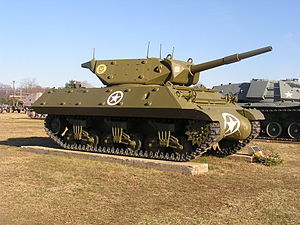
The good news was that they were able to place the gun in a turret, so they didn’t have to point the vehicle at the target. The bad news was the turret lacked a roof; neither the turret nor the hull were well armored; the profile was as high as the Sherman; and, for some reason, the US Army 76mm gun lacked a good HE (high explosive) shell so it was not as good as the Sherman in an assault/infantry support role. It also wasn't as good as the German 75mm against armor.
That lack of a good HE round shouldn’t have been a problem for the M10 TD as it’s role was supposed to be simply countering tanks. In fact, German tanks were not that common in the West most of the time (they were too busy in the East) so divisions had TDs sitting around with unused guns so they often used them in infantry support (StuG) roles. After the US Army started running into Tigers and Panthers, they realized they needed a better anti-tank gun so they developed a new turret for the M10 mounting the 90mm gun and renamed it the M36.
Personally, I would still rather have been in a StuG than an M36, but at least with the 90mm they had a chance of stopping the heavier German tanks if they could get a shot on target before they were destroyed. The US Army finally got the TD they had actually wanted all along in the M18.

This was armed with the same old 76mm, but was on a new chassis that was much faster. It was able to use it’s quickness to outflank the heavier German tanks and get a shot into their less protected sides and rear. In some ways, this was the best implementation of the Panzerjager concept.
As for the StuG role, while the StuG seems to have been fine for the Germans, the most common variety of the M4 tank, with the low velocity 75mm gun, performed this task at least as well for the US Army. And there was also a 105mm howitzer armed version of the M4 that was probably even better. In retrospect, it might have been a good idea for the US to produce its own version of the Jagdpanzer. Something like the Priest but with a 90mm gun and considerable front armor could have given the Americans an AFV that was still mobile (and transportable) while being able to stand up to the German 88mm guns. Maybe. Only, as I said before, there weren’t that many German tanks on the Western Front anyway.
The German doctrine worked well enough until Germany ran short of fuel. As early as 1942 the Germans were adding more horses for transport because they lacked fuel, even if they had the trucks and AFVs.
The American doctrine also worked well enough. If the Germans could have supported large numbers of King Tigers things might have gotten tricky, but they couldn’t. And as it was, in the last months of the war the US Army finally fielded a heavy tank, the Pershing, that could finally have a chance facing Tigers and Panthers.


