Showing posts with label Postimpressionism. Show all posts

Wednesday, March 29, 2017

140. Cézanne & Zola


Previous - 138. Paul Cezanne


Paul Cézanne continued

There's a nice summary of impressionism on pages 100-101, but I'm not going to copy it.

p103 ...Cézanne had stopped worshiping light. He found the impressionist project -- the description of light's dance upon the eye -- too insubstantial. ("Monet is only an eye," Cézanne once said, with more than a little condescension.)... He had stopped arguing with the camera. Instead, in his postimpressionist paintings he wanted to reveal how the moment is more than its light. If the impressionists reflected the eye, Cézanne's art was a mirror held up to the mind.

p104 ... Cézanne discovered that visual forms... are mental inventions that we unconsciously impose onto our sensations... No matter how hard he tried, Cézanne couldn't escape the sly interpretations of his brain. In his abstract paintings, Cézanne wanted to reveal this psychological process, to make us aware of the particular way the mind creates reality. His art shows us what we cannot see, which is how we see. 


This is related to Annie Dillard's "tree with the lights in it" from Pilgrim At Tinker Creek.

The limits of Light
...Particles of light alter the delicate molecular structure of the receptors in the retina. This cellular shudder triggers a chain reaction that ends with a flash of voltage. The photon's energy has become information. [Footnote: "...the photons cause the sodium ion channels inside our photoreceptors to close, which causes the cell to become hyperpolarized..."]

...in our evolved system, the eyeball's map of light is transformed again and again until, milliseconds later, the canvas's description enters our consciousness. Amid the swirl of color we see the apple.

...

[I'm not going to copy the scientific quest for how we see.] p106 ...Hubel and Weisel became the first scientists to describe reality as it appears to the early layers of the visual cortex. This is what the world looks like before it has been seen, when the mind is still creating the sense of sight. 


Not sure about the use of "mind" here. Maybe the under-mind -- that Operating System level I've talked about before.
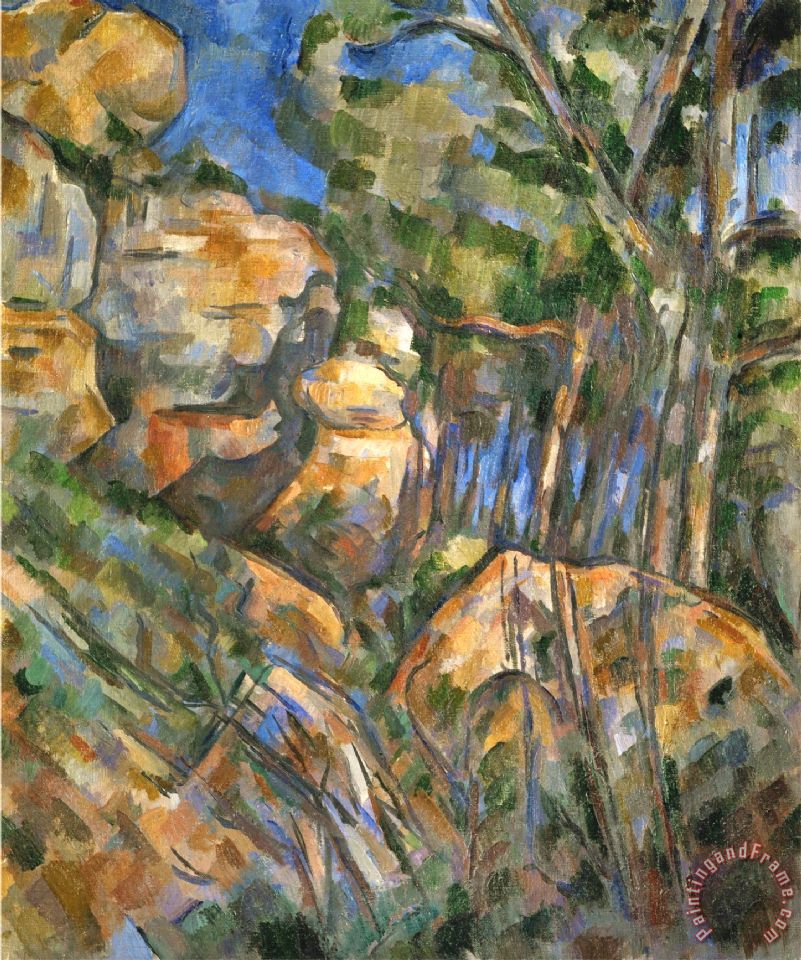

The Rocks Above the Caves at Chateau Noir.

It's as if [Cézanne] broke the brain apart and saw how seeing occurs... Cézanne's painting [above] is not about the sky or the rocks or the trees. He has broken each of these elements into their sensory parts, deconstructing the scene in order to show us how the mind reconstructs it.

...Cézanne... [creates] the entire picture out of patches and strokes... His impasto paint calls attention to itself, forcing us to see the canvas as a constructive process and not a fixed image... Instead of giving us a scene of fully realized forms, Cézanne supplies us with layers of suggestive edges, out of which forms slowly unfurl...


p107 This is the abstract reality represented by the neurons of the V1... The cells of the visual cortex, flooded by rumors of light, see lines extending in every possible direction. Angles intersect, brushstrokes disagree, and surfaces are hopelessly blurred together. The world is still formless, nothing but a collage of chromatic blocks... Before we can make sense of Cézanne's abstract landscape, the mind must intervene.


...From the earliest levels of visual processing in the brain up to the final polished image, coherence and contrast are stressed, often at the expense of accuracy.

...

[Here we get more about how the brain processes visual data into what we see, leading to a review of Oliver Sacks's Dr. P, the man who mistook his wife for a hat.]


p109 ...when Dr. P was given a rose, he described his conscious thought process to Sacks: "it looks about six inches in length. A convoluted red form with a linear green attachment." But these accurate details never triggered the idea of a rose. Dr. P had to smell the flower before he could identify its form. As Sacks put it, "Dr. P saw nothing as familiar. Visually, he was lost in a world of lifeless abstractions."


To look at a Cézanne painting is to become acutely aware of what Dr. P is missing. Staring at his postimpressionist art, we feel our top-down process at work. It is because Cézanne knew that the impression was not enough -- that the mind must complete the impression -- that he created a style both more abstract and more truthful than the impressionists... 


In the section on impressionism, the author mentions the visual problems many of them had. I wonder if Cézanne had anything in common with Dr. P?

p110 ...While [Cézanne] deconstructed his paintings until they were on the verge of unraveling, his paintings don't unravel, and that is their secret. [Like Thelonious Monk?] Instead they tremble on the edge of existence... Until Cézanne sold a canvas -- and he rarely sold anything -- he continued to edit his brushstrokes, trying to edge closer to the delicate reality he wanted to describe. [A recurring theme, here.] His work would become thick with paint, with layer after layer of carefully applied color...

...he wanted to give the brain just enough to decipher, and not a brushstroke more. If his representations were too accurate or too abstract, everything fell apart. The mind would not be forced to enter the work of art. His lines would have no meaning.


[Cézanne and Zola were pals back in Aix-en-Provence before heading off for Paris.]


p112 ... [Zola] was the proud founder of naturalism, a new school of literature that aspired to write "the scientific novel." The novelist, Zola declared, must literally become a scientist, "employing the experimental method in their study of man."


...Zola based his fiction [L'Oeuvre (The Masterpiece)] on a story stolen straight from real life. The life he stole this time was the life of his best friend. After the novel was published, in the spring of 1886, Cézanne and Zola never spoke...

...

But the real insult came when Zola [in the novel] described Claude's (Cézanne's) art. His abstract paintings, Zola wrote, were nothing but "wild mental activity . . . the terrible drama of a mind devouring itself." Sondoz's (Zola's) novels, on the other hand, "describe man as he really is." They are a new literature for the coming century of science."


...If Cézanne's paintings made our subjectivity their subject, Zola's novels were determined to turn man into just another object. The artist, Zola said, must "disappear, and simply show what he has seen. The tender intervention of the writer weakens a novel, and introduces a strange element into the facts which destroys their scientific value."


To be continued...


Next - 141. Cezanne & Gestalt

Tuesday, March 28, 2017

139. Paul Cézanne


Previous - 138. Good prions


Preparing to paint

This afternoon I took an empty gallon paint pail for a nice walk around the neighborhood. Now, I know what you're thinking, this sounds like one of those strange exercises magazines recommend for the elderly in articles like, "10 Ways To Stay Fit As You Spiral Down Toward Your Grave." But no. The story is different, though no less inane.

Our weather has been "variable" of late. I frequently switch between regular and "rain" pants over the course of a day. And then there are the work pants I put on to do painting (every few minutes, it seems). So my junk -- keys and ID and pepper spray -- are scattered in a variety of pockets. 

Today I was taking advantage of a break in the rain to bolt across town to the paint store, to pick up a quart of the paint our painters ran out of yesterday. I threw on a reasonable pair of pants, found my keys and the pail of paint for identification purposes, and headed for the bus that takes me to that neighborhood. It's a five block walk and I waited 15 minutes for the bus, and as it was arriving I realized I left my transit card and all my ID in another pair of pants. 

I walked back home. Since a late lunch was part of my original scheme, I was now too hungry to wait for another bus to go across town. So now I'm at the nearer of my regular pizzerias-with-good-WiFi. I'll get my paint tomorrow.

Paul Cézanne - From Proust...


p97 ... Reality is not out here waiting to be witnessed; reality is made by the mind. 

p98 Cézanne's art exposes the process of seeing. Although his paintings were criticized for being unnecessarily abstract -- even the impressionists ridiculed his technique -- they actually show us the world as it first appears to the brain. A Cézanne painting has no boundaries or stark black lines separating one thing from the next. Instead, there are only strokes of paint, and places on the canvas where one color, knotted on the surface, seems to change into another color. This is the start of vision: it is what reality looks like before it has been resolved by the brain. The light has not yet been made into form.


... even as his art celebrates its strangeness, it remains loyal to what it represents... Because he gives the brain just enough information, viewers are able to decipher his paintings and rescue the picture from the edge of obscurity...


...What starts as an abstract mosaic of color becomes a realistic description. The painting emerges, not from the paint or the light, but from somewhere inside our mind. We have entered into the work of art: its strangeness is our own.

...

p99 ...The symbolist poet Charles Baudelaire, a natural skeptic of science, [and a synesthete] reviewed a photographic exhibition in 1859 by proclaiming the limits of the new medium. Its accuracy, he said, is deceptive, nothing more than phony simulacra of what was really out there. The photographer was even -- and Baudelaire only used this insult in matters of grave import -- a materialist. In Baudelaire's romantic view, the true duty of photography was "to be the servant of the sciences and arts, but the very humble servant, like printing or shorthand, which have neither created nor suplemented literature. . . . If it {photography} is allowed to encroach upon the domain of the imaginary, upon anything whose value depends solely upon the addition of something of a man's soul, then it will be so much the worse for us." Baudelaire wanted the modern artist to describe everything that the photograph ignored: "the transient, the fleeting, the contingent."

p100 Inspired by Baudelaire's writings and the provocative realism of Edouard Manet, a motley group of young French painters decided to rebel. The camera, they believed, was a liar. Its precision was false. Why? Because reality did not consist of static images. Because the camera stops time, which cannot be stopped; because it renders everything in focus, when everything is never in focus. Because the eye is not a lens, and the brain is not a machine.


These rebels called themselves the impressionists... If the camera captured the dot, the impressionists represented the blur. They wanted to capture time in their paintings, show how a bail of hay changes in the afternoon shadows, or how the smoke of a train leaving Gare Saint-Lazare slowly fades into thin air. As Baudelaire insisted, they painted what the camera left out.
 

Chased out of Brain Wash by a sudden incursion of stand-up comedy.


Painting

When I paint with a small roller I always try to save the roller cover so I can use it again. This is usually less than successful. I have a small collection of covers that are too stiff and uneven to choose to use, but I can't bring myself to toss out since... You never know what you'll need some day. And now that may pay off.

I couldn't be on site when the painter was finishing his work in our entry, so the last thing I said to him was, "If there's anything you can't get to, make sure it's low on the walls so I can reach it." And there is one low surface I need to paint now that I've bought another quart of the paint he ran out of. But, the biggest problem is at the top of the space in the hardest places for me to reach. 

I know exactly what happened: I watched him using the roller to "feather" the new paint in with the old paint so that the dividing line isn't obvious. But then he sent his assistant up the ladder (I'm guessing) to get the seams where the walls and ceiling meet. And that guy didn't understand the feathering concept. It looks terrible. My idea is to use a rough, small roller cover at the end of a long pole (a longer pole than the one that is no longer in our equipment area but that the painter insists he didn't take!) to feather all the visible lines near the seams. (On the ceiling the line is on the new paint, not where the new meets the old, and I don't even know how he managed that.)

Confidence is moderately high.


Hours later...
Only an utter fool would roller paint from a fresh can onto a wall without first testing if the color matched. Guess who is an utter fool? Me. Guess how closely the new paint matched the old paint? Not very.

I still have some options, and I can't do anything at the moment because the paint store closes early on Sunday?!?! 

My technique did work with what little of the old paint remained, which is even more irritating since I would be done now if the paint was a match. I really need to eat something.


Next - 140. Cezanne & Zola